Repairing a foundation crack is mostly a matter of matching the method to the crack — and getting one judgment right before you spend a dollar. The methods themselves are well understood: epoxy injection welds a structural crack in dry poured concrete; polyurethane injection seals a leaking one; hydraulic cement plugs an active leak fast; a $20 tube of patching compound handles a cosmetic hairline. The judgment that saves homeowners the most money sits before all of that, and it is the cardinal rule of this entire subject: a crack is a symptom, so crack repair fixes the crack, not the cause. Before you seal anything, find out whether the foundation is actually moving. If it is, sealing the crack just hides a moving foundation, and the crack reopens. If it isn't, you may need nothing more than $30 of sealant — not the five-figure repair a contractor might pitch. This page walks every repair method, what each costs, and exactly how to make that call.
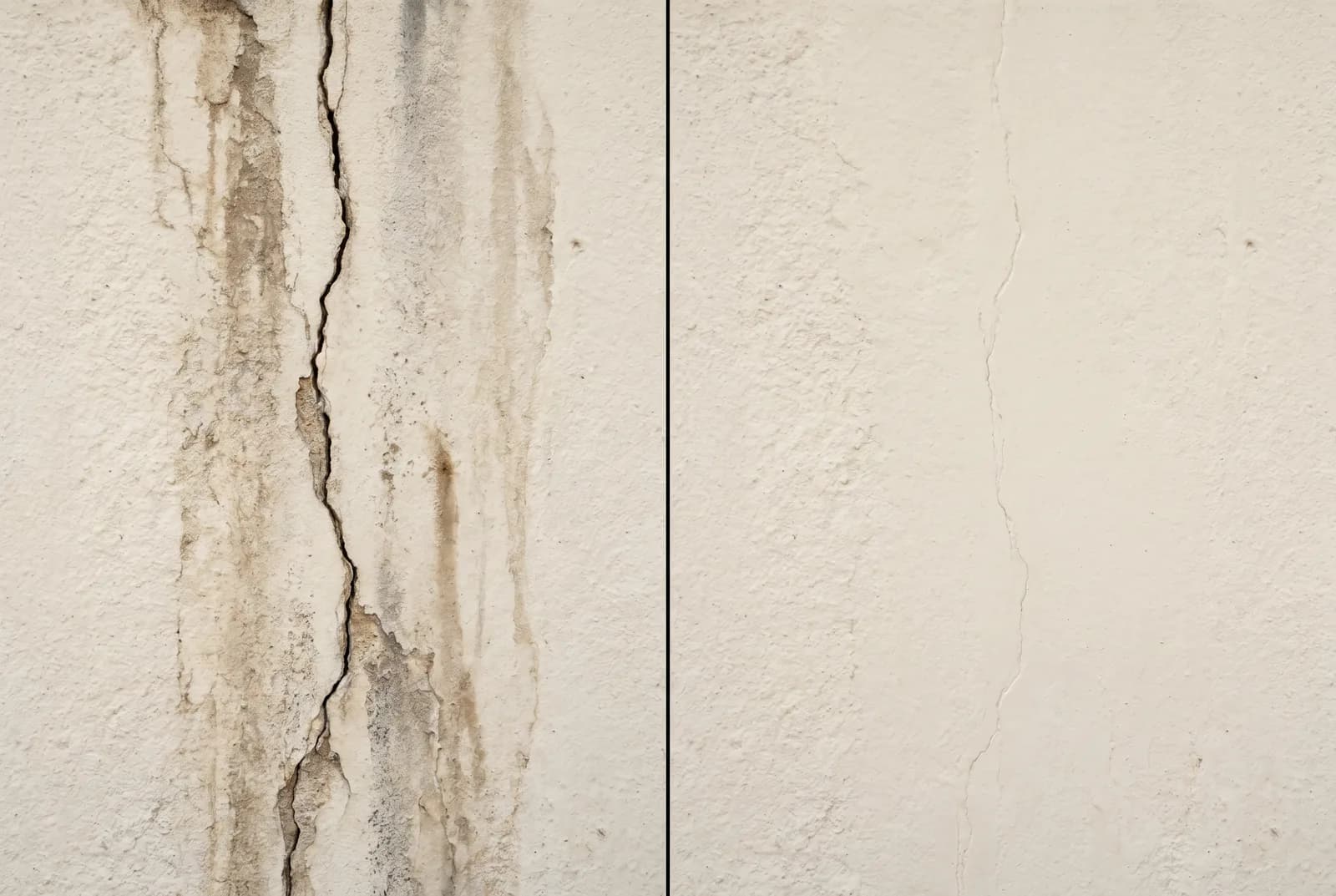
Bottom line up front
Three things decide your whole approach, and they're worth fixing in your head before the detail below pulls you into product comparisons.
1. Repairing the crack is not the same as repairing the foundation. This is the cardinal rule, and almost every costly mistake in crack repair is a version of forgetting it. Crack injection — whether epoxy or polyurethane — restores or seals the crack. It does nothing about why the foundation moved. If the cause is still active, the repair is cosmetic no matter how strong the bond, because the foundation keeps moving the crack.
2. Cosmetic versus structural decides everything else. A cosmetic crack (a thin, stable, non-leaking hairline) is a sealing-and-monitoring task you can often do yourself for the price of a sandwich. A structural crack (horizontal, stair-stepped over ¼ inch, offset, or progressing) is a cause problem that needs an engineer before any sealing happens. The same tube of sealant is either the right answer or a dangerous distraction depending on which of these you have — and the only way to know is to read the crack the way an engineer does.
3. For any structural sign, engineer first, contractor second. The classification — cosmetic or structural — is the practice of engineering, not a contractor's sales call. An independent licensed Professional Engineer is paid the same whatever the verdict, so the diagnosis isn't for sale. Budget $500–$1,500 for the assessment; against a structural repair it routinely changes the scope by more than it costs.
The rest of this page applies those three rules: how to triage your crack, the repair methods compared, the epoxy-versus-polyurethane decision, DIY versus pro, what it costs, and the situations where sealing is exactly the wrong move.
First: is this crack cosmetic or structural?
You can't make the structural call yourself — that's an engineer's job, and we cover the full method in the normal vs structural crack guide and the broader cracks pillar. But you can do the triage that tells you whether to seal, monitor, or stop and call a P.E. Engineers don't classify a crack off a single number; they weigh width, orientation, displacement, location, and progression together, and the cracks that worry them fail several at once. Here's the short version that decides which half of this page applies to you.
| If the crack is… | It's pointing toward… | Your move |
|---|---|---|
| Hairline to ⅛ inch, vertical, flush, not growing | Cosmetic (shrinkage / old settlement) | Seal and monitor — often DIY |
| ⅛–¼ inch, or changing seasonally / lengthening | Watch | Mark, measure monthly, consider an engineer if it moves |
| Horizontal, stair-step over ¼ inch, offset/displaced, or paired with sticking doors and sloping floors | Structural (active movement) | Stop — independent engineer before any sealing |
| Triage only. The authoritative classification is a licensed engineer's; this table tells you which path to take, not what the crack "is." See the normal vs structural guide for the five factors in full. |
Two points carry most of the weight. Orientation often matters more than width: a hairline horizontal crack outranks a wide but stable vertical one, because a horizontal crack usually means soil or hydrostatic pressure is bending the wall inward — the highest-urgency pattern in the field. And progression is the most telling factor of all: a crack that hasn't moved across a full wet-and-dry season is behaving like curing or old settlement, while one that's measurably widening, lengthening, or developing a step is movement that's still happening. Mark the ends, draw a dated line across the widest point, and watch it. A crack that stays put is a sealing job. A crack that's growing — or any of the structural patterns above — belongs to structural damage repair and an engineer, not to a tube of epoxy.
The repair methods, compared
Once you know the crack is something to seal (not a structural movement problem to stabilize), there are four methods, and the right one is decided by two questions: is the crack dry or leaking, and does it need structural strength or just a seal?
| Method | What it's for | Dry or wet | Structural? | Rigid or flexible | Rough cost |
|---|---|---|---|---|---|
| Epoxy injection | Structural repair of dry cracks in poured concrete | Dry only | Yes — welds the crack | Rigid (won't flex) | $250–$1,500 / crack pro; ~$60–$150 DIY kit |
| Polyurethane injection | Waterproofing active or leaking cracks | Wet / leaking | No — seals only | Flexible | $250–$1,500 / crack pro; ~$60–$150 DIY kit |
| Hydraulic cement | Fast band-aid for an active leak or gap around a penetration | Wet | No | Rigid | ~$10–$30 / container |
| Consumer patch / caulk | Cosmetic hairline cracks only (under ⅛ inch) | Dry | No | Varies | $15–$30 |
| The four crack-repair methods. "Structural" means it restores load-carrying strength; everything else seals or hides. Costs are industry estimates that vary by region, access, and crack length. |
A few clarifications the table can't carry:
- Epoxy injection is the only structural repair here. Two-part epoxy (low-viscosity for fine cracks, gel for wider ones) is injected through surface ports; because cured epoxy is stronger than the surrounding concrete, it welds a dry crack back to monolithic strength. The catches: it must be a dry, clean substrate (it won't adhere to wet concrete or a previously patched crack), it's rigid and won't accommodate further movement, and it only works on solid poured concrete — not hollow block, where the material flows into the cores. Full detail on the epoxy injection page.
- Polyurethane injection is the waterproofing tool. A moisture-activated foam expands and seals an active or wet leaking crack and stays flexible enough to absorb thermal and minor movement — but it doesn't restore structural strength. It's the right call for a leaking hairline. See the polyurethane injection page.
- Hydraulic cement is a rapid-setting cement that expands as it cures; it stops an active leak in minutes (even against weeping water) and anchors injection ports when the surface is too wet for epoxy paste. Treat it as a band-aid: it bonds poorly to old concrete and fails under continued movement or freeze-thaw.
- Consumer patch and caulk — vinyl/acrylic patching compounds, elastomeric masonry caulk — are for cosmetic hairline cracks only, the seal-for-appearance job. They're surface-only and frequently fail as permanent fixes; see the honest assessment on the DIY products page.
Epoxy vs polyurethane (the core decision)
If you've narrowed it to injection, this is the decision that trips up the most homeowners, and it comes down to one question with one follow-up.
Is the crack leaking water right now?
-
No — it's dry, and you need to restore strength → epoxy. Epoxy injection is a structural repair. The cured resin's tensile and compressive strength exceeds the concrete around it, so it monolithically welds a dry crack in poured concrete. Use it when the crack is structural-but-stable (an engineer has confirmed the movement has stopped) and the substrate is dry and clean. Remember it's rigid: if the foundation is still moving, a rigid epoxy weld will simply crack again next to the old one. Epoxy is the wrong choice for a wet crack — it won't bond — and for a crack that's still active.
-
Yes — it's actively leaking → polyurethane. Polyurethane injection is a waterproofing repair. The foam reacts with the very water that's leaking through, expands to fill the void, and stays flexible to accommodate minor movement and thermal cycling. It seals the leak; it does not add structural strength. Use it for leaking hairline cracks, weeping cracks, and cracks with slight ongoing movement where a rigid epoxy would fail.
The single-sentence rule: structural and dry → epoxy; leaking and needs to flex → polyurethane. Both are injected through interior surface ports, both are available as DIY kits and as professional services, and neither works on hollow concrete block. For the full walkthroughs — viscosities, port spacing, cure times, failure modes — see the epoxy injection guide and the polyurethane injection guide.
DIY or hire a pro?
The honest line is narrow and it follows directly from the triage: DIY is reasonable for cosmetic hairlines, and only for cosmetic hairlines.
Do it yourself when the crack is hairline to ⅛ inch, vertical, with no offset between the faces, no active leak (or a minor weep you'll seal with polyurethane), and no measurable progression across a season. That's a genuine shrinkage or old-settlement crack, and sealing it is appearance work. A low-pressure injection kit (epoxy or polyurethane) runs roughly $60–$150; a tube of patching compound or hydraulic cement is $15–$30. The technique is forgiving but not foolproof — incomplete filling is the number-one cause of DIY failure, so inject slowly at low pressure until material oozes from the next port up, and be patient. The honest DIY products page covers the kits, the consumer patch products, and where each one disappoints.
Hire a pro — preceded by an engineer — when anything points structural: a horizontal crack, a stair-step crack over ¼ inch, displacement, progression, or companion signs like sticking doors across rooms and sloping floors. Here the order matters and it is not negotiable. An independent engineer diagnoses the cause and classifies the movement first; only then does a vetted contractor execute the repair. The reason isn't snobbery about DIY — it's that the structural call decides whether you need a $30 tube of sealant or a $15,000 stabilization, and the party who profits from the larger repair shouldn't be the one making that call. Start with the normal vs structural guide to see where your crack lands, and an engineer's report to get the neutral classification.
One more caution on DIY: consumer patch and caulk products often fail as permanent fixes, and worse, they can complicate a later professional injection. Cured patching material blocks the ports a pro needs to penetrate the crack, so a $20 cosmetic fix on a crack that turns out to be structural can add cost to the real repair later.
What it costs
Crack-repair pricing has two completely different tiers, and confusing them is how homeowners either overpay or under-protect. All figures below are industry estimates that vary by region, access, crack length, and contractor.
Tier one — the crack itself (cosmetic or structural-but-stable):
| Repair | Typical cost | Notes |
|---|---|---|
| DIY patch / caulk | $15–$30 | Cosmetic hairlines only; often not permanent |
| DIY injection kit (epoxy or polyurethane) | ~$60–$150 | Low-pressure; cosmetic to moderate cracks in poured concrete |
| Professional crack injection (per crack) | $250–$1,500 (commonly $250–$800) | Epoxy or polyurethane; poured concrete only |
| Professional injection (per linear foot) | $5–$15 / linear ft | For multiple or long cracks |
| Tier-one crack-repair costs. These apply when the crack is the whole problem — cosmetic, or structural but no longer moving. See the crack-repair cost page for the full breakdown. |
Tier two — the structural fork (when the crack is a symptom of movement): if an engineer finds the foundation is actively moving, the crack injection is the last and cheapest line item, not the job. The real costs are the diagnosis and the structural repair behind it.
| Item | Typical cost | Notes |
|---|---|---|
| Independent engineer's report | $500–$1,500 | Sealed classification and scope; comes first |
| Underpinning (piers) if structural | $5,000–$30,000+ | Partial to full, depending on the affected area |
| Crack injection (after stabilizing) | $250–$1,500 / crack | The crack is sealed after the cause is fixed |
| Tier-two costs. When the foundation is moving, you're buying a structural repair, not a crack repair. |
For context, This Old House and HomeAdvisor put the national average foundation-repair project near $5,179, with a typical range around $2,225–$8,133 — but that number averages cheap crack sealing together with five-figure underpinning, so it predicts almost nothing about a specific job. Your number is set by which tier you're in, and that's set by the cosmetic-versus-structural call. The full per-method and per-region breakdown lives on the crack-repair cost page.
When sealing is the wrong move (fix the cause first)
This is the cardinal rule expanded, because it's where the money is won or lost. Crack injection repairs the crack, not the cause. Sealing a moving foundation is treating the alarm and ignoring the fire — the bond can be flawless and the crack still reopens, because the force that opened it is still working.
How do you know the foundation is moving rather than the crack just sitting there? The signs are the structural patterns from the triage: a crack that's progressing or widening over time, a horizontal crack across a wall, stair-step cracks through brick or block, doors that stick across multiple rooms, and floors that slope. Any one of those means the cause is active. In San Antonio and across the expansive-clay belt, that cause is most often the clay itself — soil that swells when wet and shrinks when dry, cycling the foundation up and down — sometimes compounded by poor drainage, a sub-slab plumbing leak, or trees drawing moisture out from under the slab. (Our expansive-clay guide covers the soil mechanics.)
The correct sequence when the foundation is moving is: stabilize the cause first, then seal the crack. Stabilizing means drainage and moisture correction (uniform perimeter moisture, gutters and downspout extensions, grade falling away from the house) and, where an engineer specifies it, piers that transfer the load past the moving soil to competent strata — that's the world of structural damage repair. Only after the movement is arrested does sealing the crack become a permanent repair instead of a cosmetic delay.
The reverse error costs just as much in the other direction. Paying for full-perimeter underpinning on a benign shrinkage hairline — a crack that needed $30 of sealant — is the mirror-image mistake, and it happens when the same company that sells the structural repair also gets to classify the crack. Both errors have the same antidote: get the call from an independent engineer first.
Get the structural call from your own engineer first
The single recommendation that runs through every section above is to fix the diagnosis before you fix the crack — and to get that diagnosis from someone with no stake in the answer.
That sequence — engineer first, then the right repair — is what turns this whole subject from a gamble into a decision. The methods are the easy part. The judgment is the valuable part, and it belongs to someone independent.
FAQ Note
The FAQ below covers what homeowners ask most when they're standing in front of a foundation crack trying to decide what to do — how the repair is actually done, whether DIY is safe, the epoxy-versus-polyurethane choice, what it costs, when a crack is too serious for injection, and whether a cracked foundation can be fixed for good. For the diagnostic side — telling a normal crack from a structural one before you touch it — start with the normal vs structural guide and the cracks pillar. For the method pages, see epoxy injection, polyurethane injection, and the honest DIY products breakdown; for what it all costs, the crack-repair cost page. And if the crack turns out to be structural, the fix lives in structural damage repair.
Get Matched With a Vetted San Antonio Foundation Specialist
If an independent engineer has read your crack and classified it — or a contractor told you a crack needs a five-figure repair and you want a P.E.-led second opinion before committing — we'll match you with a vetted San Antonio foundation specialist who can do the right repair for the measured problem. The match is free, the quote is no-obligation, and we don't take a fee from you. We screen for a sealed-engineer classification done before the quote, the correct repair for the crack (cosmetic sealing where that's all it needs, structural work only where the movement is real), and a clean Bexar County permit record. If a quote calls a benign shrinkage hairline "structural" — or waves off a horizontal crack that warrants real attention — we'll tell you. That's the only way an editorial matching service should work. Start with a free inspection match, or read the foundation-repair hub first.
Frequently asked questions
9 questionsHow do you repair a foundation crack?
Can I fix a foundation crack myself?
Epoxy or polyurethane for a foundation crack?
Does sealing a crack fix the foundation?
How much does foundation crack repair cost?
When is a foundation crack too serious to repair with injection?
Can a cracked foundation be fixed permanently?
Should I repair a foundation crack from the inside or outside?
Do hairline cracks need repair?
Related guides
- Foundation Repair/foundation-repair
- Epoxy Injection/foundation-repair/crack-repair/epoxy-injection
- Polyurethane Injection/foundation-repair/crack-repair/polyurethane-injection
- Diy Products/foundation-repair/crack-repair/diy-products
- Cost/foundation-repair/crack-repair/cost
- Normal Vs Structural/foundation-repair/cracks/normal-vs-structural
- Cracks/foundation-repair/cracks
- Structural Damage Repair/foundation-repair/methods/structural-damage-repair
- Engineer Report/foundation-repair/diagnosis/engineer-report
Sources
- [1]ACI 224R-01 — Control of Cracking in Concrete Structures
- [2]ACI 562 — Code Requirements for Assessment, Repair, and Rehabilitation of Existing Concrete Structures
- [3]ASCE Texas Section — Guidelines for the Evaluation and Repair of Residential Foundations, v3 (2022)
- [4]This Old House / HomeAdvisor (2025–2026) — foundation repair cost data (crack repair ~$250–$1,500 per crack; project average ~$5,179)