San Antonio is one of the most foundation-repair-intensive housing markets in the United States, and the reason is unusually specific to this metro. Bexar County sits on two opposing geologies at once — deep expansive Houston Black clay across the central, southern, and eastern flats, and thin stony soils over Edwards Plateau limestone in the northern Hill Country — split by the Balcones Escarpment. That clay swells and shrinks with every wet-dry swing, and the 2022–2025 drought was, per the Edwards Aquifer Authority, the second-worst in a century. The practical result for a homeowner is that two houses a mile apart can need completely different repairs, and the one control that governs all of it is a City of San Antonio permit gated by a Professional Engineer — not a contractor's license, which for foundation repair does not exist in Texas. This page is the local lens: the geology, the seasonal movement, the real cost ranges, and the engineer-first process — with links out to the national guides for the universal mechanics.
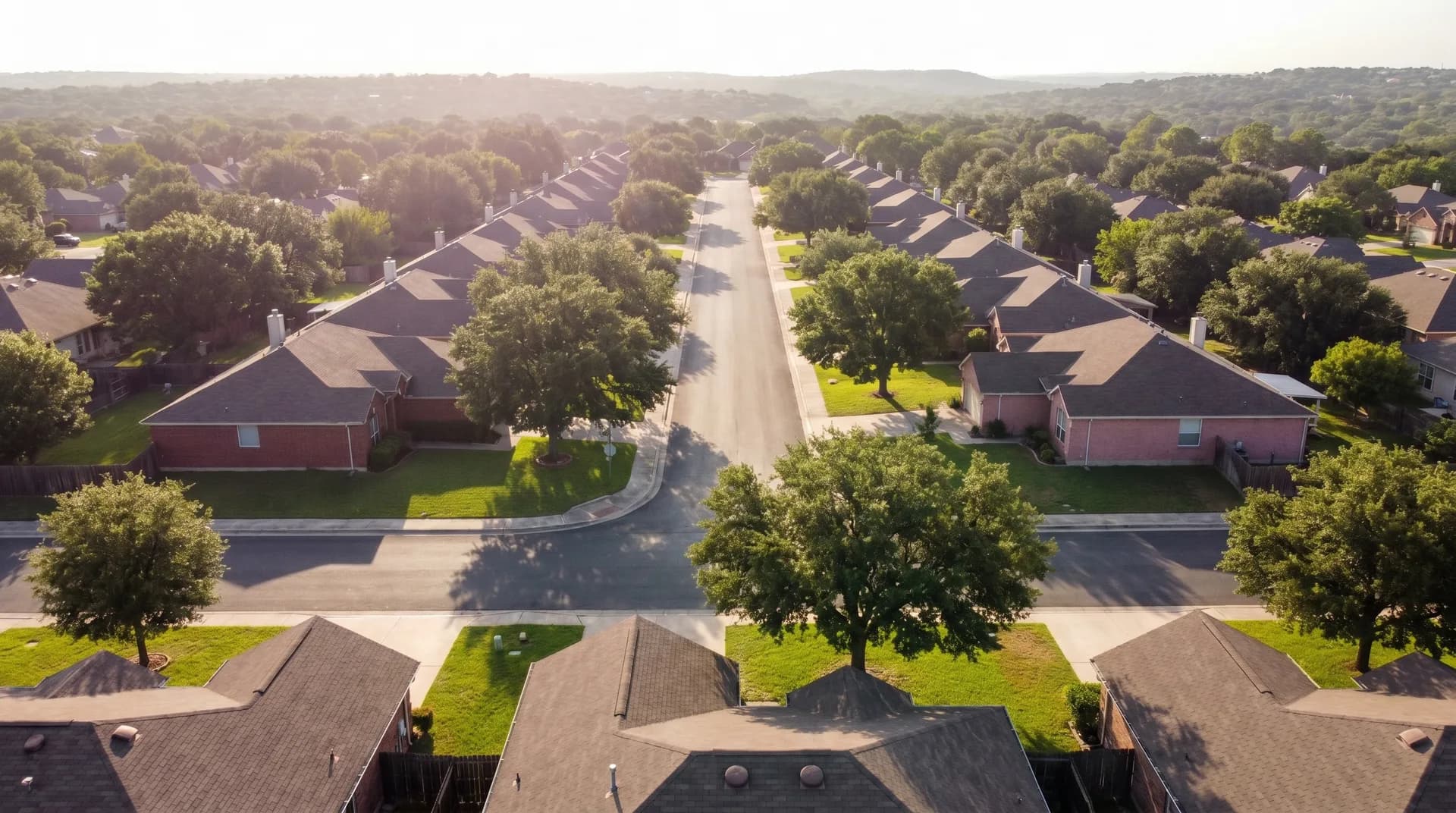
Why San Antonio Is Different: The Balcones Split-Personality
Most foundation-repair markets sit on one dominant soil. San Antonio sits on two, and the boundary runs straight through the metro. The Balcones Escarpment (the Balcones Fault) divides Bexar County into the Edwards Plateau to the north and northwest — limestone bedrock under thin, stony, gravelly alkaline soils, the Hill Country third of the county — and the Blackland Prairie across the central, southern, and eastern county, dominated by Houston Black clay and related Vertisols.
That split is the signature local fact, because it drives extreme intra-metro variance. Unlike the wall-to-wall Blackland clay of Dallas–Fort Worth or the uniform gumbo of Houston, San Antonio's failure risk and repair cost can change dramatically from one neighborhood to the next, and sometimes from one lot to the next. Older inner-city and south/east-side homes on Blackland clay carry high risk; limestone Hill Country lots to the north trade swelling soil for their own issues — steep slopes, engineered fill, and thin soil over rock. Homes built over filled creeks or clay seams are at elevated risk anywhere in the metro.
Houston Black clay is the part that destroys foundations. It is a textbook Vertisol, rich in the swelling clay mineral smectite (montmorillonite), whose crystalline layers absorb water and physically expand — Texas Vertisols can swell 30% or more in volume when saturated and shrink comparably when dry, forming cracks reported up to 4 inches wide and 6 feet deep in droughts. Engineers quantify that with the coefficient of linear extensibility (COLE) and plasticity index: per NRCS, shrink-swell potential is "low" below 3% linear extensibility, "moderate" at 3–6%, "high" at 6–9%, and "very high" above 9%, and a COLE above 0.06 can cause structural damage — Vertisols by definition run 0.09 or higher. A peer-reviewed study of expansive Texas clays found the San Antonio soil sample held moderate-to-large amounts of montmorillonite and a high plasticity index. The engineering consequence is simple: any deep repair has to anchor below the seasonally active moisture zone — roughly the upper 8 to 15 feet — into material that does not move with the seasons.
For the full science of how expansive clay loads a foundation, and the moisture-management program that protects whatever repair you install, see the national guide on expansive clay soil.
The Drought-Deluge Cycle and Seasonal Movement
Clay only moves when its moisture changes, and San Antonio's climate is built to change it. The metro averages roughly 32–35 inches of rain a year in a bimodal pattern — heaviest in late spring and again in fall, with December–January the driest. That seesaw between heavy spring and fall rain and bone-dry summers is precisely the cycling that drives clay to swell and shrink under a slab.
The 2022–2025 drought made the point at full scale. Paul Bertetti of the Edwards Aquifer Authority characterized it as "the second-worst drought in recorded history in the last hundred years... more intense than the drought we had in 2011 and 2014." Bexar County was under exceptional drought — the most severe category — from February 25, 2025, and it took the rainiest day in 12 years — about 6.1 inches at the airport on June 12, 2025 — to nudge most of the metro out of it, with western Bexar County still hanging on. A bone-dry spring snapping straight into a deluge is the worst case for differential movement, because parts of a foundation re-swell while others lag.
San Antonio Housing Stock and Foundation Types
The San Antonio–New Braunfels metro has roughly 1.1 million housing units (ACS 2024), and Bexar County's median year built is about 1989, with roughly 8.4% of the stock predating 1950. That age profile maps onto three foundation eras, each of which tends to fail — and get repaired — differently.
| Era | Typical foundation | What it tends to need |
|---|---|---|
| Pre-1950s | Pier-and-beam (often shallow, minimal-depth) | Re-shimming, sistered beams, pier resets; access is easier than slab |
| 1950s–1970s | Slab-on-grade, rebar-reinforced (earlier slabs used ineffective wire mesh) | Underpinning to competent strata when differential settlement appears |
| Mid-1970s onward | Post-tension cable slabs (now 90%+ of new Texas homes) | Specialized evaluation; tendons must be located before any drilling or cutting |
| How San Antonio's three foundation eras typically present and what each generally calls for. Specifics depend on the engineer's survey, not the build year alone. |
The older 1940s–1960s stock was engineered with less understanding of soil behavior, so decades of clay movement now stress shallow slabs and minimal-depth pier-and-beam systems. On the newest end, post-tension construction changes the work: the slab is held in compression by steel tendons, and a crew that breaks through the slab without first locating those tendons can cut one — which is one more reason interior pier placement and drilling belong on a sealed engineer's drawing.
What Foundation Repair Costs in San Antonio
San Antonio pricing, triangulated from local foundation-repair companies' own 2024–2025 marketing (so treat it as directional planning data, not an independent cost survey or a quote), clusters around an average total residential repair near $4,500. The component ranges below are the ones SA homeowners encounter most often.
| Scope | Local ballpark (company-marketing, 2024–2025) | Notes |
|---|---|---|
| Minor crack repair | $300–$1,000 | Epoxy injection, mudjacking; cosmetic-only on poured concrete |
| Per pier (installed) | ~$1,000–$3,000 | Drives most underpinning totals; depth and access vary the figure |
| Moderate stabilization | $8,000–$15,000 | Partial underpinning of a wall or corner |
| Major underpinning / whole-house lift | $15,000–$30,000+ | Reserved for severe or multi-wall movement |
| San Antonio cost ballparks triangulated from local contractor marketing, 2024–2025. Not a quote and not an independent survey; geology drives a wide spread. |
The headline local fact is the spread. San Antonio and Austin show a wider range than Houston or Dallas–Fort Worth because of the geologic split: a limestone-area home may need only inexpensive cosmetic crack sealing, while a clay-seam home a few miles away needs extensive piering. The same square footage can quote ten times apart depending on the lot's soil — which is exactly why a citywide "average" is a poor predictor of any specific job, and why an engineer's elevation survey is the only figure that normalizes competing bids.
For the full local breakdown — what drives the per-pier number, how SA compares to other Texas metros, and how it ties back to national averages — see the San Antonio cost guide.
Services and Methods Used in San Antonio
The methods deployed in San Antonio are the same engineered systems used across Texas clay — drilled bell-bottom piers, helical piers, steel push piers, slab leveling for flatwork — chosen by soil, structure weight, and depth to competent bearing rather than by metro. The local constant is that any deep repair must reach below the active moisture zone, and any method that relies on the seasonally variable upper clay (rather than bypassing it) is contested on clay-heavy lots.
Because the mechanics are universal, this page does not re-derive them. For how each system works, when it is the right call, and when it is the wrong one, see the national foundation repair methods comparison. For the San Antonio-specific service picture — including the drainage corrections, root barriers, and under-slab plumbing that are common local add-ons — see San Antonio services, and for the moisture-management side, San Antonio waterproofing and drainage.
You may also see the major chains marketed heavily here — Olshan, Ram Jack, and Groundworks-owned Foundation Support Specialists among them — alongside dozens of local independents. We cover the national players neutrally in our contractors overview; on this page the point is narrower, and it is the next section.
San Antonio's Real Quality Gate Is an Engineer, Not a License
This is the section that matters most, because it is where San Antonio differs from what homeowners assume. Texas does not license foundation-repair contractors. Bills to create such a license — HB 613, SB 1399 (the "Foundation Repair Contractors Act"), and SB 802 — all failed. The only credentials that exist are municipal contractor registration and the Professional Engineer license. So a contractor advertising that they are "licensed for foundation repair" is, per the market's own sources, misrepresenting — there is no such state license to hold.
What does bind the work is the City of San Antonio permit. Per Development Services Information Bulletin 172 and the Foundation Repair Permit Application, residential and commercial foundation repairs must be designed by, or performed under the engineering guidance of, a Texas-licensed Professional Engineer, who must also inspect. The applicant uploads a signed-and-sealed "Assumption as Engineer of Record" letter at application through the Accela Customer Access (ACA) portal, and starting work without a permit triggers a double fee. The City's residential foundation-repair permit fee is modest — on the order of $160 — and, like other San Antonio building permits, it is valid six months (180 days). Critically, the permit closes out only on the Engineer's Inspection Letter — and for a slab-on-grade home, that letter must specifically confirm that drainage away from the foundation meets minimum code, or the job earns only a "partial pass." The engineer is therefore not optional in San Antonio; the city's process is built around one.
For exactly what an independent engineer's report contains and how to commission one before you call a single contractor, see the engineer's report guide.
Insurance and Resale-Disclosure Reality
Two financial facts raise the stakes on getting the repair right the first time. First, most Texas homeowner policies do not cover foundation damage from soil movement — expansion, shrinkage, and settling are generally treated as a maintenance item and excluded. Texas offers an add-on slab/foundation endorsement (the HO-143TX) that some homeowners carry, but coverage and exclusions vary widely, so the declarations page is what matters, not the assumption of coverage. Second, Texas requires foundation issues to be disclosed at resale, which is why a genuinely transferable lifetime warranty is repeatedly cited as the single most decisive purchase factor in this market — it survives the sale and reassures the next buyer.
For how the HO-143TX endorsement works and what it does and does not pay for, see the Texas HO-143TX insurance guide.
Metros and Neighborhoods Served
The San Antonio–New Braunfels metro grew by nearly 205,000 people from April 2020 to July 2024 (about 59% of that from out of state), approaching 2.8 million, and the city remains the 7th-largest in the U.S. — growth that continuously adds slab-on-grade housing destined to enter the repair market as it ages. The metro's geology, not its city limits, is what should shape expectations: clay-heavy areas to the south, east, and the northeastern suburbs (Schertz, Cibolo, Converse, Universal City) skew toward high-ticket piering, while limestone Hill Country areas to the north and northwest (Boerne, Helotes, and parts of New Braunfels and Comal County) skew toward drainage, slope, and slab-crack work.
For a neighborhood-by-neighborhood and suburb-by-suburb view of where the clay and limestone fall across the metro, see the San Antonio areas overview.
FAQ Note
The questions below are the ones San Antonio homeowners ask most after the first crack appears or the first contractor visit — the City permit, the geology, the cost ballpark, the Texas insurance reality, which method suits local clay, and whether an engineer is really required. For a structured second opinion before you sign anything, start with an independent engineer's report and the San Antonio cost guide.
Get Matched With a Vetted San Antonio Foundation Specialist
If you've spotted movement, had a contractor quote you, or simply want a PE-led second opinion before committing, we'll match you with a vetted, independent San Antonio foundation specialist. The match is free, the quote is no-obligation, and we don't take a fee from you. We screen for a sealed Professional Engineer's design, a clean City of San Antonio permit with the required Engineer-of-Record letter, and current ICC-ES Evaluation Service Report (ESR)-listed systems. If a quote doesn't fit the engineering — or skips the permit and the engineer that San Antonio actually requires — we'll tell you. That's the only way an independent editorial matching service should work.
Frequently asked questions
9 questionsDo I need a permit to repair my foundation in San Antonio?
Why is San Antonio such a bad place for foundations?
How much does foundation repair cost in San Antonio?
Does homeowners insurance cover foundation repair in Texas?
Which repair method is best for San Antonio clay?
Do I need a structural engineer before hiring a contractor?
Is a contractor who says they're "licensed for foundation repair" legitimate?
When is foundation movement worst in San Antonio?
Does my neighborhood matter for foundation risk in San Antonio?
Related guides
- Cost/san-antonio/cost
- Services/san-antonio/services
- Waterproofing/san-antonio/waterproofing
- Areas/san-antonio/areas
- Expansive Clay Soil/foundation-repair/causes/expansive-clay-soil
- Methods/foundation-repair/methods
- Engineer Report/foundation-repair/diagnosis/engineer-report
- Texas Ho 143tx/foundation-repair/insurance/texas-ho-143tx
- Free Inspection/free-inspection
Sources
- [1]City of San Antonio Development Services — Information Bulletin 172 (IB 172) & Foundation Repair Permit Application (sealed Engineer-of-Record letter + Engineer's Inspection Letter required; double fee if unpermitted; slab-on-grade drainage sign-off)
- [2]ASCE Texas Section — Guidelines for the Evaluation and Repair of Residential Foundations, v3 (2022)
- [3]USDA-NRCS Web Soil Survey — Houston Black clay COLE / shrink-swell classification
- [4]Texas A&M AgriLife Extension — Texas expansive-soil & foundation-watering guidance
- [5]American Society of Civil Engineers — ~1 in 4 U.S. homes damaged by expansive soils
- [6]Edwards Aquifer Authority — 2022–2025 drought characterization (second-worst in a century)
- [7]U.S. Census Bureau / ACS 2024 — San Antonio–New Braunfels metro housing & population
- [8]Texas Board of Professional Engineers and Land Surveyors (TBPELS) — practice of engineering & license verification (STR/CIV)