A foundation crack is a message, and the message is written in three things: which way the crack runs, how wide it is, and where on the structure it sits. Read those three correctly and you can usually tell — before any contractor sets foot on your driveway — whether you are looking at concrete that simply cured, a foundation that is settling, or a wall that is being pushed in by the soil behind it. Read them wrong and you either lie awake over a harmless shrinkage line or, worse, paint over the one pattern that means stop.
This page teaches the reading. It is the hub for everything about interpreting foundation cracks: how orientation, width, location, and progression combine into a diagnosis; how to separate a cosmetic blemish from a structural one; the handful of cracks that mean call an engineer now; and how Texas expansive clay makes cracks open and close with the season. The single principle underneath all of it is the one that runs through this entire site: engineer first, contractor second. Reading a crack tells you whether something is worth investigating. Only an elevation survey and an independent licensed Professional Engineer's report tell you what it actually means — and the engineer, unlike the company offering a free inspection, has no incentive to sell you a repair you do not need.
One framing to internalize before anything else: nearly every poured concrete foundation cracks. The Portland Cement Association notes that virtually every poured foundation develops at least one crack within its first few years, and over 90 percent of slabs develop some shrinkage cracking. So the question is never "is there a crack?" The question is "is this crack telling me the foundation is moving?" Everything below answers that.
This cluster is about reading cracks. How to fix them — epoxy injection, polyurethane injection, hydraulic cement, when each applies — is a separate topic with its own guides; we link out to it rather than going deep here, because diagnosing the crack always comes before sealing it.
How to Read a Foundation Crack
Four variables, read in order, turn a crack from an anxiety into a diagnosis: orientation, width, location, and progression. Orientation comes first because it is the most diagnostic — the engineering literature is consistent that the direction a crack runs tells you more than how wide it is.
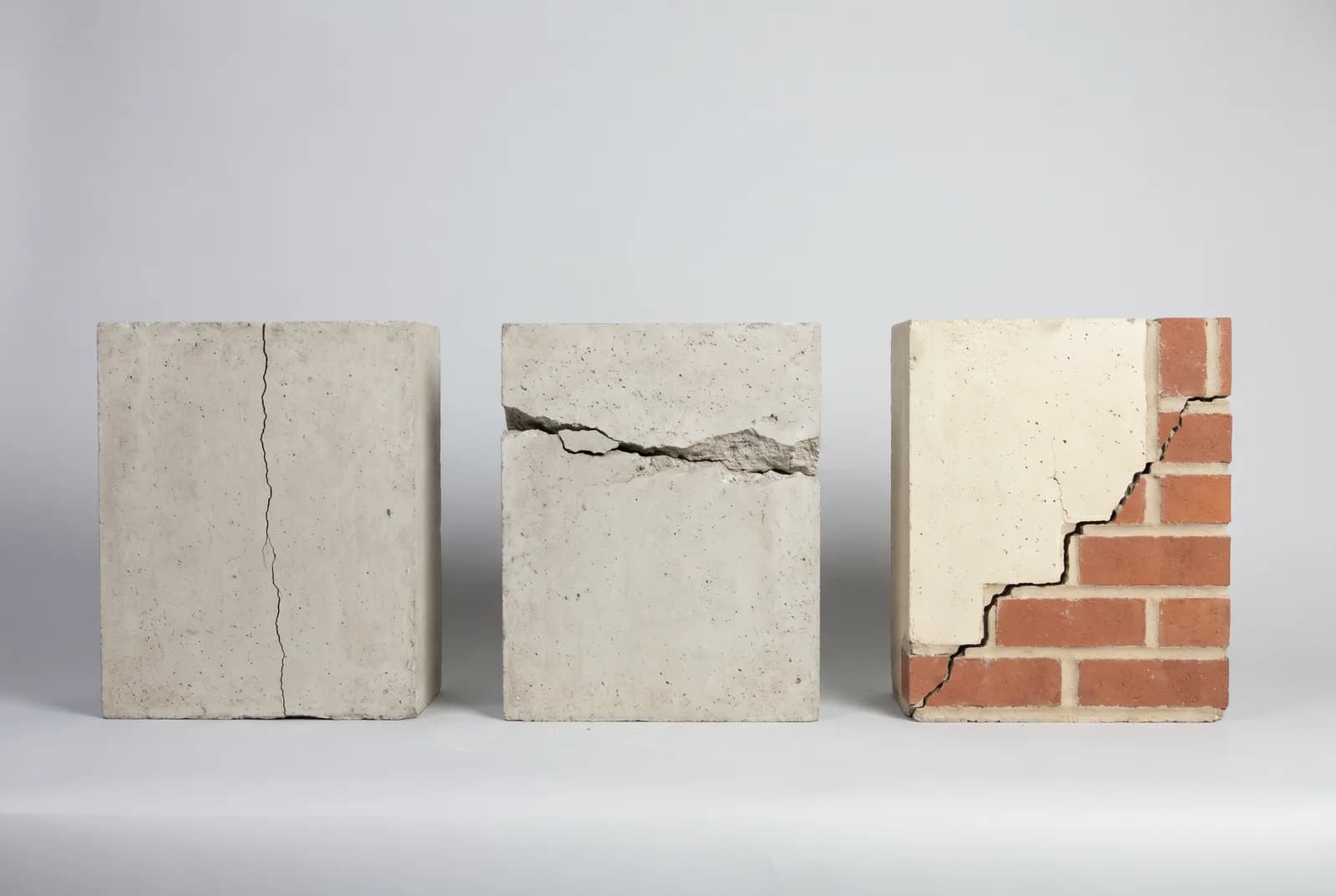
Orientation — read this first. A crack's direction points to the force that made it.
- Vertical cracks run roughly straight up and down. They usually mean concrete shrinkage or minor uniform settling — the foundation curing or seating evenly. On their own they are typically low concern, though in a basement they can be a water-entry point. See the vertical cracks guide.
- Diagonal cracks, typically at 30 to 45 degrees and often radiating from the corners of windows and doors, indicate differential settlement or shear — one part of the foundation moving relative to another. These warrant evaluation, especially when active.
- Stair-step cracks follow the mortar joints in brick or block veneer in a zig-zag. They signal differential settlement or lateral soil pressure — one section settling or being pushed more than another. With offset or a bulge, they climb the urgency scale. See the stair-step cracks guide.
- Horizontal cracks run across a foundation or basement wall, often near mid-height. They have a single dominant cause — lateral pressure from soil or water pushing the wall inward — and that cause does not go away. This is the emergency pattern; see the horizontal cracks guide.
Width — a guide, not a verdict. Width matters, but the recognized thresholds are reference points requiring judgment, not pass/fail lines. Hairline cracks under 1/16 inch (about 1.5 mm) are typically cosmetic shrinkage; the National Association of Home Builders classifies them as "negligible to slight." Above 1/16 inch in a poured wall, a crack is generally not simple shrinkage. Around 1/8 inch (about 3 mm) a crack warrants closer inspection. 1/4 inch (about 6 mm) is the most widely cited homeowner red-flag threshold — InterNACHI training material treats cracks 1/4 inch or wider as a possible indication of serious problems that should be evaluated by a licensed professional engineer. For reinforced concrete, ACI 224R-01 (Table 4.1) gives reasonable crack widths by exposure condition — for example 0.012 inch (0.30 mm) for concrete exposed to humidity, moist air, and soil — while explicitly noting these are design guidelines requiring engineering judgment, and that a portion of cracks will exceed them over time.
Location — where the crack sits changes its meaning. The same width means different things in different places. A crack radiating from a window or door corner points to racking at the weakest part of the wall. A crack at an exterior building corner, especially if it appears on two adjacent walls meeting at that corner, can mean a corner of the foundation has dropped or heaved. A crack mid-height in a basement wall is where lateral soil pressure peaks. Cracks that line up — a fine line in the drywall inside and a wider stair-step crack outside in the same area — are often the same underlying movement showing up in two materials, because brittle brick veneer reveals the wider crack while gypsum board only hints at it.
Progression — the variable no chart shows. The most important question about any crack is not on a width table: is it active or dormant? A dormant hairline crack that has not changed across a wet season and a freeze is almost certainly curing or settlement. An active crack — one measurably widening, lengthening, or developing offset — signals ongoing movement. A 1/8-inch crack that is growing is a bigger concern than a stable 1/4-inch one. The way you answer this is monitoring: a telltale crack gauge, or dated square-on photos with a coin or ruler for scale, re-checked across a full wet/dry and freeze/thaw cycle.
Crack Types at a Glance
Use this as your first-pass filter. Find the crack you are seeing, read its likely cause and urgency, then follow the link to the dedicated guide.
| Crack type | Likely cause | Urgency |
|---|---|---|
| Vertical (straight up/down) | Concrete shrinkage or minor uniform settling | Low — monitor; concern if over 1/4 in or widening → vertical cracks |
| Hairline (under 1/16 in, any direction) | Curing shrinkage; nearly universal in poured concrete | Low — usually cosmetic → hairline cracks |
| Diagonal (30–45°, from window/door corners) | Differential settlement; racking/shear | Moderate–High — assess, especially if active or over 1/8 in → normal vs structural |
| Stair-step (following mortar joints in brick/block) | Differential settlement; lateral pressure | Moderate–High — assess; higher with offset or bulge → stair-step cracks |
| Horizontal (across a basement/foundation wall) | Lateral soil or hydrostatic pressure bending the wall in | Highest — call an engineer now → horizontal cracks |
| Any crack with offset / displacement | Active structural movement | High — assess → normal vs structural |
| Any crack that is actively widening | Ongoing movement (cause not resolved) | High — assess (urgent if rapid) → normal vs structural |
| Random web of fine cracks ("map cracking") in a slab | Drying-shrinkage / crazing — surface only | Low — cosmetic, not structural → normal vs structural |
| First-pass triage of residential foundation crack types by orientation and behavior. Urgency assumes you have read width and progression alongside type. |
The pattern in that table is deliberate. The low rows are mostly material movement — concrete shrinking as it cures. The assess rows are about differential vertical movement — one part of the house dropping or rising relative to another. The single highest row is about lateral pressure — a wall being pushed inward. Match the crack to which of those three is happening and you are most of the way to the right answer.
Cosmetic vs Structural
This is the distinction that decides whether you spend nothing or thousands, so it deserves its own pass. The counterintuitive lesson from the engineering literature bears repeating: orientation and behavior matter more than width.
A poured-concrete-wall crack is more likely structural rather than shrinkage when any of these are true:
- one side is offset or higher than the other (vertical displacement equals movement);
- it follows a single continuous line (shrinkage cracks tend to be discontinuous and shallow);
- it is wider than about 1/16 inch;
- there is rust staining at the crack (reinforcing steel corroding and expanding); or
- a bulge accompanies it.
By contrast, the hallmarks of cosmetic shrinkage are a thin width (under 1/16 inch), no displacement between the two sides, a discontinuous or shallow path, and stability over time. In slabs specifically, drying-shrinkage cracking shows up as a random, interconnected web of fine shallow cracks ("map cracking" or crazing) in irregular cells a few inches across — a pattern that is almost always surface-level and non-structural, distinct from the single isolated line of a structural slab crack.
There is also a category of cracks and crack-like signs that are not foundation movement at all. Drywall nail pops and fine interior cracks come from lumber drying and shrinking for a year or more after construction. A ceiling-to-wall gap at an interior partition that worsens in winter and reverses in summer is the classic signature of truss uplift — seasonal wood movement, not foundation failure. Thermal and humidity movement opens and closes fine cracks and sticks doors without any soil involvement. Distinguishing these look-alikes from real movement is where homeowners save the most money.
The BRE Digest 251 six-category damage scale (0–5) formalizes this same intuition at the building level: cracking up to about 5 mm is treated as aesthetic, needing only redecoration, while wider cracking generally needs structural repair specified by an engineer, and the top category presents stability concerns. You do not need to memorize the scale. You need to know a credible framework exists, that an engineer applies it, and that a contractor's tape measure is not it. For the full checklist, see our dedicated normal vs structural cracks guide.
When to Worry — Call an Engineer
A short list of cracks is different in kind from everything above. They do not mean "schedule an assessment in the next few weeks." They mean stop.
Why single horizontal cracks and bowing walls out from every other pattern? Because their cause is continuous. A settlement crack records a movement that may have already stabilized; a horizontal crack records lateral pressure from saturated or expansive soil that presses against the wall every wet season and does not relent. The wall does not heal itself. The horizontal cracks guide covers how to gauge severity and what an engineer evaluates.
Cracks in Texas Expansive Clay
Much of Texas — including the San Antonio area — sits on expansive clay, and that changes how you read a crack. The American Society of Civil Engineers estimates that expansive soils cause some damage to about one in four U.S. homes, and that in a typical year they cause greater cumulative financial loss to property owners than earthquakes, floods, hurricanes, and tornadoes combined (the figure traces to Nelson and Miller, 1992, as cited by the British Geological Survey). Clay swells when it absorbs water and shrinks when it dries, and it does so on a seasonal cycle — which means the cracks it causes behave differently from cracks driven by a one-time settlement.
The signature of expansive-clay movement is seasonal and cyclical rather than steadily progressive:
- Cracks that open and close with the seasons — widening in summer drought as the clay shrinks, partly closing after sustained rain as the clay swells back. A crack that cycles is behaving differently from one that only ever widens.
- Doors and windows that bind in one season and free up in another, tracking soil moisture rather than getting permanently worse.
- Floors that rise and fall seasonally, which an elevation survey repeated across wet and dry periods can actually map.
- Movement concentrated near the perimeter, often worse where trees, leaking plumbing, or downspouts create local wet or dry zones in the clay.
The diagnostic question in clay country is whether what you are seeing is cyclical (opening and closing around a stable mean, with no net trend) or progressive (a steady worsening across multiple seasons). Cyclical movement may call for moisture management more than underpinning; progressive movement is the one that needs an engineer and possibly piers anchored below the seasonally active moisture zone. This is precisely why a single inspection can mislead and why a baseline survey, repeated over time, is so valuable for reading what your cracks really mean.
Engineer First, Contractor Second
See exactly what an independent engineer's report includes →
FAQ Note
The questions below are the ones San Antonio homeowners ask most after spotting a first crack — whether it is serious, which orientation is worst, what width matters, and how to read seasonal clay movement. For the crack type you are looking at, the dedicated guides go deeper: horizontal cracks, vertical cracks, stair-step cracks, hairline cracks, and the full normal vs structural checklist. To see how cracks fit alongside every other symptom, start at the signs of foundation problems hub.
Get Matched With a Vetted San Antonio Specialist
If you have read your cracks and you are in the assess or urgent bucket — or you simply want a PE-led second opinion before any contractor quotes a fix — we'll match you with a vetted San Antonio foundation specialist who works to an independent engineer's design. The match is free, the quote is no-obligation, and we don't take a fee from you. We screen for sealed-engineer diagnosis, elevation-survey documentation, permitted work, and a clean Bexar County record. If a quote doesn't fit the engineering, we'll tell you. That's the only way an editorial matching service should work.
Frequently asked questions
9 questionsAre all foundation cracks serious?
Which type of foundation crack is the most dangerous?
What does the orientation of a foundation crack tell me?
What crack width is dangerous in a foundation?
How can I tell if a foundation crack is cosmetic or structural?
Do foundation cracks open and close with the seasons in Texas?
When should I call an engineer about a foundation crack?
Can I just seal a foundation crack myself?
Does a foundation crack mean my whole foundation is failing?
Related guides
- Horizontal/foundation-repair/cracks/horizontal
- Vertical/foundation-repair/cracks/vertical
- Stair Step/foundation-repair/cracks/stair-step
- Hairline/foundation-repair/cracks/hairline
- Normal Vs Structural/foundation-repair/cracks/normal-vs-structural
- Signs/foundation-repair/signs
- Engineer Report/foundation-repair/diagnosis/engineer-report
Sources
- [1]ACI 224R-01 — Control of Cracking in Concrete Structures (Table 4.1, reasonable crack widths)
- [2]ACI 562 — Code Requirements for Assessment, Repair, and Rehabilitation of Existing Concrete Structures
- [3]BRE Digest 251 — Assessment of Damage in Low-Rise Buildings (six-category 0–5 scale, rev. 1995)
- [4]InterNACHI — Cracks 1/4 inch or wider warrant evaluation by a licensed professional engineer
- [5]National Association of Home Builders — hairline cracks under 1/16 inch classified as negligible to slight
- [6]Portland Cement Association — virtually every poured concrete foundation develops at least one crack within a few years
- [7]ASCE / Nelson and Miller (1992), via the British Geological Survey — expansive soils damage about 1 in 4 U.S. homes