Bottom line up front
Every foundation repair method on the market exists because it solves a specific problem. None of them solves all problems. The right method for your home is determined by your soil profile, foundation type, structure weight, and depth to competent bearing — not by which product the contractor on your driveway happens to install.
That distinction matters because foundation repair is one of the few home repairs where the diagnostic and the prescription come from the same person who profits from the sale. The American Society of Civil Engineers estimates that one in four U.S. homes has damage caused by expansive soils — which in a typical year cause greater cumulative financial loss to property owners than earthquakes, floods, hurricanes, and tornadoes combined. There is a strong, predictable, well-capitalized market of contractors ready to convert that anxiety into an invoice.
The defense is straightforward and it is the single recommendation that runs through every section below: engineer first, contractor second. An independent licensed Professional Engineer performs a structural survey and an elevation (zip-level / manometer) survey, then writes a neutral specification — pier type, count, spacing, depth target, acceptance criteria. Contractors bid against that spec. The cost of the assessment ($300–$800, or $1,000–$6,000 if geotechnical work is needed) is rounding error against a typical Texas project total of $15,000–$30,000 and routinely changes the scope by more.
This page is the side-by-side. Each method below is summarized to roughly the same depth so you can compare apples to apples, then links out to a dedicated deep dive on the one that fits your situation.
How to choose a foundation repair method (the decision framework)
Method selection follows a defined sequence. Skip a step and the prescription will be wrong.
1. Confirm there is actually structural movement. Hairline cracks under ⅛ inch with no displacement, no active leak, and no progression are usually cosmetic. An elevation survey distinguishes real differential settlement (typically out of tolerance beyond ~1 to 1.5 inches across a slab home) from drywall settling that needs paint, not piers. A baseline survey at purchase, repeated every ~3 years through wet, drought, and normal cycles, prevents unnecessary repairs.
2. Diagnose the cause. Settlement (foundation sinking into soil) is one problem; lateral wall movement (bowing or leaning walls under soil pressure) is another; cosmetic cracks in poured concrete are a third; voids under a slab are a fourth. Each calls for a different category of method.
3. Characterize the soil. Expansive clay (Texas, Colorado Front Range, Gulf Coast) behaves nothing like sandy soil, loose fill, or freeze-thaw regions. A geotechnical report — boring logs, Standard Penetration Test (ASTM D1586) N-values, plasticity and expansion indices — defines the bearing stratum and target pier depth. IBC §1803.5.3 defines "expansive soil" by four specific criteria and triggers required soil testing.
4. Match the method to the cause + soil + structure. Heavy structure over reachable bedrock → push piers. Light structure, sandy or expansive soil, limited access → helical piers. Long-term stability in Texas clay → drilled bell-bottom piers below the active zone. Sunken driveway with sound subgrade → polyurethane foam or mudjacking. Bowing basement wall under 2 inches → carbon fiber straps. Active leaking crack in poured concrete → polyurethane injection.
5. Verify with codes and product listings. Insist on ICC-ES-listed products with an active Evaluation Service Report (ESR) — for example CHANCE helical ESR-2794, Ram Jack helical ESR-1854, Ram Jack driven pile ESR-4331. Get a no-depth-clause price so deeper-than-estimated piers don't inflate the bill. Pull permits. Require pre- and post-repair hydrostatic plumbing tests.
The rest of this page applies that framework to every method on the market.
All foundation repair methods at a glance
The master comparison. Use it to filter, then read the relevant section below.
| Method | Best for | Typical unit cost | Typical project total | Permanent? | DIY? |
|---|---|---|---|---|---|
| Steel push piers | Heavy homes, reachable bedrock, settlement | $1,500–$3,500 / pier | $15,000–$30,000 | Yes | No |
| Helical piers | Light/medium homes, sandy or expansive soils, limited access | $1,500–$3,500 / pier | $15,000–$30,000 | Yes | No |
| Concrete pressed pilings | Budget DFW slab repair | ~$1,000 / piling | $8,000–$15,000 | Semi-durable | No |
| Drilled bell-bottom piers | Texas expansive clay, long-term stability | Above pressed; varies | $12,000–$25,000 | Yes | No |
| Slab jacking / mudjacking | Sunken flatwork, large/heavy slabs | $3–$6 / sq ft | $500–$2,500 | Several years | No |
| Polyurethane foam injection | Flatwork leveling, voids, soil densification | $5–$25 / sq ft | $1,000–$5,000+ | 20+ yr typical | No |
| Wall anchors (deadman) | Bowing walls >2 in., yard accessible | $400–$700 each | $80–$140 / linear ft | Yes | No |
| Helical tiebacks | Severe wall bow, limited yard | $1,500–$1,800 each | $300–$360 / linear ft | Yes | No |
| Carbon fiber straps | Bowing walls ≤2 in., no shear | $350–$1,000 / strap | $85–$250 / linear ft | Yes (passive) | No |
| Epoxy crack injection | Structural dry cracks in poured concrete | $250–$1,500 / crack | $5–$15 / linear ft | Yes | No |
| Polyurethane crack injection | Wet / leaking cracks (waterproofing) | $250–$1,500 / crack | $5–$15 / linear ft | Yes (seal) | No |
| Consumer crack patch | Hairline <⅛ in., cosmetic only | $15–$30 | $15–$30 | No | Yes |
| Segmented / spot piers | Light loads (porches, crawl space) | ~$1,000 / segmented | Project-specific | Limited | No |
| Soil stabilization / chemical grouting | Loose granular soil, voids, sinkholes | Project-specific | Project-specific | Long | No |
| Micropiles | High capacity, rock, limited access | Project-specific | Higher than piers | Yes | No |
| Side-by-side comparison of residential foundation repair methods (2026 planning data). |
Below, each method gets a tight explainer — how it actually works, when it's the right call, when it's the wrong call, and a link to the deep dive.
Steel push piers (deep underpinning for heavy homes)
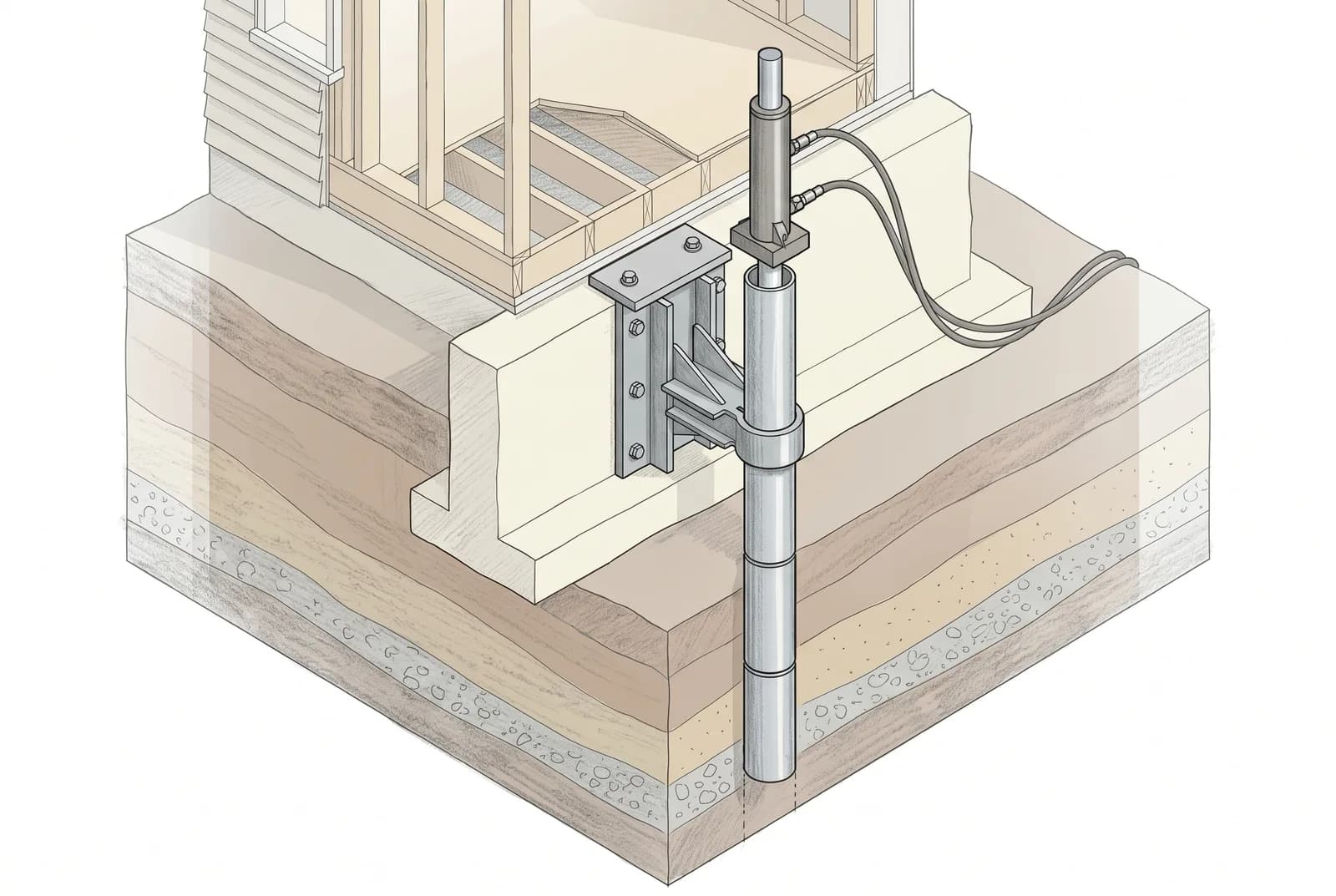
How it works. A heavy steel bracket is bolted against the existing footing (exposed by a ~3-foot-square excavation, or by removing a section of interior slab). A hydraulic ram drives sections of high-strength galvanized steel pipe — commonly 2⅞-inch or 3½-inch OD, conforming to ASTM A500 or A1085 — through the bracket into the soil, using the weight of the structure itself as the reaction force. Pier sections are added until the pier reaches refusal on bedrock or a competent load-bearing stratum. Once all piers reach depth and the required drive pressure, hydraulic jacks lift the structure back toward level in unison and the building load transfers from the failing footing through the bracket to the pier.
When to use. Heavier slab-on-grade or basement structures showing settlement, especially where a competent bearing layer or bedrock exists at a reachable depth. Push piers are end-bearing — they don't depend on soil friction — and capacity is verified by drive pressure. Ram Jack reports an allowable driven-pile bracket capacity of 55.12 kips derived from AC358 full-scale testing. Considered permanent; lifetime transferable warranties are common.
Helical piers (the screw-in pier)
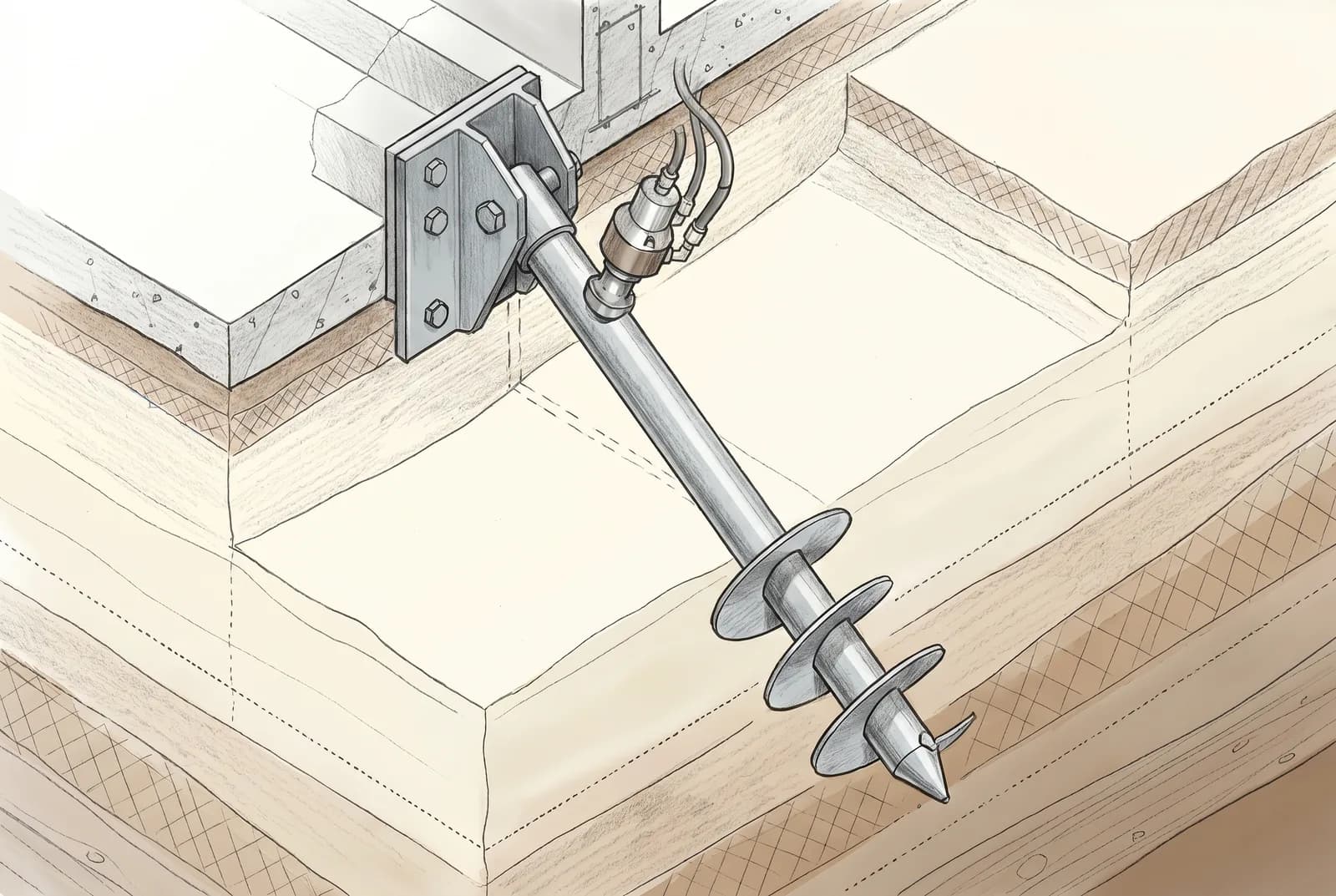
How it works. A steel shaft with one or more welded helical bearing plates is hydraulically rotated — screwed — into the ground by a torque motor. Sections (leads plus extensions, roughly 5 to 7 feet each) are added until target torque or depth is reached. A bracket connects the pier to the foundation and jacks can lift the structure. Critically, installation torque is continuously monitored and correlated to load capacity per the Hoyt & Clemence (1989) empirical relationship Qult = Kt × T — the empirical foundation formalized at the 12th International Conference on Soil Mechanics and Foundation Engineering and codified in ICC-ES AC358. Default Kt values for five shaft sizes have been published since 2007.
When to use. Lighter structures where push piers can't develop enough reaction; sandy or soft soils where friction-dependent methods struggle; expansive-clay regions (anchoring below the active zone); limited-access sites (as little as 6 feet of overhead clearance); new construction. Round shafts (2⅞", 3½", 4½") favor compression and lateral capacity; square shafts handle tension and torque. Hot-dip galvanized per ASTM A123/A153, designed for 50+ years of service in non-corrosive soils.
Concrete pressed pilings (the Texas-classic)
How it works. Pre-cast concrete cylinders (typically 6 inches in diameter and 12 inches tall) are hydraulically pressed into the soil one atop another, using the home's weight as the reaction force, until refusal. Some systems thread a steel cable or rebar insert down through the stack ("pilings with inserts"). Hybrid pilings combine a steel-pipe base with concrete cylinders to reach deeper.
When to use. Budget slab repair, especially in Dallas–Fort Worth where this is the most common method. Lowest unit cost in the category at roughly $1,000 per piling, fast installation (one to two days), widely available.
Full concrete pressed pilings guide → · All foundation piers compared →
Slab jacking & mudjacking (cosmetic slab leveling)
How it works. Holes 1 to 2 inches wide are drilled through the sunken slab and a cement-based slurry (water, soil or clay, sand, cement, sometimes crushed limestone) is pumped under pressure to fill voids and lift the slab back to level. Holes are patched. The slurry is heavy — roughly 100 lb/ft³ and up to 180 lb/ft³ in some formulations.
When to use. Sunken concrete flatwork — driveways, sidewalks, patios, garage floors — and some slab sections where the underlying soil is sound and you need a controllable, low-cost lift on large/heavy slabs. Inexpensive ($3–$6 per square foot), familiar, eco-simple materials.
Full slab jacking and mudjacking guide → · Foundation leveling explained →
Polyurethane foam injection (precision lifting)
How it works. Small holes (≈⅝ inch or smaller) are drilled and a two-part polyurethane resin is injected. It reacts and expands within seconds to minutes, filling voids and lifting the slab in real time as the technician monitors elevation. Cures in 15 to 30 minutes. The foam is light (~2–4 lb/ft³, vs. mudjacking's ~100+), hydrophobic, and reaches tight voids; compressive strength is typically 80–100 psi.
When to use. Concrete leveling on driveways, sidewalks, garage floors, pool decks, and highway slabs; void filling under slabs; soil densification; situations needing fast return to service. The U.S. Department of Transportation prefers polyurethane for highway slabs because it's lightweight enough not to overburden weak subgrade. Commonly cited at 20+ years of service.
Full polyurethane foam guide →
Wall anchors & carbon fiber straps (for bowing walls)
Bowing and leaning basement walls come from lateral soil pressure — expansive clay, hydrostatic pressure, frost heave. Three primary systems, chosen largely by deflection severity.
Carbon fiber straps (CFRP). For walls bowing ≤2 inches with no shearing. The wall is ground clean, cracks are epoxy-filled, and high-tensile carbon fiber strips (cited at 120,000–195,000 psi tensile) are bonded vertically (typically 48 inches on center) with anchors at sill plate and footing. Passive system — arrests further movement but does not straighten. Governed by ACI 440.2R for externally bonded FRP. Least invasive, no excavation, paintable.
Wall anchors (deadman anchors). For bowing >2 inches where at least 10 feet of exterior yard is accessible. An interior steel plate connects via a steel rod to an exterior plate buried in stable soil beyond the failure plane; tightening the rod can pull the wall back over time. Active system. Requires excavation.
Helical tiebacks. For severe bowing or where exterior access is limited. A helical screw shaft is drilled at an angle through the wall into soil outside, torqued to a target, and secured to an interior channel (14 to 21 feet long). Most expensive but strongest; immediate stabilization.
Full wall anchors guide → · Carbon fiber straps deep dive →
Underpinning (the umbrella term — and what it actually means)
Underpinning is not a method — it is the category of methods that install deep supports beneath an existing footing to transfer load to competent strata. Push piers, helical piers, drilled/bell-bottom piers, concrete pressed pilings, and micropiles are all forms of underpinning. When a contractor says "we'll underpin the foundation," the next question is with what product, listed under which ICC-ES ESR, at what depth.
Partial underpinning ($5,000–$20,000) addresses one wall or corner. Full underpinning ($20,000–$80,000) addresses the entire perimeter and is reserved for severe settlement, multi-wall structural cracking, or older homes. A contractor proposing full underpinning on minor differential settlement may be over-selling — the engineer's elevation survey defines the affected area, not the sales rep's tape measure.
Micropiles (mini-piles) deserve a special mention: small-diameter drilled elements (steel casing plus threaded bar plus grout) deriving capacity from side friction with soil or rock. Used where higher per-pile capacity than helical is needed and in limited-access, low-vibration situations (as little as 8 feet of overhead). Governed by FHWA micropile guidance and supported by the Deep Foundations Institute and ADSC micropile committees.
Full underpinning guide → · Segmented and spot piers →
Crack repair: epoxy, polyurethane, hydraulic cement (cosmetic-only)
Crack repair is symptoms-only. It restores or seals the crack but does not fix why the foundation moved. If cracks are progressing, widening, or accompanied by sticking doors, sloping floors, or stair-step masonry cracks, you need a structural engineer before sealing anything.
Epoxy injection. For structural repair of dry cracks in poured concrete. Two-part epoxy (low-viscosity ~100–500 cps for fine cracks; gel for wider) is injected through surface ports; cured epoxy's tensile and compressive strength exceeds the surrounding concrete, monolithically welding the crack. Rigid — will not flex. Needs a dry, clean substrate; will not adhere to wet concrete or previously patched cracks.
Polyurethane injection. For waterproofing active or leaking cracks. Moisture-activated expanding foam fills voids and seals; remains flexible to accommodate thermal and minor movement. Best for hairline leaking cracks. Not for structural strengthening.
Hydraulic cement. Rapid-setting cement that expands as it cures; used to seal actively wet cracks and penetrations and to anchor injection ports when the surface is too wet for epoxy paste. A band-aid for active leaks; ports can blow off if not properly anchored.
Consumer products (Quikrete-type patching compounds, hydraulic cement). For hairline cracks under ⅛ inch with no displacement, no active leak, and no progression — reasonable DIY for cosmetic sealing ($15–$30). Often fail as permanent fixes and complicate later professional injection (old material blocks port penetration).
Foundation leveling (the verb, not a method)
"Foundation leveling" describes the act of restoring a foundation's elevation — it is not a distinct engineered method. Push piers, helical piers, drilled piers, pressed pilings, mudjacking, and polyurethane foam can all be used to level a foundation depending on what you're leveling and why it sank.
When a contractor advertises "foundation leveling" without naming the underlying product or ESR listing, treat that as a prompt to ask which method they install under, which ICC-ES Evaluation Service Report covers it, what the target lift is in inches, and how acceptance will be verified (drive pressure, torque, elevation re-survey). Ambiguity in the marketing is fine. Ambiguity in the contract is not.
The deliberate decision underneath leveling is stabilization vs. attempted full lift. Stabilization (stopping the movement) carries near-zero collateral risk. Attempting maximum lift carries higher risk of plumbing damage and reopened drywall cracks. Discuss the trade-off explicitly with your engineer.
Full foundation leveling guide →
Soil stabilization & chemical grouting (preventive)
A separate family of methods treats the soil rather than the structure. They are trenchless, minimally disruptive, and most appropriate as either a complement to underpinning or an alternative where piers aren't feasible.
Permeation grouting. Low-viscosity polyurethane or acrylate resin saturates granular (sand or silt) soils, binding particles into a cohesive, stronger, erosion-resistant mass; improves compressive and shear strength and bearing capacity without excavation. Most effective in sandy or silty soils, harder in dense clay.
Compaction grouting. Rapidly expanding polyurethane structural foam (full expansion in ~30 seconds) injected to fill voids and densify or compact surrounding soil by expansive pressure.
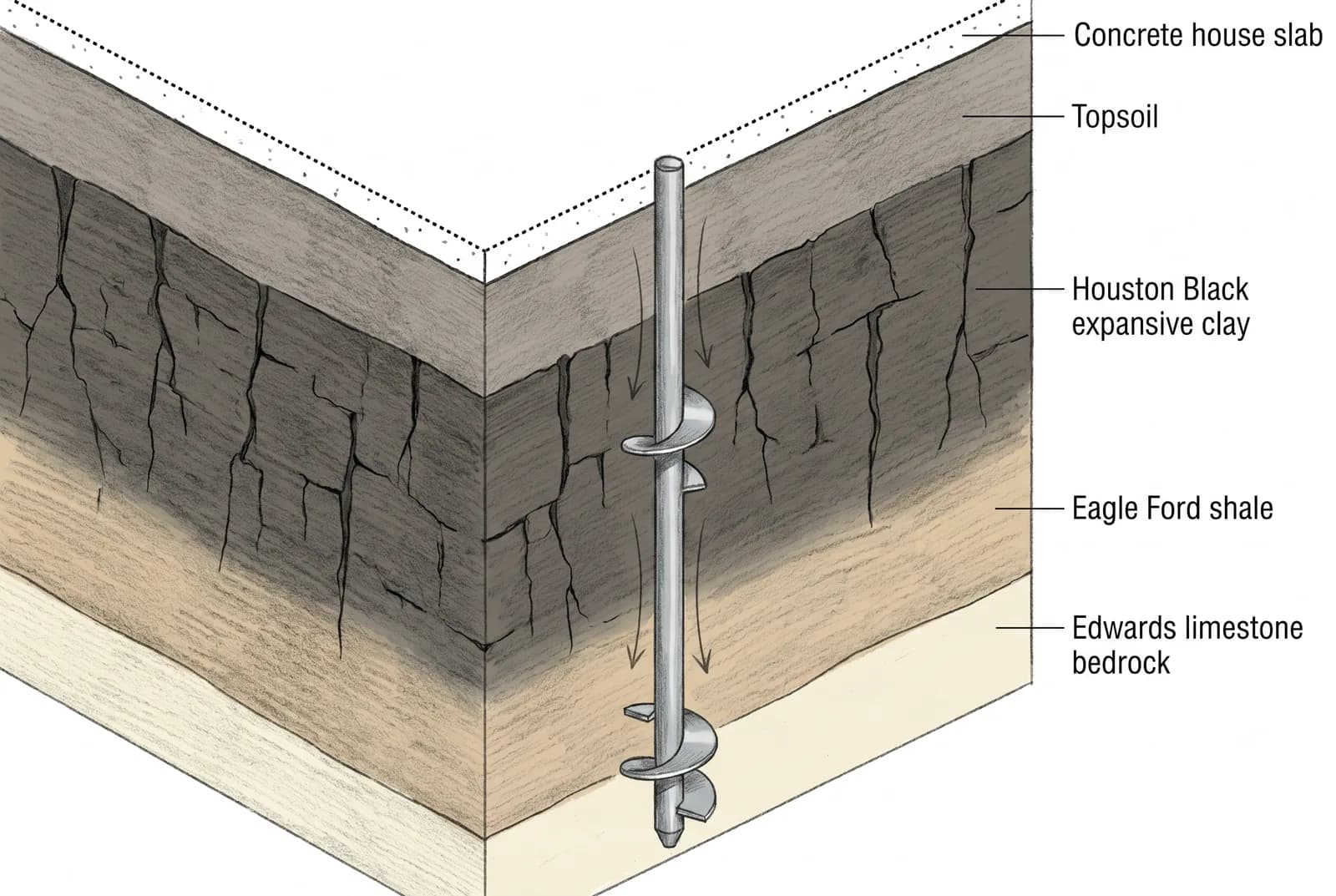
Expansive-clay treatment. Hydrophobic polyurethane foam (HPUF) and proprietary systems are injected to reduce clay swell and shrink. Peer-reviewed research (NIH/PMC) shows that ~10–15% foam injection meaningfully reduces both swelling and shrinkage cracking over repeated wet-dry cycles. Hydrophilic vs. hydrophobic grouts are chosen by water conditions.
Root barriers and drainage corrections. In expansive-clay regions, trees can draw hundreds of gallons per day, drying and shrinking clay and causing foundations to sink — roots extend 1.5 to 2.5 times tree height, and moisture migrates from under the slab toward thirsty roots even without roots physically under the foundation. A vertical HDPE root and moisture barrier (≥3 feet deep), proper grading, gutters and downspout extensions, French drains, and soaker hoses (typically 2–3 feet out, with a moisture-barrier gap) constitute the preventive program that protects whatever underpinning you install.
Full soil stabilization guide →
Trenchless / minimally-invasive options
"Trenchless" is not a method but a delivery mode that reduces excavation, disruption, and homeowner inconvenience. Several methods can be executed trenchless:
- Polyurethane foam injection — leveling and soil densification through tiny holes, no excavation.
- Chemical / permeation grouting — soil stabilization without excavation.
- Helical piers in limited access — handheld torque motors install in as little as 6 feet of overhead clearance with minimal spoils.
- Under-slab tunneling — for interior pier placement or under-slab plumbing repair, crews hand-dig a ~3-foot × 3-foot tunnel from outside rather than breaking the interior slab. Flooring and furniture stay intact; homeowners can remain in the house. Crews dig roughly 5–8 ft/day (best case ~12 ft); a typical 10–18 ft tunnel takes 2–3 days, with comparable time for backfill.
- Crack injection — interior repair without exterior excavation.
Trenchless options trade higher unit cost for lower collateral disruption. They're disproportionately valuable for occupied homes with finished interiors, tight lot lines, or mature landscaping.
Full trenchless methods guide →
Which method matches your soil + home type (decision matrix)
Use this as a starting filter, not a final answer — the engineer's report is the final answer.
| Soil / site | Steel push piers | Helical piers | Pressed pilings | Bell-bottom drilled | Polyurethane foam | Mudjacking |
|---|---|---|---|---|---|---|
| Texas expansive clay (active zone) | Conditional | Good fit | Avoid (DFW heave risk) | Good fit | Flatwork only | Flatwork only |
| Sandy / soft soils | Conditional | Good fit | Avoid | Conditional | Flatwork only | Flatwork only |
| Loose fill | Avoid (no reaction) | Good fit (torque-verified) | Avoid | Conditional | Conditional (densify) | Avoid |
| Reachable bedrock (heavy home) | Good fit | Good fit | Conditional | Conditional | Flatwork only | Flatwork only |
| Cobbly / bouldery | Conditional | Avoid (refusal) | Avoid (skew risk) | Conditional | Flatwork only | Flatwork only |
| High water table / wet | Conditional | Good fit | Conditional | Avoid (cure fails if wet) | Good fit (hydrophobic) | Avoid |
| Light frame / new construction | Avoid (lifts before refusal) | Good fit | Conditional | Good fit | N/A | N/A |
| Limited overhead access | Conditional | Good fit (6 ft clearance) | Conditional | Avoid | Good fit | Conditional |
| Method-by-soil decision matrix for residential foundation repair. 'Good fit' = an engineered choice for this soil type; 'Conditional' = workable with specific constraints; 'Avoid' = wrong tool. |
This is also why the same house gets dramatically different bids from different contractors. The bid reflects the product the salesperson installs, not necessarily what the soil requires. An independent engineer's spec normalizes the bids.
When to get an independent engineer's opinion first
See what an independent engineer's report includes →
Cost ranges by method (2026)
Costs vary widely by region (coastal-metro labor adds 20–40% over Sun Belt and Midwest), by access (hand-dug piers add $200–$500 each; basement interior work adds 15–30%), and by pier depth. The figures below are 2026 national-average planning numbers, not quotes. National average for a foundation repair project is roughly $5,179 per This Old House's 2026 data, with typical range $2,225–$8,133 — but that average bundles cheap crack sealing with mid-five-figure full underpinning, so it's a poor predictor of any specific job.
| Method | Unit cost | Typical project total | Cost notes |
|---|---|---|---|
| Steel push piers | $1,500–$3,500 / pier | $15,000–$30,000 | Many projects 3–10+ piers; lifetime transferable warranty common |
| Helical piers | $1,500–$3,500 / pier (often $2,000–$3,000) | $15,000–$30,000 | Higher end due to two-person torque-motor crew; ESR-listed products only |
| Pressed concrete pilings | ~$1,000 / piling | $8,000–$15,000 | Cheapest pier method; shorter warranty; DFW prevalent |
| Drilled bell-bottom piers | Higher than pressed | $12,000–$25,000 | Skilled labor + concrete + 28-day cure |
| Mudjacking | $3–$6 / sq ft | $500–$2,500 | Flatwork only; larger patch holes |
| Polyurethane foam (flatwork) | $5–$25 / sq ft | $1,000–$5,000+ | 2–3× mudjacking; faster cure, smaller holes |
| Polyurethane foam (deep injection) | $150–$180 / sq ft | $5,000 minimum | Soil stabilization scope, not flatwork |
| Carbon fiber straps | $350–$1,000 / strap; $85–$250 / linear ft | $3,000–$10,000 | ≤2 in. bow; passive arrest only |
| Wall anchors | $400–$700 each; $80–$140 / linear ft | $5,000–$15,000 | Requires ≥10 ft yard access |
| Helical tiebacks | $1,500–$1,800 each; $300–$360 / linear ft | $10,000–$25,000 | Strongest of the three wall systems; immediate |
| Epoxy / polyurethane crack injection | $250–$1,500 / crack; $5–$15 / linear ft | $300–$3,000 | Symptoms-only; poured concrete only |
| Partial underpinning | See pier costs above | $5,000–$20,000 | One wall / corner |
| Full underpinning | See pier costs above | $20,000–$80,000 | Reserved for severe / multi-wall structural damage |
| 2026 cost ranges by method. Unit cost is per pier, per linear foot, or per square foot as noted; project totals are typical residential repair scope. |
Full 2026 cost breakdown by method →
Bottom line: how to compare quotes
When you have three bids in hand, the comparison is not "which contractor is cheapest." Apples-to-apples requires four moves:
1. Normalize on the engineer's spec, not the contractor's pitch. Send each contractor the same independent PE specification — pier type, count, spacing, depth target, acceptance criteria. Bids that propose a different scope are answering a different question.
2. Insist on the ESR. Every bid should name the specific product, its ICC-ES Evaluation Service Report number (e.g., ESR-1854, ESR-2794, ESR-4331), and confirm AC358 compliance. Vague references to "ICC-certified" or "code-compliant" are not adequate.
3. Get a no-depth-clause price. Bids structured as "$X per pier, plus $Y per foot beyond Z feet" turn into open-ended invoices when soil conditions vary on installation day. Lock the price.
4. Read the warranty in full. Lifetime transferable warranties signal contractor confidence; watch for arbitration clauses, exclusions for plumbing damage (about 1 in 4 slab homes need some plumbing repair after a lift), and conditions that void coverage for unpermitted work.
A bid that scores well on those four moves is comparable. One that doesn't isn't a bid — it's an estimate of the contractor's preferred sales path. Walk if the contractor refuses to work with your engineer, won't pull permits, or won't put depth and acceptance criteria in writing.
Get matched with a San Antonio specialist →
FAQ
Frequently asked questions
12 questionsWhich foundation repair method is best?
Are helical piers better than push piers?
Is mudjacking permanent?
When is polyurethane foam the right choice?
Do all repair methods require a permit?
How long does each method last?
Which methods are DIY-friendly?
What method works best in Texas clay?
Is foundation underpinning the same as piers?
How do I know which method my home needs?
Is foundation leveling a repair method?
Can crack repair fix a settling foundation?
Related guides
- Steel Push Piers/foundation-repair/methods/steel-push-piers
- Helical Piers/foundation-repair/methods/helical-piers
- Concrete Pressed Pilings/foundation-repair/methods/concrete-pressed-pilings
- Foundation Piers/foundation-repair/methods/foundation-piers
- Slab Jacking Mudjacking/foundation-repair/methods/slab-jacking-mudjacking
- Polyurethane Foam/foundation-repair/methods/polyurethane-foam
- Wall Anchors/foundation-repair/methods/wall-anchors
- Carbon Fiber Straps/foundation-repair/methods/carbon-fiber-straps
- Foundation Leveling/foundation-repair/methods/foundation-leveling
- Underpinning/foundation-repair/methods/underpinning
- Foundation Lifting/foundation-repair/methods/foundation-lifting
- Foundation Replacement/foundation-repair/methods/foundation-replacement
- Foundation Stabilization/foundation-repair/methods/foundation-stabilization
- Footing Repair/foundation-repair/methods/footing-repair
- Structural Damage Repair/foundation-repair/methods/structural-damage-repair
- Segmented Piers/foundation-repair/methods/segmented-piers
- Soil Stabilization/foundation-repair/methods/soil-stabilization
- Trenchless/foundation-repair/methods/trenchless
- Cost/foundation-repair/cost
- Engineer Report/foundation-repair/diagnosis/engineer-report
Sources
- [1]ICC-ES AC358 — Acceptance Criteria for Helical Pile Systems and Devices
- [2]IBC 2024 §1810 — Deep Foundations
- [3]IRC 2024 §R403 — Footings
- [4]ASTM A500 / A1085 — Steel Hollow Structural Sections
- [5]ASCE Texas Section, Foundation Design Guidelines v3 (2022)
- [6]ASCE — 1-in-4 U.S. homes damaged by expansive soils (cumulative annual loss exceeds earthquakes, floods, hurricanes, and tornadoes combined)
- [7]This Old House — 2026 foundation repair cost data (~$5,179 national average)
- [8]Hoyt & Clemence (1989) — Uplift Capacity of Helical Anchors in Soil