Steel push piers — also called resistance piers — are galvanized steel pipe sections hydraulically driven beneath your footing, using the weight of the house itself as the reaction force, until they reach refusal on competent soil or bedrock. The building's load then transfers from the failing footing, through a steel bracket, down the pier to stable ground. In Texas a typical project runs 8–14 piers at $1,500–$3,500 each, $15,000–$30,000 all-in, and is considered permanent when driven to a sealed engineer's design. The one rule that decides whether push piers are even the right method: your house has to be heavy enough to drive them.
What Is a Steel Push Pier? (Definition & Anatomy)
A steel push pier is a deep-foundation underpinning element: a series of high-strength steel pipe sections pressed end-to-end into the ground beneath an existing footing. Unlike a helical pier, it has no screw plates — it advances by sheer hydraulic force, and the force it pushes against is the structure overhead. That single fact shapes everything about where push piers work and where they fail.
Three characteristics distinguish a push pier from the other underpinning methods:
- It is an end-bearing element. The pier carries load at its tip, on competent strata or bedrock — not by friction along its length. That's why depth is dictated by where good bearing is, not by a fixed number.
- It uses the building as its reaction mass. The hydraulic ram needs something to push against. On a heavy, settled home that's an advantage; on a light structure it's a disqualifier.
- Capacity is verified by drive pressure, in real time. Like a helical pier's torque log, a push pier's drive-pressure record is the install-time evidence that each pier reached the resistance the engineer designed for.
How Steel Push Piers Work: Building Weight as the Reaction Force
The surface soil — the upper several feet to roughly 15 feet in San Antonio's expansive-clay zone — is the part that swells, shrinks, and lets your foundation settle. A push pier bypasses it. The crew exposes the footing, seats a heavy steel bracket against it, and a hydraulic ram drives steel pipe sections one after another through the bracket and into the ground. As each section meets more resistance, the pressure required to keep advancing climbs. When the pier can no longer be driven — refusal — it has reached a stratum strong enough to carry its share of the house.
Here's the subtlety most sales pitches skip: the ram pushes down on the pier by pushing up against the footing, which means the building's own weight is the anchor. Distribute that weight across a dozen piers and each one can be driven hard enough to reach deep, competent material. But a structure that's too light simply rises — the ram lifts the house before the pier seats — and the pier never reaches the strata it was supposed to. That is the entire reason engineers reach for helical piers on additions, porches, and light slabs.
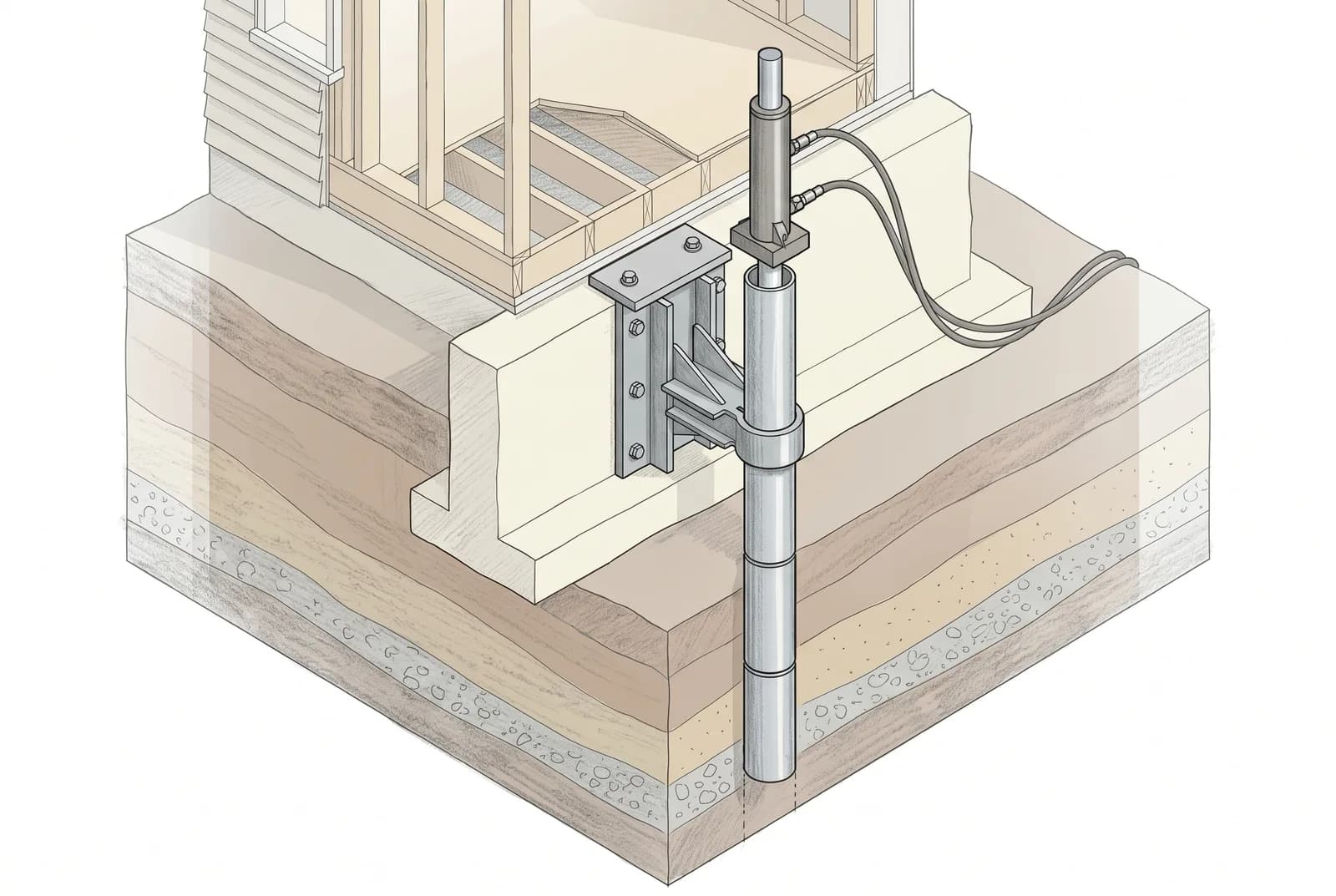
Components: Bracket, Pier Sections, Drive Stand
Four parts make up a push-pier system. Read them and you can read a manufacturer's spec sheet.
- Underpinning bracket. The L-shaped steel fitting bolted and seated under the existing footing. It's what transfers building load into the pier and what makes a generic steel pipe into a foundation-repair component. Brackets are commonly fabricated from high-strength plate conforming to ASTM A572 (Grade 50–65).
- Pier sections (the pipe). Galvanized steel pipe, commonly 2-7/8" or 3-1/2" outside diameter, in 3-, 5-, or 7-foot lengths that are added as the pier advances. Tube typically conforms to ASTM A500 Grade C or ASTM A1085 (50 ksi minimum yield). Ram Jack's driven system, for example, uses 2-7/8" OD pipe in those section lengths.
- External sleeve / coupling. Sections are joined (and often sleeved) so the assembled pier resists buckling as it's driven — important because a slender pipe pushed hard into the ground wants to deflect off line.
- Drive stand and hydraulic ram. The temporary frame that reacts against the bracket and the structure to press each section home, with a calibrated pressure gauge that produces the drive-pressure record.
Hot-dip galvanizing per ASTM A123 is the standard corrosion protection. Soils flagged corrosive (low resistivity, low pH, high sulfates) call for the engineer to specify upgraded coating or protection — the same discipline that applies to any steel underpinning element.
Steel Push Piers vs Helical Piers (Comparison Table)
This is the decision homeowners face most, and one most competing pages refuse to write honestly. Both are legitimate, code-recognized deep-foundation systems. They suit different conditions.
| Dimension | Steel Push Pier | Helical Pier |
|---|---|---|
| Driving mechanism | Hydraulic ram, reacting against the building's weight | Torque motor — supplies its own driving force |
| Best-fit structure | Heavier homes; two-story or masonry-clad | Lighter homes, additions, decks, new construction |
| Best-fit soil | A clear, reachable bearing layer or bedrock | Sandy, soft, fill, or expansive clay — anywhere torque correlates cleanly |
| Capacity driver | Drive pressure at refusal + structure weight | Torque-to-capacity correlation (Qult = Kt × T), per AC358 |
| Typical depth (TX residential) | To refusal (15 ft to 80–100 ft where bedrock is deep) | 12–25 ft, extensible to 100+ ft |
| Lateral / uplift resistance | Low — end-bearing, minimal uplift | High — helices resist compression and uplift |
| Light-structure suitability | Poor — may lift the house before refusal | Excellent — motor supplies the drive force |
| Typical cost per pier (TX, 2026) | $1,500–$3,500 installed | $1,800–$3,500 installed |
| Code path | IBC §1810.3 + manufacturer ESR (e.g. ESR-4331) | IBC §1810.3 + AC358 + manufacturer ESR (e.g. ESR-2794) |
| Side-by-side: steel push pier vs helical pier for residential underpinning in Texas. |
Clean decision rule: heavy home + a reachable bearing layer = push piers, often the cost-efficient choice. Light home, sandy or expansive soil, an addition, or tight access = helicals win on engineering. For the full helical breakdown, see our helical piers guide.
The Light-Structure Problem (When Push Piers Are the Wrong Call)
The honest framing: push piers are excellent at one job — driving deep under a heavy, settled structure to reach competent strata — and poor at everything outside that job. A contractor who proposes push piers for a detached light addition, or who can't tell you the target drive pressure and expected depth, is selling a product rather than solving your problem.
Installation Process: 7-Step Sequence with Drive-Pressure Verification
A residential push-pier install follows a tight sequence. Each step has an engineering checkpoint — the questions an independent PE will ask if asked to certify the work later.
- Pre-install: engineer's plan and utility locate. Sealed PE drawings show pier locations (typically every ~6 ft along the affected perimeter), target drive pressure, expected depth, and bracket type. Call 811 for a public-utility locate; GPR-scan a post-tensioned slab.
- Excavate to the footing. A roughly 3-foot-square hole is dug at each marked location to expose the footing bottom. Interior piers are reached by cutting a slab section or tunneling in from outside to leave the slab intact.
- Seat the underpinning bracket. The bracket is bolted and seated tight against the cleaned footing so load transfers cleanly into the pier head.
- Drive pier sections to refusal. The hydraulic ram presses sections through the bracket, adding 3–7 ft lengths as the pier descends, while the gauge logs drive pressure and depth.
- Confirm refusal at target pressure. The pier advances until it meets the design drive pressure against competent strata. Depth and final pressure are recorded for that pier.
- Transfer load (and lift, if specified). With every pier seated, hydraulic jacks either lock the brackets to stabilize or lift all piers in unison to recover elevation, then lock off.
- Backfill, restore, and turn over documents. Holes are backfilled and the site restored. The contractor delivers drive-pressure and depth logs per pier, the bracket model, and the engineer's final acceptance letter.
The drive-pressure logs are the load-test evidence for the job. Ask for them in writing as a contract deliverable.
Load Capacity & Drive-Pressure Verification
Push-pier capacity rests on two things working together: the pier reaching competent strata, and the bracket-and-pier assembly being rated to carry the design load. Manufacturers establish bracket and pier ratings through full-scale load testing under the ICC-ES AC358 framework, and the allowable axial load is determined per IBC §1810.3.3.1. As a published example, Ram Jack reports an allowable driven-pile bracket capacity of 55.12 kips derived from AC358 full-scale testing — a figure worth treating as a manufacturer claim and confirming against the current ESR rather than taking at face value.
The practical verification on your job, though, is drive pressure. Because the ram is calibrated, the pressure needed to keep advancing the pier is a proxy for the resistance it's meeting; reaching the engineer's target pressure at refusal is the evidence each pier is seated. The limitation is real and worth understanding: a slender driven pier can register high pressure against a buried obstruction, a cobble, or a temporarily stiff clay lens that won't carry load through a dry season. That's why the engineer's depth target matters alongside the pressure target — and why, on high-consequence work, a static load test per ASTM D1143 may be specified to confirm the correlation.
Soil Suitability: Where Push Piers Excel and Fail
Per the ASCE Texas Section Foundation Design Guidelines v3, soil controls method selection more than any other variable. Push piers are strongest where bearing is firm and reachable.
| Soil / site condition | Verdict | Engineer notes |
|---|---|---|
| Firm bearing layer or bedrock within reach | Strong fit | The classic push-pier case — drive to refusal on competent strata under a heavy home. |
| Expansive clay over deeper competent material (San Antonio, DFW) | Good fit | Works when the structure is heavy enough to drive piers below the active moisture zone to firm bearing. Pair with moisture management. |
| Heavy two-story or masonry-clad home | Strong fit | Ample reaction weight; push piers are often the cost-efficient choice here. |
| Light structure, addition, porch, deck | Poor fit | Insufficient reaction — the house lifts before refusal. Switch to helical piers. |
| Loose sand / soft silt with no firm layer | Conditional | May not develop reaction or reach bearing; helical or drilled systems often serve better. |
| Cobbly / bouldery or obstruction-laden ground | Poor fit | False-high drive pressure on obstructions; piers can deflect off line. |
| Deep, absent bedrock | Conditional | Piers can go very deep (80–100 ft) chasing refusal, driving cost; torque-set helicals may be more economical. |
| Soil-suitability snapshot for residential steel push piers. Verdicts assume a sealed PE design and drive-pressure-verified install. |
Engineering Standards & Code Compliance (IBC §1810, ASTM, AC358)
Push piers sit inside the model-code framework for deep foundations. A homeowner doesn't need to read these documents, but a contractor's quote should cite them and the PE's design should reference them by section.
- IBC 2024 §1810 — Deep Foundations. §1810.3 governs design, installation, and load-capacity verification of deep foundation elements; §1810.3.3.1 governs how allowable axial load is determined. Push piers are evaluated under this chapter.
- ICC-ES AC358 — the acceptance criteria under which manufacturers run full-scale bracket and pier load tests. Although AC358 is titled for helical systems, push/driven-pile brackets are commonly evaluated and reported through the same ICC-ES pathway.
- ICC-ES Evaluation Service Reports (ESRs) — independent third-party verification of IBC compliance, including allowable capacities and conditions of use, with quarterly QA audits. Ram Jack's driven (push) pile system is listed under ESR-4331.
- ASTM A500 Grade C / A1085 — cold-formed welded carbon steel HSS; the pier-tube spec (50 ksi minimum yield).
- ASTM A572 — high-strength low-alloy structural steel; the bracket and load-plate spec.
- ASTM D1143 / D3689 — static axial compressive / tensile load tests on deep foundation elements; the full-scale verification recognized by IBC §1810.
- ASCE/SEI 7-22 — minimum design loads; the demand side of the design equation.
A quote that says "code compliant" without citing IBC §1810 and a manufacturer ESR number is marketing copy, not an engineering statement.
Cost Per Pier and Typical Project Totals (2026 Pricing)
In Texas, 2026 installed pricing for residential steel push piers runs $1,500–$3,500 per pier all-in, with depth, access, and bracket size driving the variance. For regional ranges and a project estimate, see our per-pier cost breakdown and the cost calculator.
| Cost component | Typical range | Notes |
|---|---|---|
| Per-pier installed (perimeter, reachable bearing) | $1,500–$2,800 | Baseline residential spec |
| Per-pier installed (deep drive / heavy home) | $2,800–$3,500 | Two-story, masonry-clad, or deep-refusal sites |
| Interior pier via slab break-out or tunneling | +$1,500–$3,000 per location | When leaving the interior slab intact is preferred |
| Depth surcharge past contracted depth | $20–$40 / ft | Negotiate a capped surcharge or "no-depth-clause" |
| Engineer's report + sealed letter | $500–$1,500 | Independent of the contractor; required for permit in most jurisdictions |
| Permit (City of San Antonio / Bexar County) | $200–$900 | Higher with more piers |
| Hydrostatic plumbing test (pre + post) | $250–$500 each | Strongly recommended on slab homes before any lift |
A typical Texas project of 8–14 piers totals $15,000–$30,000; partial underpinning of one wall or corner can run $5,000–$15,000. For national context, This Old House puts the 2026 average foundation repair project near $5,179, and HomeAdvisor's 2025 range is $2,225–$8,133 — figures that span everything from crack sealing to full underpinning, so a multi-pier structural job sits at the upper end. The most common bill surprise is depth overrun, which is why the per-foot surcharge clause matters more than the headline per-pier price.
Warranty, Lifespan & What to Look For
A correctly installed galvanized steel push pier is engineered for decades of service, and the better systems carry a lifetime, transferable warranty. What you actually want to read in that warranty:
- Lifetime and transferable. Transferability matters at resale and signals contractor confidence in the install.
- No buried arbitration clause (or a right to opt out). Some warranties quietly mandate binding arbitration — read it.
- Tied to a permitted, sealed-engineer installation. A warranty voided by missing permits or by deviation from the engineer's design is functionally worthless.
- Clear on plumbing exclusions. Almost all structural contracts exclude plumbing damage — and about 1 in 4 slab homes need some plumbing repair after a lift — so the pre- and post-repair hydrostatic test is your protection, not the warranty. For a broader comparison across pier systems, see our warranties guide.
FAQ Note
The FAQ below covers what San Antonio homeowners ask most after a first contractor visit — the helical comparison, the building-weight requirement, depth, capacity verification, lifting, and permits. For a structured second opinion before signing, start with an engineer's report or read the signs of a sinking foundation.
Get Matched With a Vetted San Antonio Push-Pier Specialist
If your independent engineer has spec'd steel push piers — or a contractor proposed them and you want a PE-led second opinion before committing — we'll match you with a vetted San Antonio foundation specialist who can install to the engineer's design. The match is free, the quote is no-obligation, and we don't take a fee from you. We screen for IBC §1810 compliance, current ESR-listed systems, sealed-engineer design, drive-pressure documentation, and a clean Bexar County permit record. If a quote doesn't fit the engineering, we'll tell you. That's the only way an editorial matching service should work.
Frequently asked questions
9 questionsWhat's the difference between steel push piers and helical piers?
Do steel push piers need the weight of my house to install?
How deep do push piers go?
Are steel push piers a permanent foundation repair?
How much do push piers cost per pier in Texas?
How is push-pier capacity verified during installation?
Can push piers lift my house back to level?
Push piers vs concrete pressed pilings — which is better?
Do push piers require a permit in San Antonio?
Related guides
- Methods/foundation-repair/methods
- Helical Piers/foundation-repair/methods/helical-piers
- Concrete Pressed Pilings/foundation-repair/methods/concrete-pressed-pilings
- Foundation Leveling/foundation-repair/methods/foundation-leveling
- Per Pier/foundation-repair/cost/per-pier
- Engineer Report/foundation-repair/diagnosis/engineer-report
- Sinking Foundation/foundation-repair/signs/sinking-foundation
- Ram Jack/foundation-repair/contractors/ram-jack
- Warranties/foundation-repair/warranties
Sources
- [1]IBC 2024 §1810.3 — Deep Foundations: Design, Installation, and Load Capacity Verification
- [2]IBC 2024 §1810.3.3.1 — Allowable Axial Load Determination for Deep Foundation Elements
- [3]ICC-ES AC358 — Acceptance Criteria for Helical Foundation Systems and Devices (full-scale bracket load testing)
- [4]ASTM A500 / A1085 — Cold-Formed Welded Carbon Steel Hollow Structural Sections (HSS), 50 ksi min yield
- [5]ASTM A572 — High-Strength Low-Alloy Columbium-Vanadium Structural Steel (brackets and load plates)
- [6]ASTM D1143 / D3689 — Static Axial Compressive / Tensile Load Testing of Deep Foundation Elements
- [7]ASCE/SEI 7-22 — Minimum Design Loads and Associated Criteria for Buildings and Other Structures
- [8]ASCE Texas Section — Guidelines for the Evaluation and Repair of Residential Foundations, v3 (2022)
- [9]ICC-ES ESR-4331 — Ram Jack Driven (Push) Pile System
- [10]Association of Drilled Shaft Contractors (ADSC) — documented pressed-pile performance in expansive clay
- [11]This Old House (2026) — National foundation repair cost analysis (~$5,179 average)
- [12]HomeAdvisor (2025) — Foundation repair cost data (typical range $2,225–$8,133)