Helical piers are steel shafts with welded screw-like plates, torqued into the ground until they reach competent soil and bolted to your foundation to transfer load past the failing surface soil. Per ICC-ES AC358, capacity is verified in real time by installation torque — which is why engineers in San Antonio's expansive-clay belt specify them so often. A typical Texas residential project runs 8–14 piers, $1,800–$3,500 per pier, $15,000–$30,000 all-in, and is considered permanent when installed by a certified crew to a sealed PE design. The catch: an independent engineer should write the spec before a contractor writes the quote.
What Is a Helical Pier? (Definition & Anatomy)
A helical pier — also called a helical pile, screw pile, or screw anchor — is a deep-foundation element: a galvanized steel shaft with one or more helical bearing plates ("helices" or "flights") welded to its lead section. A drive head on an excavator, skid-steer, or handheld torque frame rotates the shaft into the ground; each helix bears into deeper, stronger soil. Extension sections are coupled on as the pile advances. At target torque — a real-time proxy for load capacity per AC358 — the pile is cut to height, a structural bracket is bolted to the head, and the bracket is seated under the footing to transfer the building's load.
Three things distinguish a helical pier from every other underpinning method:
- Capacity is verified during installation, not after. Push piers rely on drive pressure plus building weight; pressed concrete pilings rely on refusal against unseen obstructions; drilled bell-bottom piers rely on a 28-day cure. A helical pier reports its own load capacity in ft-lb on a torque gauge as it goes in.
- Installation requires no reaction weight from the structure. The drive motor supplies the torque — so helicals are the default for lighter homes, additions, decks, and new construction, where push piers risk lifting the house before reaching competent strata.
- The system is governed by a single mature acceptance criterion: ICC-ES AC358. No other underpinning product has a code-recognized framework that ties manufacturer testing, installation torque, and allowable capacity together as cleanly.
How Helical Piers Work: Load Transfer to Competent Soil
Surface soil — the top few feet to roughly 15 feet in San Antonio's expansive-clay zone — is the part that swells, shrinks, settles, and moves your foundation. The competent bearing stratum below that active zone doesn't move seasonally. A helical pier punches through the unstable layer, anchors its helices in the competent layer, and bridges the two. Load travels from the footing into the bracket, down the shaft, into the helical plates, and into soil that doesn't move.
The empirical formula behind the system is Qult = Kt × T, published by Hoyt (then chief engineer at A.B. Chance) and Clemence (Syracuse University) at the 12th International Conference on Soil Mechanics and Foundation Engineering in Rio de Janeiro in 1989. They analyzed 91 helical pile load tests at 24 sites and found ultimate capacity (Qult) correlates tightly with final installation torque (T) through a shaft-specific factor (Kt). At factor of safety 2.0, there's roughly a 94% probability the measured capacity equals or exceeds the torque-predicted capacity — which is why AC358 codifies FS = 2.0 as default, 2.5 when torque correlation is used without supporting soil data. In practical terms, the installer's torque gauge is doing the work a static load test would otherwise have to do. Every pier logs its own pass/fail evidence as it goes down.
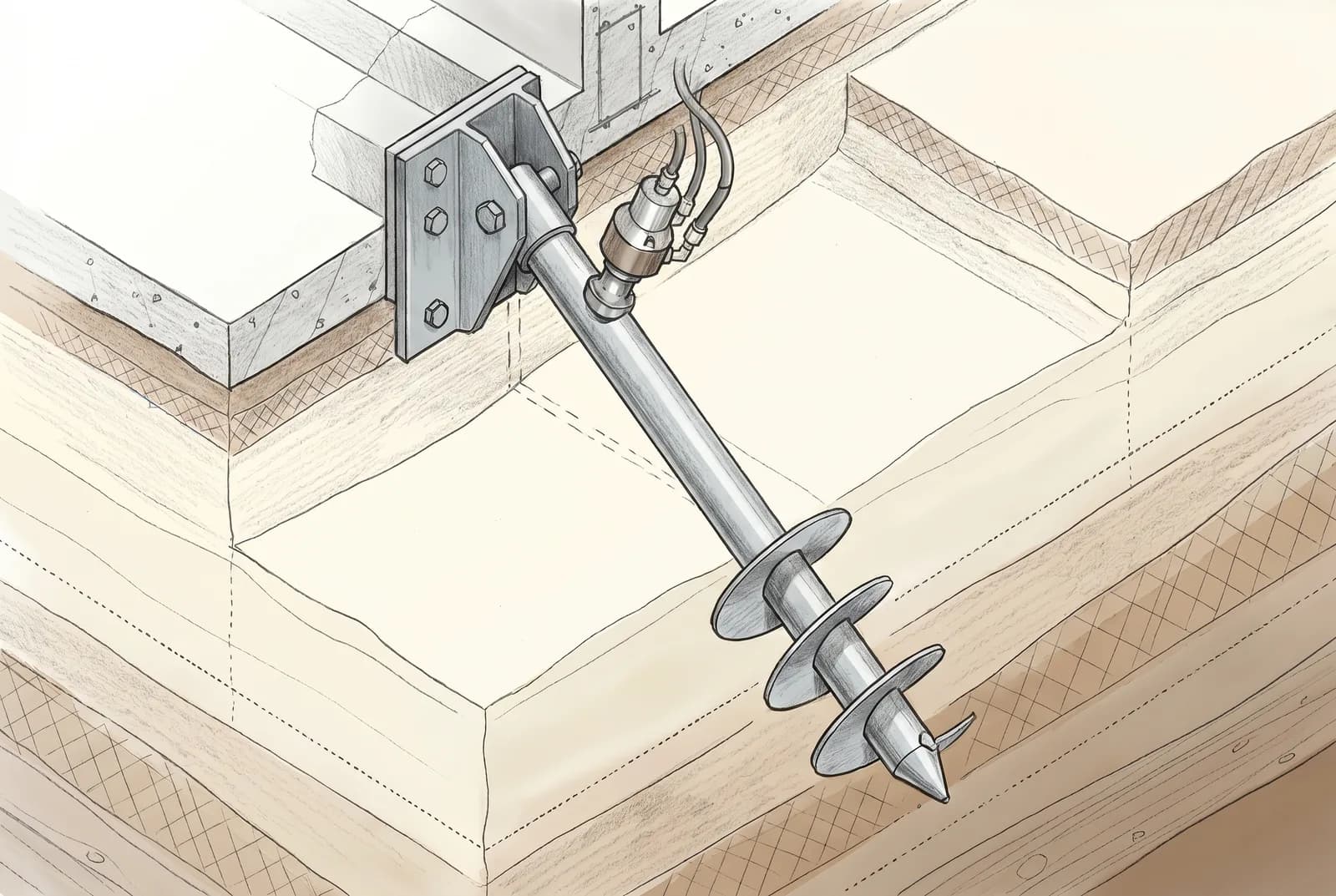
Components: Shaft, Helices, Termination Bracket, Coupling
Every helical pier system has four parts. Read them, and you can read a manufacturer's spec sheet.
- Shaft (lead section + extensions). Galvanized steel — either a round hollow tube (typical OD: 2-7/8", 3-1/2", 4-1/2") or a solid square bar (1-1/2", 1-3/4", 2-1/4"). Tube material typically conforms to ASTM A500 Grade C or ASTM A1085 (50 ksi min yield).
- Helices (plates / flights). Steel plates — typically 3/8" thick, 8"–14" diameter, 3" pitch — welded to the lead section. Single-helix leads carry one plate; multi-helix leads carry two to four, spaced roughly three plate-diameters apart so each helix bears in undisturbed soil.
- Termination bracket. The fitting that transfers load from the footing to the pier head. Underpinning brackets (offset, bolted to an existing footing) for retrofit; new-construction brackets (concentric, cast in) for new build. The bracket — not the shaft — is what makes a helical pier a foundation-repair component versus a generic anchor.
- Couplings. Bolted or pinned connectors joining each extension to the section below. Couplings must transmit both axial load and installation torque, which is why they're part of the AC358 testing regime.
Hot-dip galvanizing per ASTM A123 (shafts, plates) and ASTM A153 (bolts, hardware) is the standard corrosion protection. Soils flagged "corrosive" by AC358 (resistivity <1,000 ohm-cm, pH <5.5, sulfates >1,000 ppm) trigger thicker zinc, cathodic protection, or HDPE sleeves.
Round Shaft vs Square Shaft (When Each Wins)
Shaft choice isn't brand preference; it's a load case. Both are recognized under AC358 with manufacturer-specific Kt values, but they behave differently.
Square shaft (Type SS, solid bar) — Smaller OD (1-1/2", 1-3/4", 2-1/4" RCS), highest torque-to-capacity ratio. Per the Hubbell/CHANCE published Kt table, a 1-1/2" SS shaft has Kt = 10 ft⁻¹. Best for tension (tiebacks, guy anchors) and penetration through dense soil — small cross-section meets less resistance. Weakness: lower compression capacity than round, no annular section to resist bending, less corrosion margin.
Round shaft (HSS tube) — Larger OD (2-7/8", 3-1/2", 4-1/2"), better compression and lateral resistance. Kt drops with size: 2-7/8" = 9 ft⁻¹, 3-1/2" = 7 ft⁻¹, 4-1/2" = 6 ft⁻¹. Best for foundation underpinning where compression and lateral load dominate, and the higher demands of two-story or masonry-clad homes.
The engineering rule of thumb: square shaft for tension and torque-limited installs, round shaft for compression-dominated foundation repair. For most San Antonio residential underpinning, the workhorse spec is a 2-7/8" or 3-1/2" round shaft with multi-helix leads.
Helical Piers vs Steel Push Piers (Comparison Table)
This is the comparison homeowners face most often — and one almost every competing page refuses to write honestly. Both methods are legitimate, code-recognized deep foundation systems. They suit different conditions.
| Dimension | Helical Pier | Steel Push Pier |
|---|---|---|
| Best-fit soil | Sandy, soft, fill, expansive clay — anywhere torque correlates cleanly with capacity | Heavier soils with a clear, reachable bearing layer or bedrock |
| Typical depth (TX residential) | 12–25 ft (extensible to 100+ ft) | To refusal — can range from 15 ft to 80–100 ft in deep-bedrock regions |
| Capacity driver | Torque-to-capacity correlation (Qult = Kt × T), real-time-verified per AC358 | Building weight + hydraulic drive pressure as the pier is driven to refusal |
| Install equipment | Torque motor on skid-steer, mini-ex, or handheld frame (as little as 6 ft overhead) | Hydraulic ram + bracket — needs adequate structure weight as reaction |
| Typical cost per pier (TX, 2026) | $1,800–$3,500 installed | $1,500–$3,000 installed |
| Lateral / uplift resistance | High — helices resist both compression and uplift; round shaft adds bending capacity | Low — driven element relies on end bearing; minimal uplift capacity |
| Code & ESR compliance | IBC §1810.3.3.1.9 + AC358 + manufacturer ESR (e.g. ESR-2794, ESR-1854) | IBC §1810.3.2 + manufacturer ESR (e.g. ESR-4331 for Ram Jack driven) |
| Light-structure suitability | Excellent — torque motor supplies the drive force | Poor — may lift the structure before reaching competent strata |
| New construction | Yes — common spec for additions, decks, modular homes, solar arrays | No — requires existing structural weight to install |
| Side-by-side: helical pier vs steel push pier for residential underpinning in Texas. |
Clean decision rule: heavy home + reachable bearing layer = push piers, often cost-efficient. Lighter home, sandy or expansive soil, addition, or tight access = helicals win on engineering.
Helical Piers vs Concrete Pressed Pilings
In Dallas–Fort Worth, pressed concrete pilings ("pressed pilings") dominate the residential market because they're the cheapest deep-foundation option — typically ~$1,000 per pier installed versus $1,800–$3,500 for helicals. San Antonio sees them too. The cost gap is real; so is the engineering gap.
A pressed piling stacks pre-cast 6"-diameter × 12"-tall concrete cylinders hydraulically into the ground, using the home's weight as reaction, until refusal. Depth is typically 10–20 ft — sometimes shallower if the cylinders refuse on an unseen rock, root, or obstruction. Per the Association of Drilled Shaft Contractors (ADSC), heave and performance problems have been documented in pressed-pile installations in Dallas-area expansive clay, particularly where cylinders fail to clear the active moisture zone.
Honest summary: pressed pilings are an economic choice on light-to-moderate loads in well-understood soils, not an engineering choice. Helicals cost more because they buy you torque-verified capacity, a code-recognized acceptance criterion, an ESR-backed system, and a documented depth per shaft. The price difference reflects exactly what you give up in verification.
Installation Process: 7-Step Sequence with Torque Verification
A residential helical pier install follows a tight sequence. Each step has an engineering checkpoint — the questions an independent PE will ask if asked to certify the work later.
- Pre-install: engineer's plan and utility locate. Sealed PE drawings show pier locations, target torque, expected depth, helix configuration, and bracket type. Call 811 for a public-utility locate. GPR scan if the slab is post-tensioned.
- Excavate to footing. A 3-ft-square hole is dug at each marked location to expose the footing bottom. For interior piers, a slab section is cut out — or the crew tunnels in from outside, leaving the slab intact.
- Position drive motor and lead section. The torque motor (Kelly bar on a skid-steer or excavator, or a handheld frame for restricted access) is positioned and the lead helix started.
- Advance the pier; add extensions. The motor rotates the shaft; 5–7 ft extensions are coupled on as the pile descends. Torque is logged every 6 in to 1 ft of depth.
- Reach target torque. Per the sealed plan, the pile advances until final installation torque (T) matches or exceeds the target — set to deliver Qall = (Kt × T) / 2.0 ≥ design load. Depth is logged.
- Cut to height; install bracket. Shaft is cut to elevation, the underpinning bracket is bolted to the head and seated under the footing.
- Lift (or stabilize) and transfer load. Hydraulic jacks on all piers lift in unison if a lift is specified, then the bracket is secured. The contractor turns over: torque logs per pier, depth per pier, bracket model, and the engineer's final acceptance letter.
The torque logs are the load-test evidence for the job. Ask for them in writing as a contract deliverable.
Load Capacity: Torque-to-Capacity Correlation (Kt Factors)
The published Hubbell/CHANCE Kt values, codified in ICC-ES ESR-2794 and aligned with AC358, are the working numbers most engineers use:
| Shaft type & size | Kt (ft⁻¹) | Notes |
|---|---|---|
| Type SS square, 1-1/2" | 10 | Highest torque-to-capacity ratio; favored for tension and dense penetration |
| Type SS square, 1-3/4" | 9 | Intermediate |
| Round, 2-7/8" OD | 9 | Workhorse foundation-repair shaft for typical residential loads |
| Round, 3-1/2" OD | 7 | Heavier loads, two-story masonry homes, larger footings |
| Round, 4-1/2" OD | 6 | Commercial loads, deep installs, post-tension slab corners |
A worked example: a 2-7/8" round-shaft pier (Kt = 9 ft⁻¹) reaches 8,000 ft-lb of final installation torque. Qult = 9 × 8,000 = 72,000 lb (72 kip). Allowable at FS = 2.0 = 36 kip. If design load per pier is 30 kip, the pile passes with margin. If it's 40 kip, the engineer either raises the torque target, specifies a 3-1/2" shaft with multi-helix leads, or adds a pier — documented on the torque log, not assumed.
Subtlety worth knowing: before AC358 (2007), industry practice used Kt = 10 ft⁻¹ for all square shafts regardless of size. AC358 was the first time a code agency specified default Kt values across five shaft sizes — meaning quotes from older or non-ESR-listed systems can systematically overstate capacity. If a quote doesn't cite the ESR and the Kt used, ask why.
Soil Suitability Matrix: Where Helicals Excel and Fail
Per ASCE Texas Section Foundation Design Guidelines v3, soil controls method selection more than any other variable. Helicals span more soil types than any other underpinning method — but they aren't universal.
| Soil type | Verdict | Engineer notes |
|---|---|---|
| Expansive clay (San Antonio, DFW, Houston Gulf Coast) | Strong fit | Helices must seat below the active moisture zone — typically 8–15 ft in South Central TX. Multi-helix leads spread bearing across a larger area to reduce settlement risk. |
| Loose sand / silty sand | Strong fit | Torque correlation is well-behaved in granular soils; push piers struggle here because building weight may not develop enough reaction. |
| Silt and silt-rich glacial till | Good fit | Behaves predictably; design Kt as published. Watch for moisture-sensitive layers and seasonal water tables. |
| Engineered or uncontrolled fill | Good fit (with caution) | Common default solution where push piers can't develop reaction. Verify the lead helix penetrates fully into native soil below the fill — a boring log is essentially required. |
| Karst / fissured limestone (Hill Country edges of Bexar County) | Conditional — needs geotech | Voids and seam-controlled refusal can give false-high torque readings. A geotech investigation (CPT or SPT borings) and likely a static load test per ASTM D1143 are the engineering response. |
| Cobbly / bouldery glacial outwash, rocky fill | Poor fit | Helices can deflect, snap couplings, or stop on a single boulder reading false high torque. Drilled or driven systems usually serve better. If helical is still chosen, expect refusal logs and pier relocations. |
| Organic / peaty soils | Poor fit | No competent bearing within reach. Method selection should pivot to deeper micropiles, full underpinning, or geotechnical soil improvement. |
| Corrosive soils (low resistivity, low pH, high sulfates) | Conditional — needs corrosion protection | Per AC358 thresholds. Standard hot-dip galvanizing is not sufficient; spec must add cathodic protection, HDPE sleeves, or upgraded zinc thickness. |
| Soil-suitability matrix for residential helical piers. Verdicts assume a sealed PE design and torque-verified install. |
Engineering Standards & Code Compliance (AC358, IBC, IRC, ASTM)
Helical piers are one of the few underpinning methods that sit cleanly inside the model code framework. A homeowner doesn't need to read these documents — but a contractor's quote should cite them, and the PE's design should reference them by section.
- ICC-ES AC358 — Acceptance Criteria for Helical Foundation Systems and Devices. Approved June 2007 (based on the 2006 IBC), revised most recently September 2017 with Appendix A added for residential retrofit and high-seismic. Defines the torque-to-capacity method, default Kt values across five shaft sizes, load-test requirements, and corrosivity thresholds.
- IBC 2024 §1810 — Deep Foundations. §1810.3.2.4 governs design loads. §1810.3.3.1.9 recognizes the three helical pile capacity methods: theoretical soil-bearing calculation, torque correlation, and full-scale load test. Per Hubbell/CHANCE guidance, at least two should be used; torque correlation alone calls for FS ≥ 2.5.
- IRC 2024 §R403.1.7 — Alternative Footing Systems. The pathway most residential installs travel for code approval. Requires AHJ acceptance and an engineer-sealed design.
- ASTM A500 Grade C / A1085 — Cold-formed welded carbon steel HSS; round-shaft tube spec (50 ksi min yield).
- ASTM A123 / A153 — Hot-dip zinc coatings on iron and steel; corrosion-protection spec for shafts, plates, and hardware.
- ASTM D1143 / D3689 — Static axial compressive / tensile load tests on deep foundation elements. The full-scale load test recognized by IBC §1810.3.3.1.9.
- ASCE/SEI 7-22 — Minimum Design Loads and Associated Criteria. The demand side of the design equation.
A quote that says "code compliant" without citing AC358 and a manufacturer ESR number is marketing copy, not an engineering statement.
Cost Per Pier and Typical Project Totals (2026 Pricing)
In Texas, 2026 installed pricing for residential helical piers runs $1,800–$3,500 per pier all-in. Variance comes from depth, access, and the specific bracket and shaft size. For regional ranges, see our per-pier cost breakdown and the cost calculator.
| Cost component | Typical range | Notes |
|---|---|---|
| Per-pier installed (2-7/8" round, single helix, ≤15 ft) | $1,800–$2,400 | Baseline residential spec |
| Per-pier installed (3-1/2" round, multi-helix, ≤20 ft) | $2,400–$3,200 | Two-story or masonry-clad homes |
| Per-pier installed (4-1/2" round, deep / commercial) | $3,200–$4,500 | Less common in residential |
| Depth surcharge past contracted depth | $20–$40 / ft | Negotiate a "no-depth-clause" or capped surcharge |
| Engineer's report + sealed letter | $500–$1,500 | Independent of contractor; required for permit in most jurisdictions |
| Permit (City of San Antonio / Bexar County) | $200–$900 | Higher with more piers |
| Interior pier via tunneling | +$1,500–$3,000 per tunnel | When break-out of slab is undesirable |
| Hydrostatic plumbing test (pre + post) | $250–$500 each | Strongly recommended on slab homes |
A typical Texas project of 8–14 piers totals $15,000–$30,000. Heavier two-story masonry-clad homes can reach $35,000–$45,000. The most common bill surprise is depth overrun — which is why the per-foot surcharge clause matters more than the headline per-pier price. For a vetted local specialist, see our SA-specific helical piers page.
Top Manufacturer Systems & ESR Cross-Reference (CHANCE, Ram Jack, ECP, Magnum)
When a contractor proposes helical piers, the system should be backed by a current ICC-ES Evaluation Service Report (ESR) — independent third-party verification of IBC and AC358 compliance, including allowable load capacities and conditions of use. ESRs require quarterly QA audits. A system without a current ESR isn't necessarily defective, but it doesn't ride the code-recognition pathway — and many municipalities and warranties require ESR-listed product.
| Manufacturer | System | ICC-ES ESR | Notes |
|---|---|---|---|
| Hubbell / CHANCE | Helical Piles | ESR-2794 | The legacy A.B. Chance product line; published the original Kt tables. |
| Ram Jack | Helical Pile System | ESR-1854 | Per Ram Jack, the first helical manufacturer to receive an ESR (Feb 1, 2011). |
| Ram Jack | Driven (push) Pile System | ESR-4331 | Separate report for the push-pier line. |
| Earth Contact Products (ECP) | Helical Pile System | ESR-3032 | Widely specified in the Midwest and Texas. |
| Magnum Piering | Helical Pile System | ESR-2701 | Round and square shaft offerings under common AC358 evaluation. |
| PierTech | Helical Pile System | ESR-3969 | Round-shaft system referenced on the company's product pages. |
Two practical tests for a homeowner: ask for the ESR number on the system, then look it up at icc-es.org/report-listing to confirm it's current. A quote that says "CHANCE-equivalent" or "premium helical system" without an ESR number is borrowing reputation without citing it. For a closer look at one of the largest Texas-active contractors, see our Ram Jack contractor profile.
Warranty, Lifespan & Corrosion Protection (HDG, Cathodic, Sleeves)
A correctly installed helical pier with hot-dip galvanizing per ASTM A123 is engineered for decades of service. Hubbell/CHANCE documents service life exceeding 50 years (defined as loss of zinc coating plus ~10% steel substrate) in most soils, and roughly 150 years for galvanized shafts in non-corrosive ground — meaning service life is a non-issue at any reasonable residential horizon.
What you actually want to read in a warranty:
- Lifetime, transferable, system warranty. Industry-standard for manufacturer-certified installers. Transferability matters at resale.
- No arbitration clause (or right to opt out). Some warranties bury mandatory binding arbitration. Read it.
- Tied to a permitted, sealed-engineer installation. A warranty voided by missing permits or contractor deviation from the engineer's design is functionally worthless.
- Defined exclusions for corrosive soils. If AC358 corrosivity flagged the site, the warranty must acknowledge upgraded protection or carve out coverage explicitly.
Corrosion protection options above baseline galvanizing: heavy-duty hot-dip galvanizing (thicker zinc per ASTM A123 Class), cathodic protection (sacrificial zinc or magnesium anodes bonded to the shaft), HDPE sleeves over the upper corrosive zone, and — most important — soil testing for resistivity, pH, sulfates, and chlorides per AC358 thresholds before install. Protection options are the response; soil testing is the diagnosis. For a broader comparison across pier systems, see our warranties guide.
FAQ Note
The FAQ below covers the questions San Antonio homeowners ask most often after a first contractor visit — permits, capacity, soil failure modes, depth in expansive clay, and insurance coverage. For a structured second opinion before signing, start with an engineer's report or read about the signs of a sinking foundation.
Get Matched With a Vetted San Antonio Helical Pier Specialist
If your independent engineer has spec'd helical piers — or your inspector used the words and you want a PE-led second opinion before committing — we'll match you with a vetted San Antonio foundation specialist who can install to the engineer's design. The match is free, the quote is no-obligation, and we don't take a fee from you. We screen for current AC358-listed systems, sealed-engineer compliance, lifetime transferable warranties, and a clean Bexar County permit record. If a quote doesn't fit the engineering, we'll tell you. That's the only way an editorial matching service should work.
Frequently asked questions
10 questionsAre helical piers permanent?
Helical piers vs steel push piers — which is better?
Do helical piers require permits?
Can helical piers be installed in a finished home?
What load capacity can a helical pier actually carry?
What soil conditions cause helical piers to fail?
How deep do helical piers go in San Antonio expansive clay?
Can I install helical piers myself?
How long does a helical pier installation take?
Does homeowners insurance cover helical pier repair?
Related guides
- Methods/foundation-repair/methods
- Steel Push Piers/foundation-repair/methods/steel-push-piers
- Concrete Pressed Pilings/foundation-repair/methods/concrete-pressed-pilings
- Foundation Piers/foundation-repair/methods/foundation-piers
- Per Pier/foundation-repair/cost/per-pier
- Engineer Report/foundation-repair/diagnosis/engineer-report
- Sinking Foundation/foundation-repair/signs/sinking-foundation
- Ram Jack/foundation-repair/contractors/ram-jack
- Warranties/foundation-repair/warranties
- Services/san-antonio/services
Sources
- [1]ICC-ES AC358 — Acceptance Criteria for Helical Foundation Systems and Devices
- [2]IBC 2024 §1810.3.2.4 — Deep Foundations Design Loads
- [3]IBC 2024 §1810.3.3.1.9 — Helical Pile Capacity Methods
- [4]IRC 2024 §R403.1.7 — Alternative Footing Systems
- [5]ASTM A500 / A1085 — Cold-Formed Welded Carbon Steel Hollow Structural Sections
- [6]ASTM A123 / A153 — Hot-Dip Zinc (Galvanized) Coatings on Steel
- [7]ASTM D1143 / D3689 — Static Axial Compressive / Tensile Load Testing of Deep Foundations
- [8]ASCE/SEI 7-22 — Minimum Design Loads and Associated Criteria for Buildings
- [9]ASCE Texas Section, Foundation Design Guidelines v3 (2022)
- [10]Hoyt & Clemence (1989) — Uplift Capacity of Helical Anchors in Soil, 12th ICSMFE
- [11]ICC-ES ESR-2794 — Hubbell/CHANCE Helical Pile System
- [12]ICC-ES ESR-1854 — Ram Jack Helical Pile System
- [13]ICC-ES ESR-3032 — Earth Contact Products (ECP) Helical Pile System
- [14]ICC-ES ESR-2701 — Magnum Piering Helical Pile System