If you searched "foundation repair" today, you probably saw a wall of contractor ads and a national average price somewhere around five thousand dollars — with no obvious way to tell whether your house actually needs the work, or how to keep from getting sold the most expensive version of it.
This guide is the long version of the answer. It's written for Texas homeowners, reviewed against published engineering standards, and citation-led. It hubs out to every other page on the site — methods, costs, signs, causes, insurance, prevention — so you can drill into whatever applies to your house and skim the rest.
The bottom line, up front:
- The American Society of Civil Engineers estimates one in four U.S. homes has some damage caused by expansive soils, which cause greater cumulative financial loss to property owners in a typical year than earthquakes, floods, hurricanes, and tornadoes combined. Texas sits on some of the worst expansive clay in the country.
- The 2026 national average foundation repair project is about $5,179 (This Old House), with a typical range of $2,225–$8,133. Real underpinning jobs — the kind that fix structural movement — run $9,000–$30,000 on a typical San Antonio slab home, and $20,000–$80,000 for full perimeter underpinning on the worst cases.
- The single biggest decision you make is engineer first, contractor second. Hire an independent Professional Engineer (PE) to diagnose the movement and specify the repair before you take a single contractor's "free inspection." Diagnosis is the practice of engineering — not contracting. A contractor paid on commission and asked to diagnose his own scope of work is being asked to do something the Texas Board of Professional Engineers reserves for licensed PEs.
The rest of this guide tells you how to do that, what your options are, what each one costs, what insurance actually covers in Texas, and what to do today if you think your house is moving.
1. What is foundation repair? (the bottom line)
"Foundation repair" is shorthand for any structural intervention that stops or corrects movement in the foundation system of a building. In residential practice in 2026, it covers nine distinct procedures that share the label but differ enormously in engineering, cost, and permanence:
- Steel push piers — hydraulically driven steel pipe to refusal on bedrock or competent strata.
- Helical piers — torque-set steel screw piles.
- Concrete pressed pilings and drilled bell-bottom piers — the historical Texas methods.
- Mudjacking / slab jacking — cement-slurry slab leveling for flatwork.
- Polyurethane foam injection — expanding-foam slab leveling and void fill.
- Wall anchors, helical tiebacks, and carbon-fiber straps — for bowing or leaning basement walls.
- Crack injection — epoxy for structural dry cracks, polyurethane for active leaks.
- Soil stabilization / chemical grouting — permeation and compaction grouts that strengthen the soil itself.
- Root barriers and moisture management — the preventive layer that keeps any repair durable in expansive clay.
The methods that engineers and manufacturers consistently call permanent are the deep underpinning methods — push piers, helical piers, and drilled bell-bottom piers — because they transfer the building's load past the unstable near-surface soil to a stronger layer beneath. Mudjacking, foam, pressed pilings, and crack repair are valid but condition-specific. They have their place, but they're not what fixes structural settlement.
The right method for your home depends on four variables, in this order:
- Your soil profile — expansive clay, sand, fill, or organics — and the depth to competent bearing.
- Your foundation type — slab-on-grade, pier-and-beam, or basement.
- The weight of your structure — heavy homes can drive push piers; light homes need helical.
- The severity and type of distress — settlement vs. lateral wall movement vs. crack vs. void.
Not which product a contractor markets. We'll come back to this; it's the single most expensive trap in the industry. For the full method-by-method breakdown, see our repair methods pillar.
2. Do you actually need foundation repair?
This is the question every other question depends on, and most homeowners answer it with their eyes — sticking door, hairline crack, marble that rolls across the kitchen — when the right answer is a measurement.
The measurement is an elevation survey, also called a manometer or zip-level survey. A surveyor maps the relative elevations of points on your floor with a water-level instrument accurate to about a tenth of an inch, then plots the result as a contour map of differential settlement. Slab homes are generally considered out of tolerance beyond roughly 1 to 1.5 inches of differential across the floor plan. Below that threshold, you may have cosmetic distress (cracks, sticking doors) without any need for structural intervention. Above it, you have a problem that won't get better on its own.
The cheapest, highest-leverage thing a Texas homeowner can do for their foundation is to get a baseline elevation survey at the time of purchase and repeat it every three years thereafter (covering at least one wet, one drought, and one normal year). A baseline tells future-you, and future contractors, what's actually new and what was there the day you moved in. It prevents both unnecessary repairs and missed early movement. Budget $300–$800 for the survey on a standard home.
Visual signs still matter — they're how you know it's time to call an engineer. See the next section.
3. The 5 most common signs of foundation problems
Most homes with active movement show some combination of these five. None is conclusive on its own; the pattern matters. For the full diagnostic decision tree, see our signs pillar.
1. Diagonal cracks at door and window corners. Drywall cracks that start at the upper corners of door or window openings and run diagonally toward the ceiling are the single most common sign of differential settlement. Vertical cracks are far less diagnostic — most are seasonal. Stair-step cracks in brick veneer along the same diagonal vector tell you the movement has propagated into the cladding. See our cracks pillar for how to read them.
2. Sticking doors and windows. Interior doors that suddenly need trimming, exterior doors that have to be muscled past the strike plate, windows that won't close — when these change quickly (over months, not years), the frame is racking because the structure underneath is moving.
3. Sloping floors you can feel. Lay a marble down. If it rolls, you have detectable slope. A four-foot level on the floor will tell you quickly whether the slope exceeds half an inch — at which point you should commission an elevation survey before anything else.
4. Gaps at baseboards, crown molding, and exterior trim. When finishes pull away from walls or ceilings — a quarter-inch gap appearing along a baseboard, a triangular separation at the top of a crown molding run — the framing has moved relative to the finish carpentry.
5. Exterior signs: stair-step cracks in brick, separation at the brick-to-mortar joint near corners, gaps between brick and window frames, and chimneys leaning away from the house. A leaning chimney is one of the most diagnostic exterior signs because a chimney is usually a separate foundation element; differential movement between the chimney pad and the main slab is hard to mistake.
What's not a foundation problem, despite the panic it causes:
- Drywall nail pops — almost always thermal expansion of framing lumber, not movement.
- Hairline cracks that haven't grown. A hairline crack under one-sixteenth of an inch, with no displacement (the two faces of the crack are still flush), no active water, and no progression over a season is usually cosmetic.
- A gap that appears between the ceiling and an interior wall in winter and closes in summer. This is truss uplift — a seasonal humidity-driven phenomenon of engineered roof trusses, not foundation movement.
4. Why foundations move: expansive clay, drought, plumbing, drainage
In Texas, four causes account for the overwhelming majority of residential foundation movement. For the deep dive, see our causes pillar.
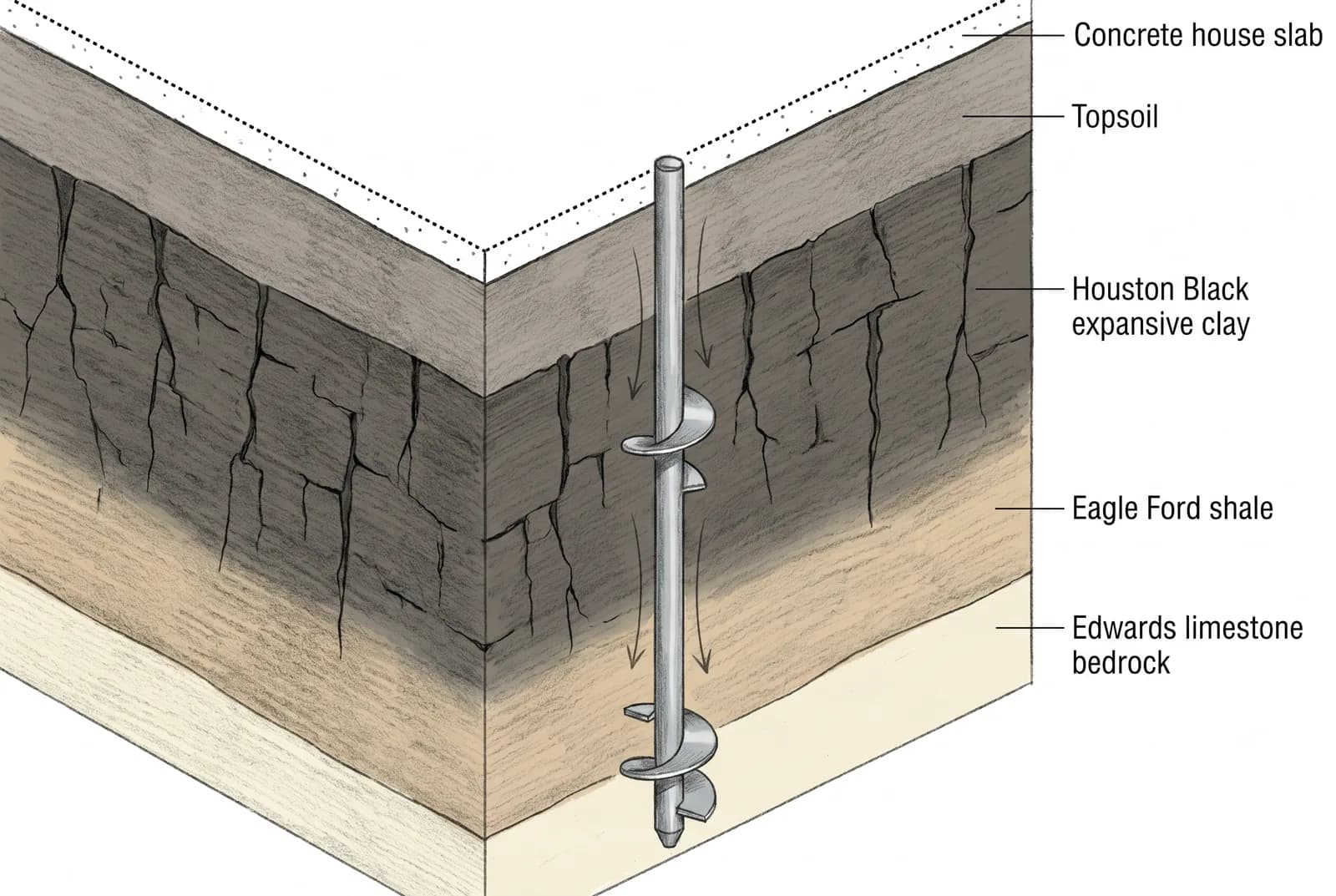
Expansive clay (the dominant Texas cause)
San Antonio, Austin, Dallas, Houston, and most of the I-35 corridor sit on high-plasticity clay — soils with plasticity indices above 20 and large fractions of montmorillonite minerals. The minerals' crystal structure absorbs water between layers. Wet clay swells; dry clay shrinks. Over a typical Texas year — wet spring, drought-summer — a clay subgrade can move vertically by several inches.
The International Building Code defines expansive soil by four criteria (IBC 2024 §1803.5.3): a Plasticity Index of at least 15, more than 10% passing the No. 200 sieve, more than 10% finer than 5 microns, and an Expansion Index above 20. South Texas clays meet all four routinely.
The engineering response is to anchor the foundation below the active zone — the depth to which seasonal moisture penetrates, typically 6–12 feet — into a layer that doesn't swell. That's the entire reason the deep methods (helical, push, and bell-bottom piers) work in Texas and the shallow methods don't last. See our expansive clay deep dive.
Drought and moisture imbalance
Foundations fail in drought, not just in wet years. In a 2011-style drought, the active-zone clay shrinks more than seasonal cycles predict, and shrinkage is uneven — usually worst on the south and west exposures because they bake longer. Asymmetric shrinkage is what produces differential settlement, which is what cracks foundations. A drought that takes one corner of the house down two inches while the rest stays put is a foundation emergency.
The prevention answer in expansive clay is to maintain consistent perimeter moisture year-round — soaker hoses two to three feet from the foundation, proper grading, gutter extensions — so the clay never fully dries out. See prevention.
Plumbing leaks under the slab
Sub-slab supply leaks and drain leaks are the second most common cause of foundation movement in Texas, and the only one that's sometimes insurable. A pinhole copper-line leak under a slab discharges hundreds of gallons a month into the bearing soil; the clay swells locally, lifts the slab in one spot, and cracks it. A failed cast-iron drain does the opposite — the soil washes out into the line, creating voids beneath the slab. Either way the slab moves. See our slab leaks pillar for detection methods and the insurance angle.
Drainage and tree roots
Negative grading toward the foundation, downspouts dumping at the slab edge, and large trees within 1.5 times their mature height of the slab — all are correctable preventive issues. Trees draw hundreds of gallons per day in summer; roots extend 1.5–2.5 times tree height, and even when roots aren't under the slab, the moisture gradient pulls clay water toward the tree and dries the subgrade under the foundation. Root barriers — vertical HDPE membranes installed at least three feet deep between tree and foundation — are the standard mitigation.
5. How an engineer diagnoses a foundation problem
This is the section the industry would prefer you skip, because the independent engineer workflow is the consumer-protection moat against oversold repairs. Here's the actual sequence.
-
Visual assessment. Walk-through documenting cracks (width, orientation, location, photographed with a scale), sticking doors, sloping floors, exterior brick patterns, downspout and grading conditions, tree proximities, and visible signs of plumbing intrusion.
-
Elevation survey. Manometer or zip-level mapping of relative floor elevations across the plan, typically at 5–10 foot spacing. The output is a contour map of differential settlement that defines the affected area and the magnitude of the problem. A floor plan with less than 1 inch of differential and stable cracks may need only monitoring and crack sealing — not piers.
-
Geotechnical input when warranted. For severe movement or ambiguous cases, soil borings with Standard Penetration Test N-values (ASTM D1586) or cone penetrometer logs establish the soil profile, the depth to competent bearing, and the expansion indices. Geotechnical fees: $1,800–$6,000.
-
Structural assessment. A licensed PE reviews movement data, load paths, observed distress, and structural geometry to determine whether stabilization, partial underpinning, or full underpinning is warranted, where the pier locations should be, and what target depths to specify.
-
Sealed Engineer-of-Record letter and pier plan. In Texas, this is the document the building department typically requires at permit — and the document you bid out to contractors. It specifies the method, pier count, locations, target depth, capacity, and any conditions (such as required pre- and post-repair plumbing tests).
The structural assessment fee in San Antonio runs typically $500–$1,500 for a residential elevation survey and report. Versus a $15,000 underpinning project, that's the highest-ROI thousand dollars a homeowner ever spends — and it removes the conflict-of-interest that exists when the company diagnosing your problem also profits from the solution. See our engineer report guide.
6. Repair methods at a glance
The full method-by-method comparison lives in our methods pillar. This table is the 30-second summary.
| Method | Best for | Typical unit cost | Typical project total | DIY? | Permanent? |
|---|---|---|---|---|---|
| Steel push piers | Heavier slab/basement homes, reachable bedrock | $1,500–$3,000 per pier | $9,000–$25,000 | No | Yes |
| Helical piers | Lighter homes, sandy/clay soils, limited access | $1,800–$3,500 per pier | $10,000–$30,000 | No | Yes |
| Bell-bottom piers (drilled) | Expansive clay, long-term stability in TX | $1,200–$2,500 per pier | $8,000–$20,000 | No | Yes |
| Pressed concrete pilings | Budget slab repair (most common in DFW) | ~$1,000 per pier | $5,000–$15,000 | No | Semi-durable |
| Slab jacking / mudjacking | Flatwork — driveways, patios, garage floors | $3–$6 per sq ft | $500–$2,500 | No | Several years |
| Polyurethane foam injection | Slab leveling, void fill, soil densification | $5–$25 per sq ft | $2,500–$8,000 | No | 20+ years |
| Wall anchors | Basement walls bowing >2 in., yard access | $400–$700 each | $5,000–$15,000 | No | Yes (stabilizes) |
| Carbon-fiber straps | Basement walls bowing ≤2 in., no shear | $350–$1,000 per strap | $3,000–$8,000 | No | Yes (arrests) |
| Epoxy crack injection | Structural dry cracks in poured concrete | $250–$1,500 per crack | $500–$3,000 | Light DIY possible | Yes |
| Polyurethane crack injection | Active leaking cracks (waterproofing) | $250–$1,500 per crack | $500–$3,000 | Light DIY possible | Yes (seal) |
A few things this table won't say out loud:
- Pressed concrete pilings are the cheapest underpinning method and the most common in Dallas–Fort Worth. They reach refusal at variable depths because the depth depends on soil moisture on installation day, and the segments can skew or crack on hidden obstructions without anyone knowing. The Association of Drilled Shaft Contractors has documented performance issues with pressed piles in Dallas-area expansive clay. If a contractor's only method is pressed concrete, that's a signal to bid the work elsewhere too.
- "Lifetime transferable warranty" is the marketing claim that signals real engineering confidence in deep underpinning — it's standard on steel push and helical pier work and rare on pressed concrete. Read the warranty language; arbitration clauses and exclusion lists matter.
- Mudjacking and foam are not foundation repair in the structural sense. They lift slabs back to level by filling voids — but they don't address the soil that created the void in the first place. They're the right tool for driveway and pool-deck leveling. They are not the right tool for a home with active settlement.
7. How much does foundation repair cost?
For the long version with regional and method-by-method breakdowns, see our cost pillar.
The current national-average benchmarks:
- $5,179 — 2026 national average for residential foundation repair, per This Old House.
- $2,225–$8,133 — typical project range, per HomeAdvisor 2025 data.
- $5,160 — Angi's 2025 national average, corroborating the same band.
Those averages mix every job type, from a $400 crack injection to a $60,000 full underpinning, so they're useful for context but not for planning. The more honest planning bands:
- Cosmetic crack injection — $250–$1,500 per crack; $500–$3,000 per project.
- Partial underpinning (3–10 piers on one wall or corner) — $5,000–$20,000.
- Typical perimeter underpinning on a San Antonio slab home — $9,000–$25,000 depending on method and pier count.
- Full underpinning (entire perimeter plus interior piers, 20–40 piers) — $20,000–$80,000.
- Slab leveling for flatwork — $500–$2,500 mudjacking; $2,500–$8,000 foam.
Texas-specific cost drivers: depth surcharges (most pressed-piling and helical contracts charge $20–$25 per extra foot past contracted depth), engineer fees ($500–$1,500), permit fees ($200–$3,500 by jurisdiction), plumbing testing before and after lift ($350–$800 per test), and landscaping restoration. Budget 10–15% above the contracted pier price for these line items.
What's almost never in the base contract: interior cosmetic crack patching and drywall repair (often excluded because the cracks may shift again during lift), plumbing repair if the lift damages a line, and any moisture-management work (root barriers, soaker hoses, gutter extensions). Get the exclusions in writing before you sign. See financing options if the number is more than you can absorb out of pocket.
8. Pier-and-beam vs slab: how each is repaired
Slab-on-grade homes dominate San Antonio post-1970 construction. Older neighborhoods — Monte Vista, Alamo Heights, parts of Olmos Park, Beacon Hill — are heavily pier-and-beam. They fail differently and they're repaired differently.
Slab-on-grade foundations are a single reinforced concrete pad poured directly on prepared soil. When they move, the entire slab rotates and bends; cracks appear in the slab itself, in the brick veneer, and in interior finishes. Repair means installing piers along the affected perimeter (and sometimes interior piers through slab break-outs or under-slab tunnels), then lifting the slab back toward level in unison. Pier spacing is typically 6–8 feet along the affected lines. Plumbing under the slab is the major collateral-damage risk during lift — about 1 in 4 slab homes need some plumbing repair afterward, which is why pre- and post-lift hydrostatic testing is the standard.
Pier-and-beam (or crawl-space) foundations rest on perimeter masonry or concrete walls and a grid of interior piers, with wood floor framing above. The crawl space is accessible; that's a feature, not a bug. Re-leveling a pier-and-beam home usually means shimming or adjusting the existing interior piers — far less invasive than slab repair. Perimeter underpinning (drilled or helical piers tied into the perimeter beam) is added where the exterior wall has settled. Rotted or warped wood beams and joists are sistered or replaced as needed. In expansive-clay areas, periodic re-leveling — typically every two to four years — is normal maintenance, not a sign of failure. Crawl-space ventilation, vapor barriers, and encapsulation are part of the long-term story; see our pier-and-beam pillar and our crawl-space guide.
9. Crawl spaces and vapor barriers
When a pier-and-beam home shows sagging floors, the problem is often not the foundation — it's the crawl space. Saturated ground beneath the crawl rots floor joists and beams, supports mold colonies, drives indoor humidity above 60% (where dust mites and mold thrive), and accelerates decay of the very piers that hold the house up. Visible standing water, white efflorescence on masonry piers, rust on metal piers and ductwork, and a musty smell on the first floor are the standard tells.
The repair stack — sequenced cheapest to most invasive:
- Grading and drainage outside the perimeter first, so surface water stops entering the crawl.
- A 6-mil to 20-mil polyethylene vapor barrier over the dirt floor, lapped up the perimeter masonry, sealed at seams.
- Powered crawl-space ventilation or full encapsulation (closed-cell foam insulation on the inside of the perimeter wall, dehumidifier inside) for severe moisture or radon cases.
- Pier and beam structural work — replacement of rotted members and adjustment of existing supports.
See our crawl-space pillar for the full breakdown including the high-volume vapor-barrier product comparisons.
10. Foundation repair and insurance
This is the single most misunderstood part of the homeowner side of foundation repair, and it's an expensive misunderstanding. For the long version see our insurance pillar.
The short version, accurate as of the 2026 ISO forms:
- Standard HO-3 and HO-5 homeowners policies exclude damage caused by earth movement, settling of the foundation, expansion or contraction of soils, hydrostatic pressure, and most defects of design or workmanship. This excludes the great majority of Texas foundation claims by cause.
- The narrow covered case is sudden, accidental damage from a covered peril — most commonly a sudden burst of a supply line or a covered plumbing failure that damages the slab. Standard policies often cover the tear-out and access to repair the leak itself, but may exclude the cost to repair the resulting foundation movement. Read your specific policy.
- Texas-specific endorsement HO-143TX extends some coverage for foundation damage caused by water from a leaking plumbing system. Many Texas insurers offer it; ask explicitly.
- You almost never get sympathetic treatment from the adjuster without an engineering report. A sealed PE letter establishing cause, mechanism, and scope is the single most important document in a Texas foundation insurance claim.
This is why the engineer-first workflow isn't just a quality control — it's an insurance access tool when the cause is insurable.
11. Is foundation repair permanent?
The honest answer is: it depends on the method, the soil, and the workmanship. The industry consensus, narrowly:
- Permanent. Steel push piers, helical piers, and properly executed drilled bell-bottom piers all transfer building load to competent bearing strata. Galvanized-steel pier service life is measured in many decades; hot-dip galvanizing per ASTM A123 is often cited at 75–150 years depending on soil corrosivity. Lifetime transferable warranties are standard.
- Permanent for the crack, not the cause. Epoxy structural crack injection welds the crack monolithically; the repaired crack will not reopen. But if the underlying movement continues, new cracks will appear elsewhere.
- Semi-durable / condition-dependent. Pressed concrete pilings (depth depends on installation-day moisture), mudjacking (slurry erodes and re-settles), and segmented or spot piers (too shallow to reach competent strata in most Texas soils).
- Durable for leveling, not curative. Polyurethane foam cited at 20+ years for slab leveling — it doesn't degrade. But it doesn't address the soil cause; if the soil moves again, the slab moves again.
The biggest predictor of long-term durability isn't the method — it's whether the underlying cause is also addressed. Underpinning a slab without correcting the failed sub-slab plumbing leak that caused the settlement guarantees the new piers will be sitting in saturated soil. Installing piers without gutters, grading, and consistent perimeter moisture in a drought-prone clay region guarantees the next active-zone cycle will move the rest of the house. The pier is the load path; the moisture management is the durability story.
For the full objection-handling on permanence and collateral damage, see our dedicated permanence page.
12. When to call an independent PE first
13. How to evaluate a contractor: 8 questions to ask
Once you have your engineer's specification, the contractor selection is much easier — they're all bidding the same scope. The questions to ask each:
- "Will you work to my engineer's spec?" Yes is the right answer. Any equivocation is a red flag.
- "Will you pull the permit, or expect me to?" Reputable contractors pull the permit themselves and include it in the contract.
- "What is your no-depth-clause price?" A no-depth-clause (or "depth-included") price means deeper-than-estimated piers don't trigger a change order. Insist on it for helical and pressed-piling work; otherwise depth surcharges of $20–$25 per extra foot can swell the bill.
- "Are your pier products ICC-ES listed? Can I see the active ESR number?" Push and helical pier systems should have an active Evaluation Service Report (e.g., Ram Jack ESR-3750, CHANCE ESR-2794, Magnum ESR-2701). No ESR means you can't verify the published load capacities.
- "What is your warranty? Is it transferable? Are there arbitration clauses?" Lifetime transferable is the standard for steel underpinning. Short warranties (5–10 years) are a signal of less confidence; arbitration clauses limit your recourse if the warranty is later denied.
- "Will you do a pre-lift and post-lift hydrostatic plumbing test, and is that test cost included?" It should be on any slab lift, given the 1-in-4 plumbing damage rate.
- "What's your scope for cosmetic and drywall repair?" Almost always excluded. Confirm in writing so it's not a surprise.
- "Can I see three references in my zip code from the last 12 months?" Local references matter more than testimonial reels.
For a full vetted vetting framework, see how to choose a foundation contractor.
14. Bottom line: what to do today
If you suspect your foundation is moving, the ordered, lowest-cost, highest-leverage sequence is:
-
Photograph the symptoms — every crack, every door that sticks, every sloping floor — with a scale (a ruler or coin) in frame and the date in metadata. Repeat every six months; the rate of change is the diagnostic data.
-
Lay a level on the worst floor. If you see more than half an inch of slope across four feet, escalate.
-
Walk the exterior. Note gutter downspouts dumping at the slab edge, negative grading, large trees within 1.5 times their height of the house, and visible signs of plumbing intrusion.
-
Commission an independent elevation survey and PE letter — $500–$1,500 in San Antonio. Even if the result is "monitor only," you now have a baseline. If it's structural, you have a neutral spec to bid against.
-
Correct the moisture story first if the PE recommends it — gutters, extensions, grading, soaker hoses, root barriers. These are the cheapest things you'll do, and they make every repair last longer.
-
Bid the PE's spec to three contractors. Use the 8 questions above to evaluate them.
-
Pull the permit, run the plumbing tests, do the work, verify the result. Save the binder — engineer's letter, permit, pier log, lift diary, plumbing tests, warranty — for resale.
If you're in San Antonio and want help running the matching step, that's what we built this site to do. We're not a contractor; we maintain a vetted list of licensed Texas PEs and underpinning specialists, and we'll match you to a starting point based on your zip code, foundation type, and visible symptoms. The matching is free; we're paid by the specialist on the back end only if you proceed. See San Antonio or jump straight to the free inspection request.
The full source list for the citations and stats in this guide appears at the bottom of the page. Anywhere you see a code, an ASTM standard, an ASCE document, or a price benchmark, it ties back to a primary source you can verify yourself.
15. Frequently asked questions
The most common follow-up questions — drawn from real Texas homeowner searches — are answered below. For deeper coverage, the linked pages go further on each topic.
Frequently asked questions
10 questionsHow do I know if I need foundation repair?
How much does foundation repair cost?
Is foundation repair permanent?
Will home insurance cover foundation repair?
Can foundation repair cause more damage?
How long does foundation repair take?
Can I sell a house with a repaired foundation?
What's the difference between pier-and-beam and slab?
Do I need a permit for foundation repair?
Should I get multiple quotes?
Related guides
- Signs/foundation-repair/signs
- Cracks/foundation-repair/cracks
- Causes/foundation-repair/causes
- Expansive Clay Soil/foundation-repair/causes/expansive-clay-soil
- Methods/foundation-repair/methods
- Helical Piers/foundation-repair/methods/helical-piers
- Steel Push Piers/foundation-repair/methods/steel-push-piers
- Cost/foundation-repair/cost
- Insurance/foundation-repair/insurance
- Financing/foundation-repair/financing
- Prevention/foundation-repair/prevention
- Pier And Beam/foundation-repair/pier-and-beam
- Crawl Space/foundation-repair/crawl-space
- Slab Leaks/foundation-repair/slab-leaks
- Engineer Report/foundation-repair/diagnosis/engineer-report
- San Antonio/san-antonio
Sources
- [1]American Society of Civil Engineers — Expansive Soils statistic (1 in 4 U.S. homes)
- [2]ASCE Texas Section, Foundation Design Guidelines for Expansive Soils v3 (2022)
- [3]International Building Code 2024, Chapter 18 §1810 — Deep Foundations
- [4]International Residential Code 2024, Chapter 4 §R403 — Footings
- [5]ICC-ES AC358 — Acceptance Criteria for Helical Foundation Systems and Devices
- [6]This Old House — 2026 Foundation Repair Cost Report ($5,179 national average)
- [7]Insurance Information Institute — Standard Homeowners Policy Forms (HO-3 / HO-5)
- [8]USDA Natural Resources Conservation Service — Web Soil Survey