A pier and beam foundation lifts your home off the ground on a grid of concrete piers and wood (or steel) beams, creating a 18-inch to 4-foot crawl space underneath. It is the dominant pre-1960s foundation style in Texas, and it remains the engineer's preferred choice on expansive clay, in flood-prone areas, and on sloped lots — because, unlike a slab, you can actually fix it.
This guide is the one we wish existed when we started matching homeowners with foundation specialists. It draws on the International Residential Code (IRC) Chapters 4 and 5, the USDA Forest Products Laboratory's Wood Handbook, ASHRAE Standard 160 on moisture-control design, and the NAHB Residential Construction Performance Guidelines. Every cost figure, lifespan number, and load-path claim is cited.
We are an independent research and matching service. We do not own a repair company, we do not perform inspections, and we do not collect commissions on parts. When we recommend an independent Professional Engineer's report before any repair, it is because the SERP is full of contractors who do their own diagnosis — and the conflict is structural.
What Is a Pier and Beam Foundation?
A pier and beam foundation is a layered structural system. The home does not sit on the ground; it sits on a regular grid of vertical supports called piers, which themselves sit on concrete pads called footings sunk into the soil. Horizontal beams (also called girders) span pier to pier and carry the floor joists, which carry the subfloor, which carries the finished floor and everything above. The air gap between the soil and the underside of the floor joists is the crawl space.
Three things define a pier and beam foundation in practice:
- The structure is elevated. Typical crawl-space clearance is 18 in. to ~4 ft, with 18–24 in. being the most common range cited in older construction. IRC §R408.4 requires a minimum unobstructed under-floor access opening; most modern designs target enough clearance for a person to crawl underneath and work.
- The wood framing is isolated from the soil. Unlike a slab-on-grade home, no structural wood touches dirt — a deliberate moisture decision. The crawl-space air gap and the concrete piers form a capillary break.
- The system is repairable. Because the piers, beams, joists, plumbing, and electrical are all accessible from below, problems can usually be diagnosed and fixed in place. This is the single largest practical advantage over a slab.
The IRC governs all of this under Chapter 4 (Foundations, §R403 footings and §R408 under-floor space) and Chapter 5 (Floors). Local jurisdictions amend these provisions, but the structural logic — load path, frost depth, bearing capacity, ventilation or conditioning of the crawl space — is essentially uniform.
Pier and Beam vs Block-and-Base vs Post-and-Beam (Disambiguation)
Terminology is genuinely confusing here, because three closely related terms get used interchangeably in marketing and inconsistently in regional usage. Engineers distinguish them as follows.
True pier and beam. A continuous, ground-penetrating concrete or masonry perimeter beam supports the exterior walls. Freestanding interior piers carry the interior load-bearing lines. The perimeter beam doubles as the crawl-space stem wall, with screened vents (or sealed access points in encapsulated systems).
Block-and-base (sometimes called "pier-and-block" or "pad-and-pier"). There is no continuous perimeter beam. The exterior walls rest on freestanding perimeter piers, just like the interior load lines, and a non-structural skirting closes the crawl space visually. This is common in older Central Texas construction and in manufactured homes. From the outside it looks identical to pier and beam; from underneath it is clearly different.
Post-and-beam. In residential foundation contexts, "post-and-beam" is often used as a synonym for pier and beam — the name simply emphasizes that wood posts (rather than concrete piers) sit atop the footings. But the term also means something completely different in framing: a heavy-timber structural method using large posts and beams joined with metal connectors or half-lap joints, contrasted with traditional mortise-and-tenon timber framing. If a contractor is talking about your foundation, they probably mean the synonym; if an architect is talking about your frame, they probably mean the timber method.
A practical rule of thumb: if you can see a continuous concrete wall around the perimeter of your crawl space, you have true pier and beam. If you see individual concrete or CMU columns with skirting between them, you have block-and-base. Both are repairable, both are inspectable, and both are governed by the same crawl-space provisions in IRC §R408.
Anatomy and Load Path: Footings → Piers → Beams → Joists → Subfloor
Gravity is the only load that matters here, and it travels downward in a strict sequence. Understanding the load path is what separates a useful repair scope from a salesman's quote.
1. Finished floor and subfloor. The finished flooring (hardwood, tile, LVT) is fastened to the subfloor — typically tongue-and-groove plywood or, in older homes, 1× board sheathing laid diagonally. The subfloor distributes point loads (furniture, people, appliances) across the joists below.
2. Floor joists. Repetitive horizontal members, commonly 2×8 to 2×12 dimensional lumber, spaced 16 or 24 in. on center. Joists carry the subfloor and span between beams. Their depth and spacing are set by the live and dead loads and the unsupported span — IRC Chapter 5 publishes prescriptive span tables for common species (Douglas fir, southern yellow pine, hem-fir) and grades. Over-spanned joists are one of the most common causes of bouncy floors in pre-1970s homes.
3. Beams (girders). Horizontal members that collect joist loads and deliver them to the piers. In older Texas homes these are typically built-up 2× lumber (e.g., three 2×10s nailed/bolted together) or solid 4× or 6× timber. Modern construction may use engineered LVL or steel I-beams. Beam size is again driven by load and span; an undersized girder will sag visibly between piers.
4. Sill plate / sill beam. Where the perimeter beam meets wood framing, a horizontal sill member — typically pressure-treated lumber — provides the bearing surface for the joists. The sill is the single most rot-vulnerable component in the system because it sits closest to the masonry and soil. A capillary break (sill seal, termite shield) is required by IRC §R317 in most situations.
5. Piers. Vertical supports spaced roughly 4–8 ft on center along beam lines. Materials in residential pier and beam include poured concrete, precast concrete, concrete masonry units (CMU), brick masonry, drilled-and-poured concrete piers, steel pipe columns, and — in older or historic homes — wood posts. Each pier transmits a concentrated load to the footing below.
6. Footings. Concrete pads (often square or round, poured in place) that spread the pier's point load over enough soil area to keep bearing pressure under the soil's allowable limit. IRC §R403.1 sets minimum footing widths by soil bearing capacity (1,500 psf default presumptive bearing for clay/silt; higher for gravel and rock) and requires footings to bear below the local frost depth. In most of Texas the frost depth is 12 in. or less; in the panhandle it can reach 24 in.
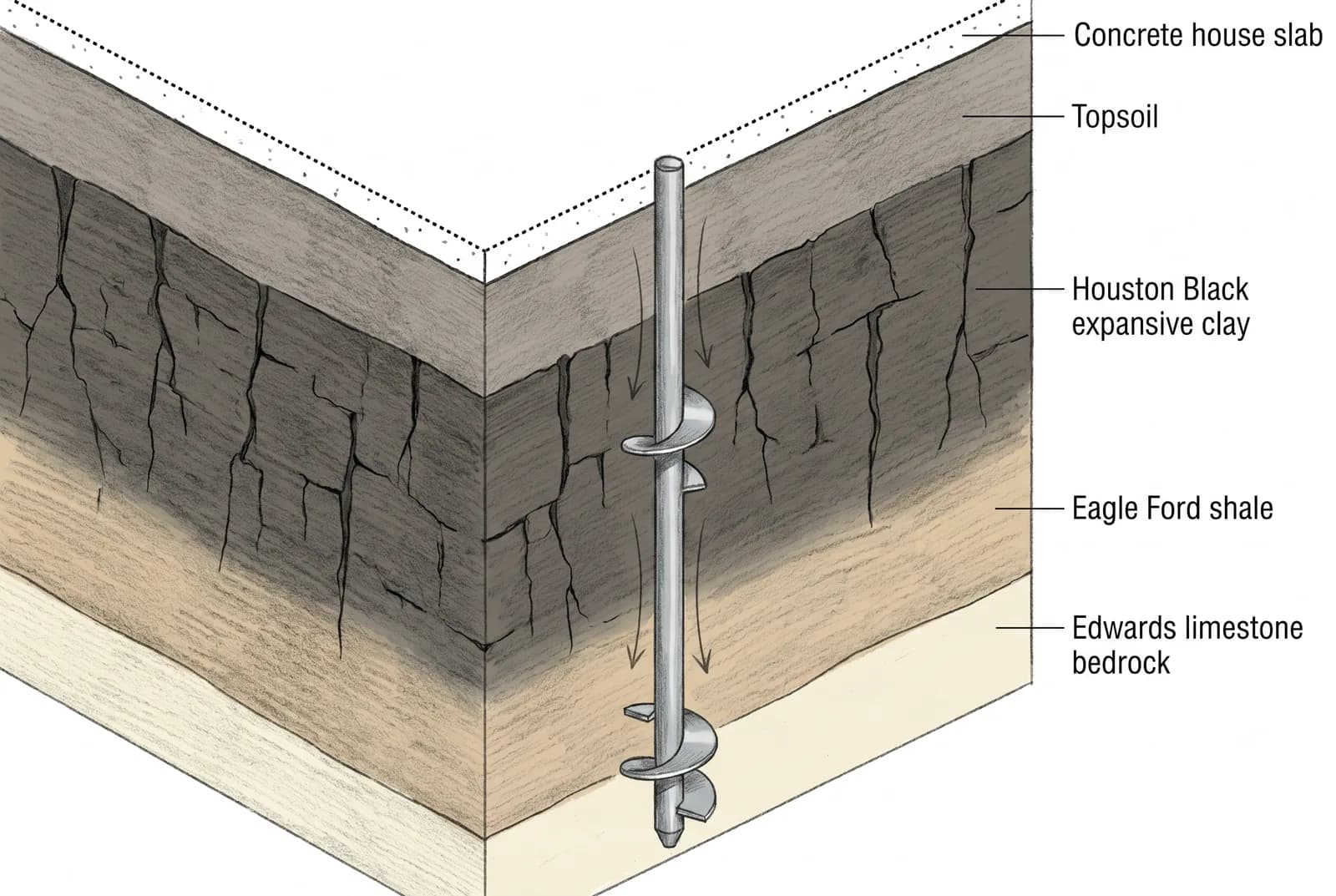
7. Soil. The final receiver. Bearing capacity, expansive potential (plasticity index), and moisture state determine whether the system stays still or moves. Expansive clay soils across Central and East Texas can swell by 5–15% volumetrically when wet and shrink correspondingly when dry — the mechanism behind the vast majority of Texas foundation movement.
The load path is a chain. A failure at any link — a rotted sill, a crumbling brick pier, an overstressed joist — shows up at the top as sagging floors, sticking doors, or cracked drywall. Repair is always a question of which link in the chain has yielded.
How a Pier and Beam Foundation Is Built (Step Sequence)
The construction sequence on a new pier and beam home reads like a reverse load path — you build the soil interface first and the finished floor last. The IRC governs every step.
- Site preparation and layout. The footprint is staked, vegetation and topsoil are stripped, and the crawl-space area is graded to drain away from the building footprint. IRC §R401.3 requires that the ground surface be sloped a minimum of 6 in. of fall within the first 10 ft from foundation walls (or, where this is impractical, that drains or swales redirect surface water).
- Footing excavation. Footing trenches and pier pad locations are excavated to below the local frost line (IRC §R403.1.4) and to undisturbed bearing soil. Where expansive clay is present, footings may be deepened to reach a stable bearing stratum — often 3–10 ft in Central Texas.
- Footing pour. Concrete footings are poured to the dimensions called out on the structural drawings. IRC §R403.1 sets minimum widths from a load-and-soil table; typical residential pier pads run 16–24 in. square at 8–12 in. thick. Rebar is placed per the engineer's spec.
- Pier construction. Once footings cure, piers are built up — CMU block laid in mortar, precast piers set and grouted, poured concrete formed and poured, or drilled-and-poured piers cast in augured shafts. Piers must be plumb; out-of-plumb piers transmit eccentric loads and fail prematurely.
- Perimeter beam (true pier and beam only). Where a continuous perimeter beam is specified, it is formed and poured (or laid as CMU) tying the perimeter footings together.
- Sill plate installation. Pressure-treated sill lumber is set on the perimeter beam (or, in block-and-base, on the perimeter piers) over a sill seal and termite shield, anchored with embedded anchor bolts per IRC §R403.1.6.
- Girder beams set. The main carrying beams are set across interior piers, leveled, and shimmed as needed. Connections to piers are typically steel bearing plates with dowels or welded clips.
- Floor joists installed. Joists are toe-nailed or hung from beams using engineered joist hangers, blocked at supports per IRC §R502.7, and bridged at mid-span where required by code or by deflection performance.
- Subfloor installed. Plywood or OSB subfloor is glued and nailed/screwed to the joists, ready to receive the wall framing above.
- Crawl-space finishing. Either screened vents are installed per IRC §R408.1/.2 (the vented approach) or the crawl is detailed as unvented per §R408.3 (the conditioned approach — vapor barrier, sealed vents, insulation, and one of four conditioning methods). This is where building science has shifted significantly; we cover it in §8.
A correctly built pier and beam foundation can last a century. An incorrectly built one — undersized footings on expansive clay, no capillary break at the sill, no vapor barrier in the crawl — can start failing within a decade.
Pier and Beam vs Slab-on-Grade vs Basement (Comparison Table)
This is the comparison every Texas homeowner actually wants. Basements are rare in Texas (frost depth is shallow; soils are often unstable for deep walls), but the three options together cover essentially the universe of residential foundations in the U.S.
| Factor | Pier and Beam | Slab-on-Grade | Full Basement |
|---|---|---|---|
| New-build cost | Higher — typically $10–$15/sq ft more than slab | Lowest of the three — fastest to pour | Highest — deep excavation, walls, waterproofing |
| Expected lifespan | 75–100+ yr with maintenance | 80–100 yr | 100+ yr; wall cracks long before structural failure |
| Repair access | Excellent — plumbing, electrical, HVAC, structure all reachable | Poor — utilities embedded; repair requires cutting or tunneling concrete | Excellent — full headroom |
| Flood resilience | Strong — living space elevated 18–48 in. above grade | Weak unless raised; finishes flood at grade | Worst — basement floods first and drains last |
| Energy / floor temperature | Cold floors unless crawl is sealed and insulated; stack-effect losses | Stable — soil buffers temperature; slab-edge insulation matters | Stable; conditioned basements add usable square footage |
| Expansive-clay tolerance | Best — system flexes; piers can be re-leveled | Vulnerable — slab heaves, cracks, and is expensive to lift | Walls can shift; uplift pressure is a known failure mode |
| Noise / floor feel | Softer underfoot; can transmit footstep noise if joists under-spec | Hard, quiet, dead-feeling | Above basement, similar to pier and beam |
| Resale perception | Mixed — premium in flood/clay regions; "more upkeep" in newer suburbs | Highest — modern default in TX new construction | High in colder markets; rare and unusual in TX |
| Pier and beam vs slab-on-grade vs basement: head-to-head comparison. |
The single sentence summary: pick pier and beam where soil moves, water rises, or future under-house access matters. Pick slab where soil is stable, drainage is good, and you want the lowest build cost and maintenance. Basements are largely climate-driven and don't really compete in most of Texas.
Pros and Cons of Pier and Beam Foundations
Every SERP page in this niche has a pros/cons list, so we will be brief and structural. The honest version:
Pros.
- Repairable. This is the biggest one. Settled pier? Add a shim, replumb, or replace. Rotted joist? Sister it. Leaking plumbing? Access from the crawl. A slab repair of the same problem can run 5–10× the cost.
- Flood-resilient. Elevation above grade saves finishes and saves contents in 1–2-ft flood events.
- Forgiving on expansive clay. The system can absorb a few inches of differential movement before it becomes a problem; small movements are correctable by reshimming.
- Sloped-lot friendly. Piers of varying heights can match the grade without expensive cut-and-fill.
- Utility access. Plumbing leaks, HVAC supply runs, and electrical changes are vastly cheaper to make from a crawl space than through a slab.
- Compatible with historic preservation. Most pre-1960 Texas homes were built this way; matching the original system avoids the structural drama of converting to slab.
Cons.
- Moisture exposure. All the structural wood lives above a damp crawl space. Without active moisture control, wood-decay risk is real and progressive.
- Higher new-build cost. Roughly $10–$15/sq ft more than slab on most Texas projects.
- Pest pressure. Crawl spaces are termite, ant, rodent, and snake territory. Inspection-friendly, but exposed.
- Maintenance commitment. Annual inspection is required for full lifespan. A pier and beam home that gets ignored for 20 years will accumulate problems a slab would not.
- Floor feel. Without proper joist sizing and bridging, floors can feel "bouncy" — especially in older homes where the live-load assumption was lower.
- Resale framing. In new-construction suburbs where buyers are used to slab, pier and beam can read as "older and higher-maintenance," even when it's structurally superior.
The pros lean structural; the cons lean operational. A pier and beam home with a sealed, conditioned crawl space and an annual inspection essentially has none of the cons — but you have to actually do that work.
Common Pier and Beam Problems (Settlement, Rot, Shimming, Pests, Humidity)
Almost every problem in a pier and beam foundation traces to one of two root causes: soil movement (expansive clay swelling/shrinking, settlement of poorly compacted fill, or hydrostatic uplift) or moisture in the crawl space (which drives rot, mold, and pest pressure). The five common failure modes below are how those root causes manifest at the structural level.
| Problem | Root cause | Symptom (what you notice) | Typical repair | Typical cost |
|---|---|---|---|---|
| Pier settlement | Expansive clay shrinkage; undersized footing; poor original compaction | Sloping floors over a discrete area; cracks at door corners; sticking doors | Reshim; replumb pier; add new pier; or underpin with helical/push pier | $1,000–$3,500 reshim; $2,000–$5,000 per added pier |
| Beam (girder) rot | Sustained wood MC above ~28–30% (decay-fungi threshold per USDA FPL Wood Handbook) | Sagging line across multiple rooms; spongy or crumbly wood at the beam | Sister with PT lumber, or full beam replacement | ~$800/beam replaced; $4,000–$12,000 whole-home (10–12 beams) |
| Joist sag / bounce | Under-sized or over-spanned joists; rotted joist ends; missing bridging | Bouncy floor under foot traffic; visible deflection between beams | Sister joists per APA Z725; add mid-span beam; replace rotted joists | $300–$600 per joist sistered; $4,000–$8,000 typical zone |
| Shim failure | Old wood shims rotted/compressed; steel shims missing or shifted | Localized low spot; audible movement when walked over | Pull old shims; reshim with steel shims to corrected elevation | $1,000–$3,500 site-wide reshim |
| Wood-destroying organisms (termites, ants, fungi) | Wood-soil contact; cellulose debris in crawl; moisture above 20% MC | Mud tubes on piers; frass piles; fungal fruiting bodies; hollow-sounding wood | Pest treatment; replace compromised lumber; eliminate conducive conditions | $1,500–$8,000 depending on scope; rot-driven rebuilds reach $20,000+ |
| Crawl-space humidity / mold | Vented crawl in humid climate; missing vapor barrier; bulk-water intrusion | Musty odor in living space; high RH on hygrometer; visible mold on framing | Drainage fix → vapor barrier → encapsulation → dehumidifier | $2–$4/sq ft vapor barrier; $5,000–$15,000 full encapsulation |
| The six problems that account for nearly all pier and beam structural complaints, with their root cause, repair method, and 2026 cost ranges. |
A note on the USDA Forest Products Laboratory's 20% / 28–30% wood-moisture thresholds, which nobody else in this SERP cites and which actually matter: per the Wood Handbook (the standard reference for wood-as-a-structural-material in the U.S.), wood-decay fungi require sustained wood moisture content above the fiber-saturation point — roughly 28–30% — to initiate decay. Surface mold can grow at lower wood moisture (around 16%, per ASHRAE Standard 160). Pest-control professionals widely report subterranean termite activity correlated with wood moisture at or above 20%. These are the numbers behind the "keep the crawl dry" rule of thumb — they are the actual physical threshold below which the wood in your foundation is biologically safe.
The Crawl Space: Vapor Barrier, Encapsulation, and Moisture Control
Every problem in the table above is downstream of the crawl space. The SERP for "pier and beam foundation" treats the crawl space as a feature (it has one!), not as a system. This is where the moat is — modern building science has moved decisively on this question, and almost none of the top-ranking pages reflect it.
The ventilation debate, settled (in humid climates). Codes historically required crawl-space vents on the assumption that airflow removes moisture. In humid summers across most of Texas, the actual physics goes the other way: warm humid outdoor air enters the vents, hits cooler crawl-space surfaces, and condenses — adding moisture, wetting framing, and feeding mold. Joseph Lstiburek of Building Science Corporation argues crawl spaces should be "either in or out" — fully conditioned (inside the building's thermal envelope, sealed and dehumidified) or, far less commonly, properly detailed as vented in a dry climate. The middle ground — vents open, no vapor barrier, no dehumidification — is what most pre-1980s pier and beam homes have, and it is the configuration most likely to rot.
Field evidence. Advanced Energy's five-year North Carolina field study (the Princeville project, beginning 2001, on 12 matched 1,040-sq-ft homes) reported that "the houses built on the closed crawl space foundations saved, on average, 15% or more on annual energy used for space heating and cooling," and that "during the humid summer months, the relative humidity in the closed crawl spaces was typically below 60%, while in the open crawl spaces, the relative humidity was normally above 80%." That research drove North Carolina's 2004 code revisions allowing closed crawl spaces. A 2009 DOE-funded multi-climate follow-up confirmed the humidity control across climates but found mixed energy results — so the clean ~15% figure is specific to the original North Carolina study; the broader principle (humidity control via sealing) is general.
The code is now permissive. IRC §R408.3 (Unvented Crawl Space) explicitly allows sealed, conditioned crawl spaces with a continuous Class I vapor retarder (overlapped 6 in., sealed, run 6 in. up the stem wall) plus one of four conditioning methods:
- Continuous mechanical exhaust at ≥1 cfm per 50 sq ft of floor area, plus a transfer pathway to conditioned space.
- Conditioned air supply from the HVAC system, with a return pathway.
- A standalone dehumidifier sized at ≥70 pints/day of moisture removal per 1,000 sq ft of crawl floor (this option was formally added to the 2024 IRC as a recognized method).
- Crawl space used as a plenum (existing buildings only; prohibited in new construction).
The vapor barrier itself. Code minimum is 6-mil polyethylene; practical encapsulation uses 12–20 mil reinforced liner because the thicker product survives puncture from the inevitable foot or knee on rough soil and around piers. The IRC requires joints overlapped a minimum of 6 in. and sealed, and the liner to run a minimum of 6 in. up the stem wall, mechanically attached and sealed.
ASHRAE 160-2021 ties this together at the design level. The standard sets criteria for moisture-control design analysis in buildings and flags surface mold growth where wood moisture exceeds ~16% sustained, and the EPA's Brief Guide to Mold, Moisture, and Your Home recommends maintaining indoor relative humidity below 60% (ideally 30–50%). A correctly encapsulated crawl space — vapor barrier + sealed vents + insulation + dehumidifier — typically holds RH at 45–55%, comfortably below those thresholds.
The bottom line: if you have a pier and beam home in humid Texas and you have not encapsulated, you are paying for it in either reduced wood lifespan, higher cooling bills, or both. Full encapsulation typically runs $5,000–$15,000 depending on square footage and access, and in humid climates it routinely pays back in 5–10 years on energy alone.
Warning Signs You Have a Problem
The structural symptoms of pier and beam trouble are almost always visible from inside the house long before the cause is. The list below is roughly ordered from "minor, watch it" to "call an engineer this week."
- Sloping floors. Roll a marble across the room; if it consistently runs to one corner, you have differential movement. A laser level confirms the magnitude. Per NAHB Residential Construction Performance Guidelines, a deflection of more than 1 in. in 20 ft of floor is generally outside the acceptable range for finished construction.
- Bouncy or "spongy" floors. Walking over a floor that visibly deflects, or where dishes rattle on a sideboard, indicates joists that are under-sized, over-spanned, or rotted at the supports.
- Sticking doors and windows. As beams sag or piers settle, door and window frames rack out of square. The door catches at the top corner opposite the side that has dropped.
- Drywall cracks at door corners and where walls meet ceilings. These are the classic "moving foundation" cracks. Hairlines are usually cosmetic; cracks wider than ~1/8 in. that grow over a season are not.
- Gaps at trim, baseboards, and crown molding. When framing moves, trim that was caulked and painted tight reveals gaps at corners.
- Musty smell, especially when the AC kicks on. A stack-effect signal that crawl-space air is being pulled into the living space. Confirms high crawl-space RH or active mold.
- Visible sagging in the floor line of the exterior. Standing 20 ft away and looking down the long side of the house, the bottom plate of the wall should be roughly horizontal. A dip in the middle indicates a girder beam has settled.
- Insects in living space. Termite swarmers in spring, frass piles on windowsills, and carpenter ants are all signals to inspect the crawl space.
- Rising energy bills with no other explanation. Crawl-space air leakage via the stack effect can quietly add 10–20% to cooling costs in a humid climate.
- Standing water visible at access opening. Open the crawl-space hatch after a storm. Water on the soil means drainage has failed; that water is going into your framing.
The signs are not diagnostic — many of them have non-foundation causes — but in combination, two or more from this list almost always warrants an inspection.
How Pier and Beam Foundations Are Repaired (Re-Leveling, New Piers, Sistering Joists, Helical Piles)
Pier and beam repair is staged, incremental, and almost always cheaper per problem than slab repair. The basic philosophy: stop the movement, support the load, and restore the geometry — without over-correcting. Professionals don't aim for perfectly flat; they aim for structural stability and stopping further movement, lifting gradually to avoid cracking finishes above.
The general repair sequence follows the load path in reverse, from foundation up:
1. Assessment and elevation survey. A licensed engineer (or, at minimum, a qualified inspector) maps the floor's high and low points with a laser or water level, identifies load-bearing lines, and inventories the condition of every pier, beam, joist, and sill plate accessible from the crawl space. Wood moisture meters and hygrometers document the moisture state. The output is a sealed report identifying which physical interventions are needed.
2. Shoring and access. Steel or heavy-timber temporary support beams are placed perpendicular to the floor joists at the work zones. Hydraulic jacks are positioned under girder beams or load points.
3. Synchronized incremental lift. Jacks are raised together in small increments — commonly a fraction of an inch per pass — monitoring drywall, doors, and floors above for stress. Some engineers target ~1/8–1/2 in. per pass, with the structure held for a period (sometimes days, sometimes overnight) before the next lift, to let finishes adjust. Cribbing supports the structure between lifts.
4. Support installation. Depending on what the survey found:
- Reshim. Steel shims (more durable than the historic wood shims) inserted between pier top and beam to take up the gap created by past settlement.
- New piers. Concrete (poured or precast), CMU, or steel pipe piers added on new footings to provide load points where existing piers have failed or where additional support is needed.
- Helical piles. Where bearing must reach deeper, stronger soil — common in soft fill or where surface clay is unreliable — helical piles can be torqued in beneath beams to reach competent strata, governed by ICC-ES AC358. See our helical piers guide for the engineering detail. For comprehensive coverage of all leveling techniques, see foundation leveling methods.
- Push piers (less common in pier and beam than in slab) — driven hydraulically using the building's weight as reaction.
5. Structural repair. Where wood has failed:
- Sister beams or joists. New pressure-treated lumber bolted alongside the existing member to share the load, per APA Engineered Wood Association Technical Note Z725 (joist reinforcement guidance). The sister member should overlap a damaged section by a generous bearing length and be through-bolted at standard intervals.
- Replace rotted lumber. Cut out and replace beams, joists, or sill plates that are structurally compromised. Always replace with pressure-treated lumber and galvanized or stainless fasteners — the original failure was a moisture failure, and the replacement needs to outlast it.
6. Lower and finalize. The structure is set on its new supports, level is rechecked, and the engineer walks the interior to verify door and window function before sign-off.
7. Root-cause moisture and drainage work. No repair is complete without addressing what caused the failure. This is gutters, downspout extensions, regrading, vapor barrier, encapsulation — the §8 work. Skipping this step is why some pier and beam homes need re-leveling every 5 years instead of every 15.
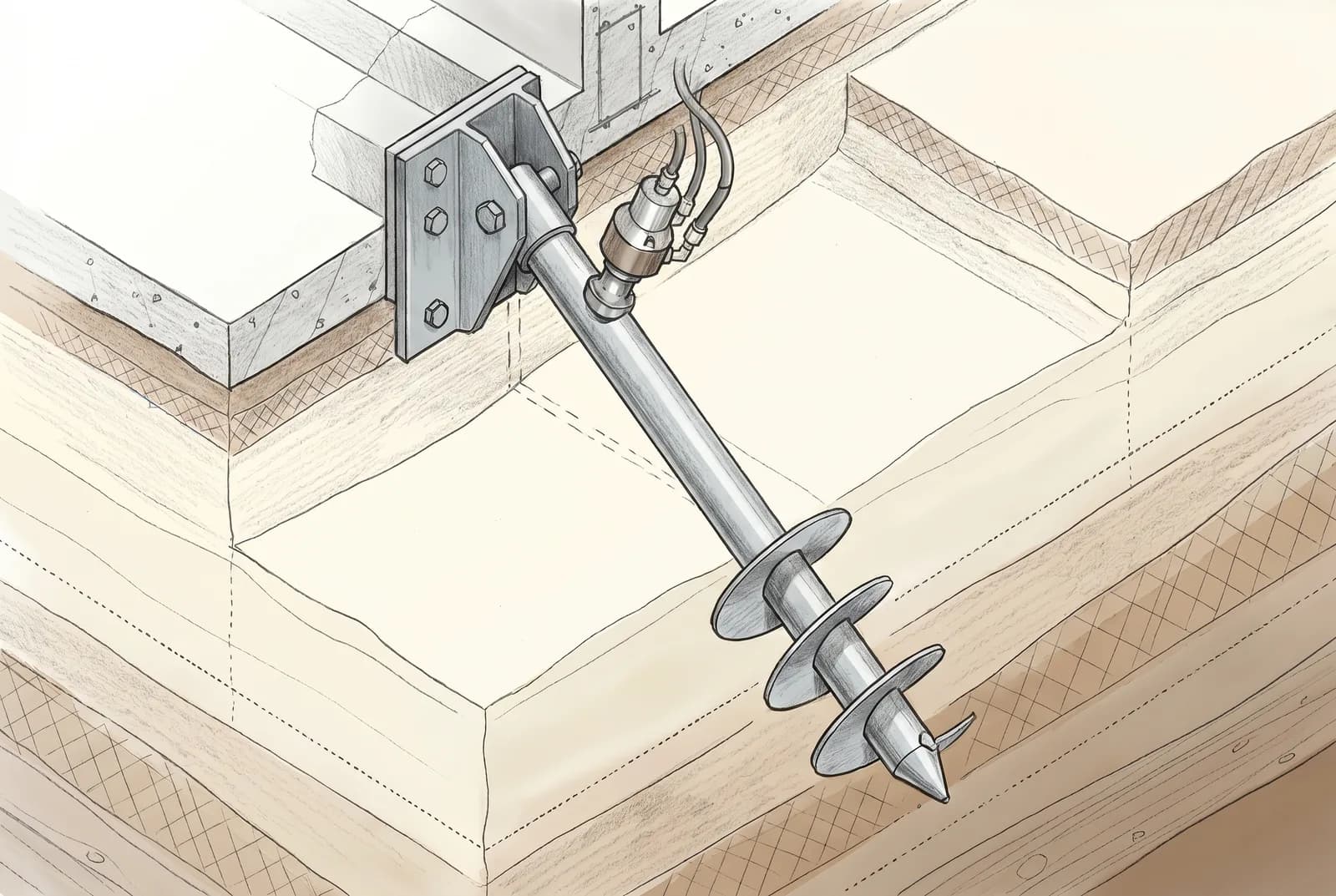
For deeper coverage of the pier-and-beam-specific repair workflow, see our planned pier and beam repair guide, re-leveling guide, concrete pier replacement, and joist sistering and replacement.
Pier and Beam Foundation Repair Cost (2026 Ranges + Table)
Costs vary enormously by region, by access (a 24-in. crawl is harder to work than a 4-ft crawl), by soil, and by scope. The ranges below are national 2025–2026 averages from contractor surveys cross-referenced against published guidance from the NAHB Cost Estimator and major regional contractors; we treat them as planning numbers, not quotes.
| Repair | 2026 typical cost | Notes |
|---|---|---|
| Reshim / minor re-level | $1,000–$3,500 (avg ~$1,600) | Most common maintenance repair; expect every 5–8 yr in clay regions |
| Add a new concrete or CMU pier | ~$2,000 each (range $800–$4,000) | Includes footing, pier, shim; access drives the variance |
| Replace a girder beam | ~$800 each ($400–$1,200); whole-home 10–12 beams $4,000–$12,000 | Pressure-treated lumber + galvanized fasteners standard |
| Sister a floor joist | $300–$600 per joist | Per APA Z725; commonly priced by linear foot of crew time |
| Sill beam replacement (incl. piers) | $4,000–$6,000 | The sill is the most common rot site; often combined with new perimeter piers |
| Typical full re-leveling project | $4,000–$11,000 | Shimming + a few new piers + minor beam work; the middle of the market |
| Extensive rebuild (rot/termite + access difficulty) | $20,000–$25,000+ | Multiple beams, joist replacement, sill replacement, limited crawl access |
| Helical pile underpinning | ~$1,800–$3,500/pile; project $15,000–$30,000 | Where surface bearing is unreliable; see helical piers guide |
| New pier-and-beam foundation (new build) | $7,000–$24,000 for typical residential footprint | Roughly $10–$15/sq ft more than slab on most TX projects |
| Pier and beam repair cost ranges, 2025–2026 national averages. Local Texas labor markets fall mid-range; access difficulty is the largest single multiplier. |
For the full Texas-specific cost breakdown, see the planned pier and beam cost guide. For an honest read on what an engineer's report should cost and contain, see the planned engineer report guide.
Annual Inspection and Maintenance Checklist
A 30-minute annual inspection is the single highest-ROI piece of maintenance a pier and beam homeowner can do. Most major repairs are accumulations of small problems that were visible — and cheap to fix — for years.
The checklist below is a HowTo we recommend running once a year and again after major weather events.
Exterior, around the perimeter:
- Walk the foundation perimeter and check the grade — soil should slope away from the building at a minimum of 6 in. of fall within the first 10 ft (IRC §R401.3).
- Inspect gutters and downspouts. Downspout extensions should discharge a minimum of 4–5 ft from the foundation.
- Look for soil cracks running parallel to the house — a sign of expansive-clay shrinkage during drought.
- Check for vegetation, firewood, or mulch in contact with siding or sill — all should be cleared back at least a few inches to maintain a termite inspection gap.
Crawl-space entry (wear an N95 respirator, gloves, eye protection):
- Open the access hatch and stand for a minute before entering — let any standing dust settle and any animals leave. Note any standing water or damp soil.
- With a flashlight, walk the perimeter beam (or perimeter piers). Look for cracks, crumbling masonry, gaps between pier top and beam, and rusted hardware.
- Inspect every visible girder beam and sill plate for fungal fruiting bodies (white or brown growth), spongy wood that takes a screwdriver tip, or staining indicating past wet events.
- Check for termite mud tubes climbing piers or interior walls; check for frass (sawdust-like piles) under wood members.
- Take a wood moisture reading (a $30 pin meter is sufficient) at three locations on the sill and three on girder beams. Per ASHRAE 160 and EPA guidance, anything sustained above ~16% wood MC is a mold risk and anything above ~20% MC invites termite activity.
- Take a hygrometer reading of crawl-space relative humidity. EPA flags above 60% as a mold risk.
- Inspect the vapor barrier (if installed) for tears, gaps, or displacement. Reseal where compromised.
- Check the dehumidifier (if installed) — auto-drain functioning, filter clean, last service date logged.
Inside the house:
- Walk every room with a marble or a 4-ft level. Note where it consistently runs — that is your differential movement map for the year.
- Open and close every exterior door. Sticking, hard latching, or daylight at the threshold are all signs to log.
- Note any new drywall cracks at door corners or wall-ceiling intersections, photograph and date them.
The output is a one-page log — date, readings, photos, notes. Two years of logs make the difference between "I think the floor is sloping more" and a documented elevation drift the engineer can act on.
When to Call a Structural Engineer
Independent of any repair contractor, you should engage a Professional Engineer when:
- Two or more warning signs from §9 are present and worsening over a season.
- Drywall cracks exceed ~1/8 in. and are growing.
- A marble rolls consistently across a room (any room) and the slope feels new.
- Doors that worked last year are sticking or not latching now.
- A repair contractor has quoted more than ~$5,000 of work.
- You are buying or selling a pier and beam home.
- After any significant flood, drought, or plumbing leak under the slab.
- Before adding any meaningful weight to the structure (second story, masonry chimney, large addition).
The engineer's deliverable is a sealed report describing the structural condition, the recommended interventions, and (in most Texas jurisdictions) the basis for a permit application. The fee is typically a small fraction of the repair cost — often $400–$1,200 for a single-family home — and it pays for itself by giving you a scope to bid against rather than a quote to argue with.
Regional Considerations (Texas, Gulf Coast, Expansive Clay, Freeze-Thaw)
Pier and beam behaves differently in different climates and soils, and the Texas case is genuinely distinctive.
Central and East Texas — expansive clay. The dominant geotechnical condition across roughly the eastern two-thirds of the state. Plasticity indices on these clays commonly fall in the 20–50 range, with the worst running higher; volumetric swell from dry to saturated states can reach 5–15%. This is the mechanism behind almost all Texas foundation movement. Pier and beam is better on this soil than slab is — the system tolerates and adjusts to seasonal heave/shrink — but it is not immune. Maintenance reshim every 5–8 years is normal in San Antonio, Austin, Dallas–Fort Worth, and Houston. See our planned expansive clay soil guide for the geotechnical detail.
Gulf Coast — humidity and flood. Pier and beam's flood resilience is most valuable in the Gulf Coast band from Houston south. The tradeoff is humidity: outdoor RH commonly exceeds 70% for months, which puts every vented crawl space at chronic risk. Encapsulation is essentially mandatory south of I-10 for any long-term-thinking owner. FEMA flood-zone homes need flood vents — full sealing is incompatible with some flood designations; verify with your local floodplain administrator.
West Texas — drought stress. Lower rainfall, less humidity, but the dry extremes are the threat. Severe drought desiccates clay soils and shrinks them away from footings. The Texas 2011 and 2022 droughts produced documented spikes in foundation repair claims across DFW and San Antonio. A foundation watering regimen — soaker hoses on a timer, run during prolonged dry spells — is a legitimate preventive measure for both slab and pier and beam in West and Central Texas.
Panhandle and high plains — freeze. Texas frost depth is generally shallow (6–12 in. for most of the state), but the panhandle can require footings to 24 in. or deeper per local amendments to IRC §R403.1.4. Freeze-thaw cycles on crawl-space soil are uncommon enough that they don't drive design, but they do drive plumbing decisions (insulate any pipe in a crawl space north of San Angelo).
Coastal humidity and termites combined. The combination of high humidity, sandy soils, and Formosan subterranean termites along the upper Gulf Coast is the worst single environment in Texas for an unencapsulated pier and beam home. Annual professional termite inspection is not optional; encapsulation with sealed inspection gap is the practical standard.
San Antonio sits at a useful midpoint: significant expansive clay (Houston Black, Branyon, and related soils dominate the eastern half of Bexar County), moderate humidity, mild winters, and rare flooding. The standard maintenance pattern for SA pier and beam is: encapsulate (most homeowners eventually do), reshim every 5–8 years, and inspect annually. We match San Antonio homeowners with vetted independent engineers and pier and beam specialists.
FAQ
The questions below come from real homeowner conversations and from the search terms people type before calling. Full Q&A is rendered from the page frontmatter and emitted as FAQPage structured data for AI overviews and search-result rich results.
If your question isn't here — or you want the engineer-first version of an answer specific to your home — request a free match with an independent specialist below. We do not own a repair company, we do not perform inspections, and our match is free for the homeowner.
Frequently asked questions
12 questionsHow long does a pier and beam foundation last?
Pier and beam vs slab — which is better in Texas?
How much does pier and beam re-leveling cost?
Can a pier and beam crawl space be encapsulated?
What causes pier and beam floors to sag?
Do I need a permit to re-level my pier and beam home?
How often should pier and beam foundations be inspected?
Can I add a second story to a pier and beam home?
Is pier and beam better for floods?
Why is my pier and beam crawl space humid?
Are 'pier and beam' and 'crawl space' the same thing?
How do I find a qualified pier and beam contractor?
Related guides
- Repair/foundation-repair/pier-and-beam/repair
- Leveling/foundation-repair/pier-and-beam/leveling
- Concrete/foundation-repair/pier-and-beam/concrete
- Joist Repair/foundation-repair/pier-and-beam/joist-repair
- Crawl Space/foundation-repair/crawl-space
- Vapor Barrier/foundation-repair/crawl-space/vapor-barrier
- Encapsulation/foundation-repair/crawl-space/encapsulation
- Sloping Floors/foundation-repair/signs/sloping-floors
- Foundation Leveling/foundation-repair/methods/foundation-leveling
- Helical Piers/foundation-repair/methods/helical-piers
- Engineer Report/foundation-repair/diagnosis/engineer-report
- Expansive Clay Soil/foundation-repair/causes/expansive-clay-soil
Sources
- [1]IRC 2024 Chapter 4 §R403 — Footings
- [2]IRC 2024 Chapter 4 §R408 — Under-Floor Space (Crawl Space)
- [3]IRC 2024 Chapter 5 — Floors
- [4]USDA Forest Products Laboratory — Wood Handbook (Ch. 14, Biodeterioration)
- [5]ASHRAE Standard 160-2021 — Criteria for Moisture-Control Design Analysis in Buildings
- [6]NAHB Residential Construction Performance Guidelines (5th ed.)
- [7]ICC-ES AC358 — Acceptance Criteria for Helical Foundation Systems
- [8]APA — The Engineered Wood Association, Technical Note Z725 (Joist Reinforcement)
- [9]EPA — A Brief Guide to Mold, Moisture, and Your Home
- [10]Advanced Energy — Closed Crawl Space Performance (Princeville, NC field study)