Foundation problems almost never have a single, simple cause — and the one most homeowners name first, "bad soil," is only half the story. The destructive variable is not the soil itself but the changes in soil moisture around your foundation, which make expansive clay swell and shrink unevenly and bend the structure through differential movement. Get that one mechanism, and every specific cause below — drought, poor drainage, thirsty trees, plumbing leaks, and the clay underneath it all — falls into place as a different way of disturbing the same moisture balance. This page is the hub: it explains the mechanism every cause shares, summarizes the five things that actually move a Texas foundation, and links to a deep guide for each.
Bottom line up front
For foundation repair, the cause matters more than the method. Two houses can show the same cracked drywall and sticking doors and need completely different work — because one is settling into clay a drought dried out, and the other is heaving over a slab leak. Pick a repair before you know which, and you can spend $15,000–$30,000 fixing the wrong thing while the real driver keeps working.
That is why the single recommendation running through every section here is the same one that runs through serious foundation engineering: diagnose the cause first, with your own independent engineer — contractor second. Foundation repair is one of the few home repairs where the person who diagnoses the problem also profits from the prescription, and the American Society of Civil Engineers estimates roughly one in four U.S. homes has damage caused by expansive soils — a large, anxious market that contractors are well-capitalized to convert into invoices. An independent licensed Professional Engineer has no pier to sell. Their elevation survey and (where warranted) geotechnical report establish what actually moved your foundation, and the assessment cost — $500–$1,500 for the report, or $1,000–$6,000 if geotechnical work is needed — is rounding error against the project it scopes.
This page is the map of causes. Each one below is summarized to the same depth so you can see how they relate, then links to a dedicated deep dive. We don't re-derive the clay science here — that lives in its own expansive clay soil guide; this hub is about what disturbs the clay and how the causes combine.
The one mechanism behind almost every cause: differential movement
Before the individual causes, the spine that unifies them. Almost every foundation failure in Texas is a story about uneven movement, and the distinction between three kinds of movement is the whole game.
Uniform settlement is the whole foundation moving down evenly, as one rigid body. A house can ride a surprising amount of it with little structural damage — no racked door frames, no diagonal cracks — because nothing is being bent.
Differential settlement is parts of the foundation moving down at different rates or amounts — one corner dropping away from the rest, often because soil dried unevenly, or because the house sits partly on cut and partly on fill. This twists and bends the structure, and this is what cracks slabs, brick veneer, and interior finishes.
Heave is the opposite direction: upward movement from soil that has swelled after taking on water — rain, a plumbing leak, overwatering, or the rebound after a large tree is removed. In a slab home, localized heave can dome the floor upward.
The reason uneven movement is nearly guaranteed on expansive clay is that moisture is never uniform around a house. One elevation is shaded while another bakes; a downspout wets one corner; a tree dries another; a leak swells a third. Every gradient produces a swell-here, shrink-there pattern the foundation has to absorb.
What's important is how engineers think about a slab on this ground. Per the Foundation Performance Association and the Post-Tensioning Institute, residential slabs are designed as semi-rigid "floating" elements that respond to soil movement, not resist it. As the FPA puts it, all foundation systems move — even a properly designed and built one — generally beginning the day the foundation is placed. So damage is judged not by movement itself but by the distress that movement causes. The two most widely used numerical tolerances, as of recent practice, are about 1% for tilt and L/360 for deflection (FPA / PTI) — though both standards stress that evaluation requires engineering judgment and is inherently somewhat subjective. As a practical rule of thumb, a slab home is often considered out of tolerance once differential movement exceeds roughly 1 to 1.5 inches across the structure, but the distress pattern, not a single number, is what an engineer weighs.
Hold this in mind for everything below: the causes differ, but they nearly all do their damage the same way — by changing the moisture in the clay unevenly and producing differential movement.
Expansive clay: the underlying condition
Expansive clay is not so much one of the causes as the stage on which the other causes act. It is soil that changes volume with moisture — swelling when wet, shrinking when dry — because of its clay mineralogy. Smectite-group minerals, especially montmorillonite, have an expanding crystal lattice that pulls water in between its layers, so a soil rich in them can move dramatically through a single wet-dry cycle. South Texas sits on some of the most reactive smectitic clay in North America.
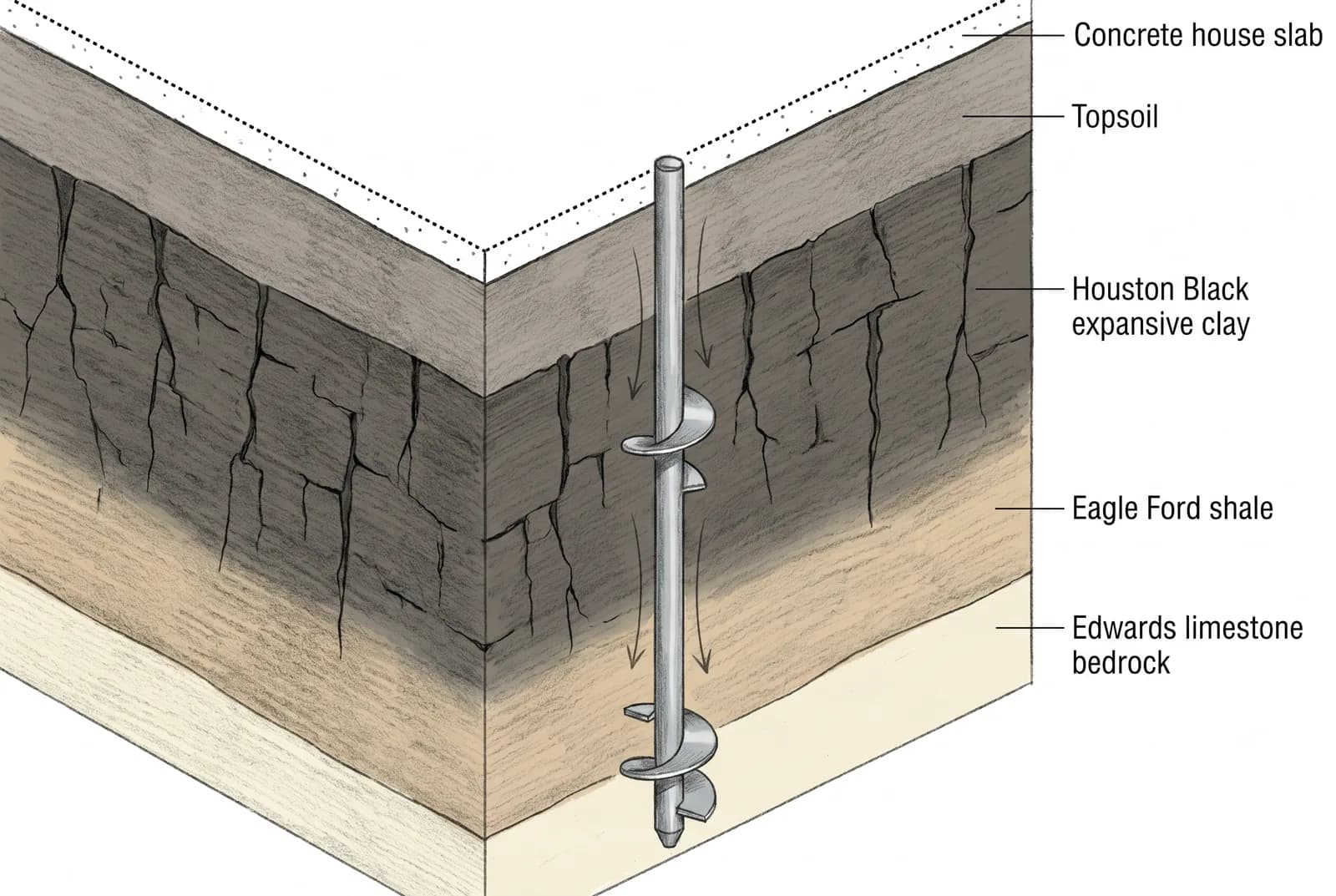
San Antonio sits at the southern end of the Blackland Prairie corridor, the belt of expansive soil running along the I-35 line from the Red River through Dallas–Fort Worth, Waco, and Austin. The classic local soil is Houston Black, the Texas state soil — a textbook Vertisol so reactive it opens wide, deep cracks in drought. The scale of the problem is easy to underestimate because it is slow and invisible: the ASCE's roughly one-in-four U.S. homes figure, and the 1973 Jones & Holtz paper pointedly titled "Expansive Soils — The Hidden Disaster," which found these soils inflict more damage each year than floods, hurricanes, tornadoes, and earthquakes combined. It is "hidden" precisely because there is no single dramatic event — just a slow, statewide tax on foundations paid one cracked slab at a time.
The one number that makes all of this fixable is the active zone — the near-surface layer in which moisture, and therefore volume, fluctuates seasonally. In the San Antonio region it runs roughly 8 to 15 feet deep. Everything destructive happens inside that band; the clay below it is dimensionally quiet, which is the entire reason deep piers work. That is also why the clay is the condition and the causes below are the triggers — they all act by disturbing moisture inside the active zone. The full soil science, classification (Plasticity Index, COLE), and the Texas geology are covered in depth in our expansive clay soil guide; the rest of this page is about what sets that clay in motion.
The five things that actually move it
If expansive clay is the loaded gun, these five are the fingers on the trigger. Each one works by changing the moisture in the active zone — and each has a dedicated deep guide.
Drought and moisture swings
The most powerful trigger in Texas is the climate itself. Prolonged drought desiccates the active zone, shrinking the clay and letting the foundation settle into it; deep polygonal cracks open at the surface — in Houston Black, the NRCS records cracks ½ to 4 inches wide at one-foot depths in dry spells. Then heavy rain rushes into those cracks, the soil swells, and the foundation heaves. This drought-to-rain whiplash is the single most destructive cycle for Texas foundations, and it is why drought — not just rain — is when Texas foundations fail. The reference point is the 2011 drought, the driest single year in state history, which drove a documented surge in foundation damage statewide. Stable year-round moisture is what blunts the cycle; the swing is what does the damage. Full detail, including the seasonal mechanics and watering response, is in our drought and moisture guide.
Poor drainage and grading
Where drought dries the soil, bad drainage does the opposite — it dumps concentrated water into the perimeter soil, swelling it and, on saturated ground, reducing its bearing capacity. The usual culprits are mundane: a lot that grades toward the house, missing splash blocks, a flat yard that ponds after every storm. The code standard is specific and worth knowing, because it is the cheapest fix on this whole list: the International Residential Code (§R401.3) requires the grade to fall at least 6 inches within the first 10 feet from the foundation, with impervious surfaces sloping away at 2% or more. Get the water moving away from the slab and you remove one of the most common moisture gradients before it can move the foundation. Our drainage and grading guide covers diagnosis and the regrading playbook.
Trees and roots
Large trees damage foundations mostly by drying the clay, not by roots physically cracking concrete. A big tree can transpire well over a hundred gallons of water a day — DFW industry sources cite up to around 190 gallons for some large species — pulling moisture out of the surrounding clay and shrinking it, so the foundation settles toward the tree. Crucially, the moisture migrates from under the slab toward thirsty roots even when no root sits directly beneath the foundation, so the tree doesn't have to "reach" the house to dry the soil under it. The countermeasures are setback, root barriers, and consistent watering. The one trap to avoid: abruptly removing a long-established tree near a chronically dry foundation, which can let the soil rehydrate and heave. Our trees and roots guide covers setbacks, barriers, and the removal decision.
Plumbing and sewer leaks
A leak is the most localized of the triggers — and one of the most common causes of differential movement specifically. A pressurized supply-line leak or a gravity sewer-line leak introduces concentrated water under one part of the slab; in expansive clay that produces localized heave, often doming the slab upward over the leak. A severe sewer leak can do the opposite too, eroding and washing soil into the broken line and causing localized settlement. Older homes — pre-1970, with cast-iron or clay sewer lines near the end of their 50-to-60-year service life — are especially vulnerable. Because a leak so cleanly mimics soil movement (cracks, sticking doors, uneven floors), it has to be ruled in or out before any structural repair: a hydrostatic plumbing test is the tool. Our plumbing leaks guide covers the symptoms and the test sequence.
Causes that don't get their own page
Beyond the big five, a handful of causes appear often enough to matter but don't warrant a standalone guide. Several are real elsewhere in the country yet largely irrelevant to slab-on-grade San Antonio — knowing why is part of diagnosing your own house correctly.
Soil consolidation, poor compaction, and fill. Distinct from the shrink-swell story, this is settlement driven by load rather than moisture. Consolidation is the slow expulsion of pore water from saturated fine-grained soil under sustained weight; the classic failure is a house built partly on undisturbed ground and partly on fill, where the two settle at different rates and produce differential movement at the seam. Uncontrolled fill — placed without moisture conditioning or density testing — leaves loose zones that compress later. The U.S. Army Corps of Engineers notes that cohesive backfill compacted even 3 to 4 percentage points below optimum water content can produce large settlements when it later collapses or heaves on saturation. New construction on poorly prepared fill is the usual setting.
Gutters, downspouts, and evapotranspiration. A close cousin of drainage: clogged gutters and downspouts discharging at the foundation concentrate roof water into the perimeter soil (swelling and hydrostatic load), while evapotranspiration — sun, wind, and plant uptake — dries that same perimeter and causes edge shrinkage. Extending downspouts several feet out and keeping a stable, mulched perimeter moisture level addresses both ends of the swing.
Frost heave, erosion, and hydrostatic pressure. These are mostly other regions' problems. Frost heave lifts shallow foundations where a sustained freezing front grows ice lenses in frost-susceptible soil — a cold-climate issue that is largely a non-issue in Texas, where footings sit above any meaningful frost line. Erosion (running water removing soil support) and hydrostatic pressure (saturated soil bowing basement walls, water weighing in around 60–62 lb/ft³) are real but skew toward basement regions; San Antonio's slab-dominant, basement-rare housing stock sees far less of them.
Original construction and design defects. Some foundations were compromised before the soil ever touched them: thin, lightly reinforced slabs (the 1950s–70s vintage, with less steel than modern post-tensioned or stiffened slabs), footings not carried below the active zone, or a design simply not matched to the soil. One useful note from the Colorado Geological Survey: lightly loaded residential foundations are far more susceptible to expansion damage than heavily loaded commercial ones — a downtown high-rise is too heavily loaded for expansive soil to lift it, while a one-story house is not. Older, lighter, under-reinforced slabs are the ones that move.
Here is the full menu in one view — note how the last column collapses the list: nearly everything a homeowner can actually influence runs through moisture.
| Cause | Core mechanism | Dominant movement | Controllable? |
|---|---|---|---|
| Expansive clay (the condition) | Shrink-swell with moisture change | Differential (both directions) | No (manage moisture) |
| Drought and moisture swings | Desiccation then re-wetting of the active zone | Settlement, then heave | Partly (watering) |
| Poor drainage and grading | Concentrated water swells perimeter soil | Heave / loss of bearing | Yes |
| Trees and roots | Root desiccation dries clay | Settlement toward tree | Yes |
| Plumbing and sewer leaks | Concentrated sub-slab water | Localized heave (or settlement) | Yes (repair leak) |
| Soil consolidation / poor fill | Load-driven compression; cut-vs-fill | Differential settlement | At build only |
| Gutters / evapotranspiration | Roof-water concentration vs edge drying | Heave or edge shrinkage | Yes |
| Frost heave | Ice-lens growth (cold climates) | Heave | N/A in San Antonio |
| Erosion / hydrostatic pressure | Soil removal / lateral water load | Settlement / wall bowing | Partly (basement-region) |
| Construction / design defects | Thin slabs, shallow footings, soil mismatch | Differential, premature | No (pre-existing) |
| Every common cause of residential foundation movement, with its mechanism, dominant direction, and how much a homeowner can control it. Note how the controllable causes nearly all act through moisture. |
How the causes combine (and why diagnosis matters)
Real foundation failures rarely have one neat cause. A typical San Antonio case is layered: an under-reinforced 1960s slab (a construction factor) on Houston Black clay (the condition), with a downspout dumping at one corner (drainage) and a live oak drying the opposite side (a tree), all amplified by a drought summer (climate) — and then a hairline sewer crack starts a slow leak under the kitchen (plumbing). Each contributes; no single one tells the whole story. That is exactly why a cause-first approach beats a method-first one, and why the diagnosis is engineering work rather than a sales call.
The starting point is not a contractor's free inspection — it is an independent licensed engineer's elevation (zip-level / manometer) survey, which maps where and how much the foundation has actually moved, plus a plumbing hydrostatic test to rule a leak in or out and a geotechnical investigation when the clay's behavior or the active-zone depth is genuinely in question. Only that package lets you rank the contributors and address the dominant ones, instead of treating whichever symptom a salesperson noticed first.
The cost math makes this an easy call. An engineer's elevation/assessment survey runs about $300–$800 (rising to roughly $1,000–$6,000 if geotechnical work is added), and a sealed engineer's report typically $500–$1,500. Set that against the project it scopes — a typical Texas underpinning job of $15,000–$30,000 — and the diagnosis is a rounding error that routinely changes the scope by far more than it costs. For national context, This Old House puts the 2026 average foundation repair project near $5,179, with HomeAdvisor's 2025 typical range at $2,225–$8,133 — but those averages bundle cheap crack sealing with full underpinning, so they predict almost nothing about a specific multi-cause job. The number that matters is the one your own engineer's survey produces. See what that report includes in our engineer's report guide, and the early warning signs that should prompt one in our signs guide.
FAQ Note
The FAQ below answers what San Antonio homeowners ask most about causes — the number-one driver, whether it's the soil or the water, settlement versus heave, whether you can prevent it, trees, insurance, how to tell which cause is yours, which cracks matter, and whether frost heave is a local concern (it isn't). For the moisture-management program that addresses most of these causes at their root, see our prevention guide; for the deep dive on the soil underneath them all, see expansive clay soil.
Get Matched With a Vetted San Antonio Foundation Specialist
If your house is showing the warning signs — cracks tracking diagonally from door corners, doors that have started to stick across several rooms, a floor you can feel slope — the right next step is figuring out which cause is behind it, and that starts with a measurement, not a sales call. We'll match you with a vetted San Antonio specialist and point you to an independent engineer who can determine what actually moved your foundation — the soil, a leak, drainage, a tree, or some combination — before you commit to any repair. The match is free, the quote is no-obligation, and we don't take a fee from you. We screen for sealed-engineer diagnosis that names the cause, target depths set below the active zone, and a documented moisture-management plan alongside any structural work — because on expansive clay, fixing the cause is the only repair that lasts.
Frequently asked questions
9 questionsWhat is the #1 cause of foundation problems?
Is it the soil or the water that causes the damage?
What's the difference between settlement and heave?
Can I prevent foundation problems?
Do trees really cause foundation damage?
Will insurance cover it?
How do I know which cause is affecting my house?
Are all foundation cracks a sign of a serious cause?
Is frost heave a concern in San Antonio?
Related guides
- Foundation Repair/foundation-repair
- Expansive Clay Soil/foundation-repair/causes/expansive-clay-soil
- Drought And Moisture/foundation-repair/causes/drought-and-moisture
- Trees And Roots/foundation-repair/causes/trees-and-roots
- Drainage Grading/foundation-repair/causes/drainage-grading
- Plumbing Leaks/foundation-repair/causes/plumbing-leaks
- Signs/foundation-repair/signs
- Engineer Report/foundation-repair/diagnosis/engineer-report
- Prevention/foundation-repair/prevention
Sources
- [1]ASCE Texas Section — Guidelines for the Evaluation and Repair of Residential Foundations, v3 (2022)
- [2]USDA Natural Resources Conservation Service — Web Soil Survey (COLE / shrink-swell classification)
- [3]Jones & Holtz (1973), "Expansive Soils — The Hidden Disaster," ASCE Civil Engineering Vol. 43 No. 8
- [4]USGS — Swelling Clays Map of the Conterminous United States, Map I-1940 (1989)
- [5]International Building Code 2024 §1803.5.3 — Expansive soil classification criteria
- [6]International Residential Code 2024 §R401.3 — Surface drainage (grade to fall ≥6 in within first 10 ft)
- [7]International Residential Code 2024 §R403 — Footings on expansive soils
- [8]Foundation Performance Association — slab-on-ground performance and active-zone guidance (FPA-SC-13)
- [9]Post-Tensioning Institute — DC10.8 Guide for Performance Evaluation of Slab-on-Ground Foundations (tilt ~1%, deflection L/360)
- [10]U.S. Army Corps of Engineers — backfill compaction and settlement guidance
- [11]This Old House (2026) — National foundation repair cost analysis (~$5,179 average)