Drought damages foundations, but not the way most people assume. It is not the dryness itself that cracks a slab — it is the change in soil moisture: the clay shrinks and the house settles during the drought, then the rain that breaks the drought rushes into the cracked, shrunken ground and swells it back, heaving what just settled. That swing — drought, then rain, then drought again — is the most destructive thing that happens to a Texas foundation, and the state's climate of multi-month droughts punctuated by heavy Gulf rains makes it the textbook case. This page is about the trigger: how moisture change drives the shrink-settle-heave cycle, why Texas's drought record matters, and how to hold the perimeter soil steady so the cycle never gets started.
Moisture Change, Not Moisture, Is the Cause
The single most important fact about expansive clay is that it does not move unless its moisture content changes. Hold the moisture steady — wet or dry, it almost doesn't matter — and even a highly reactive clay sits quietly. It is the cycling between wet and dry that produces the repeated swelling and shrinking that progressively stresses a structure.
That reframes "drought damage" entirely. A drought does not crack a foundation by drying soil per se; a foundation can sit on stably dry soil for a long time without trouble. It cracks foundations by changing the moisture in the active zone — pulling it down during the dry months, then letting it surge back when the rain returns. Each swing is a load cycle on the slab, and because moisture never changes evenly around a house, each swing is uneven: one elevation shrinks while another holds, one corner heaves while another settles. That uneven, repeated movement is what bends and cracks slabs, brick veneer, and interior finishes.
The mineralogy behind all of this — why smectite and montmorillonite clays expand, why Houston Black is so reactive, how engineers classify shrink-swell potential — lives in our companion guide to expansive clay soil. The short version: the clay is the loaded gun. This page is about the trigger that pulls it. And in Texas, the loudest trigger is the drought-to-rain whiplash.
The Drought-to-Rain Whiplash
Picture the cycle in three acts, all of it playing out in the upper several feet to roughly 15 feet of soil that San Antonio engineers call the active zone.
Act one — desiccation and settlement. A prolonged drought, amplified by summer heat, draws moisture out of the active zone. The clay shrinks. As it shrinks, it pulls away from the foundation and withdraws support, and the structure settles into the shrinking soil. At the surface, the ground opens into a network of deep polygonal cracks. In Houston Black "black gumbo" clay, the USDA-NRCS Official Series Description records these drought cracks at 1/2 to 4 inches wide at one-foot depths, extending more than 80 inches deep. Those cracks are not just a surface curiosity — they are channels that reach far down into the soil profile.
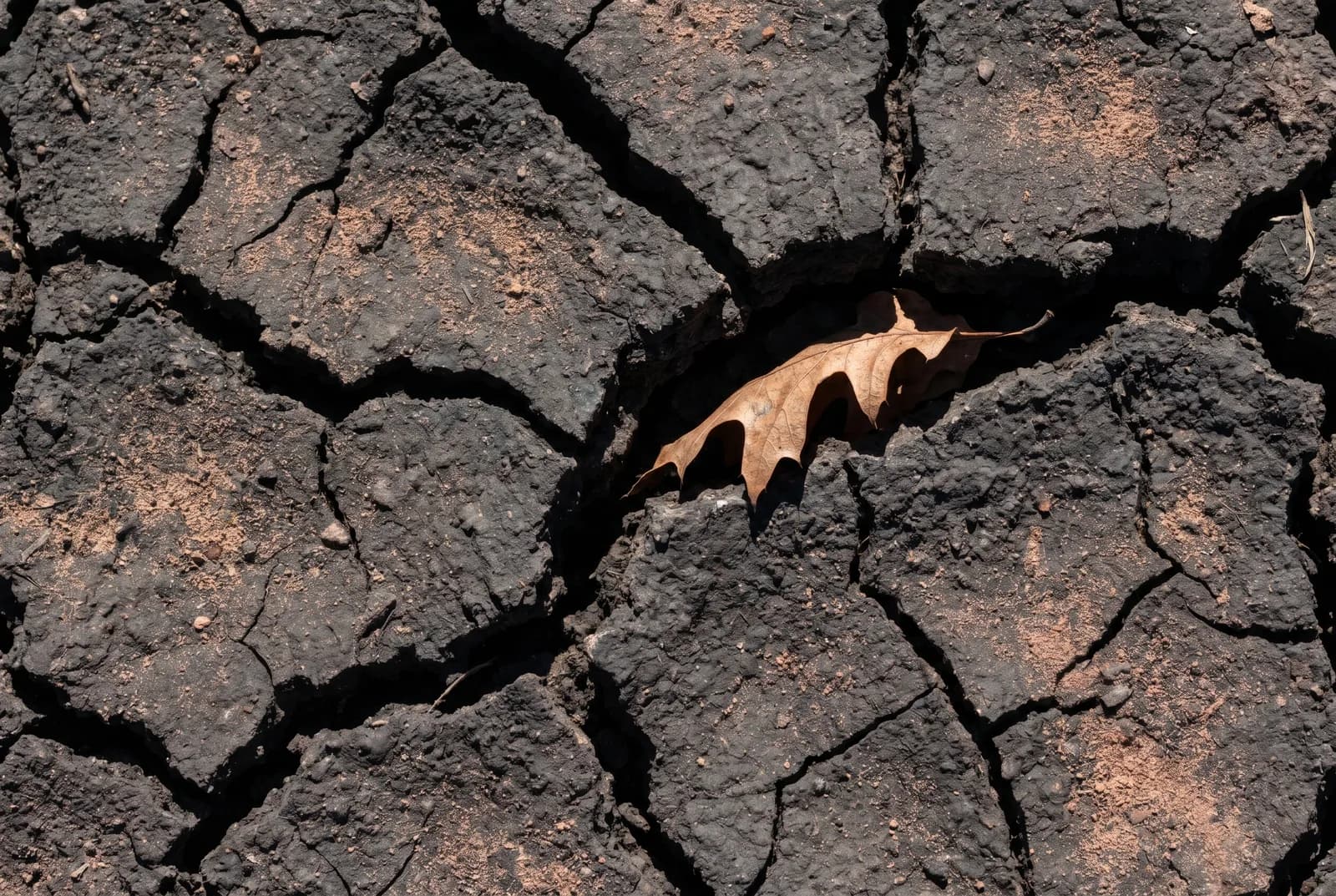
Act two — re-wetting and heave. Then the drought breaks. Heavy rain — often the abrupt Gulf-driven kind Texas specializes in — pours straight into those open desiccation cracks and re-wets the shrunken soil from within, fast. The clay swells and pushes back up: heave. Because the cracks and the wetting are uneven, the heave is uneven too. The corner that settled deepest in the drought may not be the corner that rebounds highest in the rain, and the difference is differential movement — the destructive mode.
Act three — repeat. The next dry season pulls the moisture back out, and the cycle runs again. It is the repetition of swell-and-shrink, not any single drought or single storm, that does the cumulative damage. This drought-to-rain whiplash is the most destructive cycle for Texas foundations, which is exactly why so many homeowners first notice cracks and sticking doors not in the depth of a drought, but in the weeks after it finally rains. (For what that movement looks like inside the house, see the signs of a sinking foundation.)
Texas's Drought Record and Why It Matters
Texas is the U.S. hot spot for this problem because it pairs some of the most reactive clay in North America with one of the most volatile moisture climates. The state swings between humid-subtropical Gulf rains and multi-month droughts, with a semi-arid west pulling moisture out of the ground hard — and those large seasonal swings are precisely the cycling that expansive clay turns into foundation movement.
The reference point is the 2011 drought, the driest single year in Texas history. Per the National Weather Service, the statewide average rainfall that year was just 14.88 inches — narrowly under the prior 1917 record of 14.99 inches, and barely half the long-term norm near 27 inches. That extreme desiccation of the active zone drove a documented surge in foundation damage across the state, and the rains that eventually followed delivered the heave half of the cycle. It is the clearest evidence available that drought — not just rain — is when Texas foundations fail, and it is why a multi-year dry-then-wet pattern shows up in foundation-repair demand statewide.
The broader, slower scale of the problem is just as real even if it never makes the news. The 1973 ASCE paper by Jones and Holtz, pointedly titled "Expansive Soils — The Hidden Disaster," found that shrinking and swelling soils inflict more damage each year than floods, hurricanes, tornadoes, and earthquakes combined — a "hidden" disaster precisely because it has no single dramatic event, just a slow statewide tax paid one cracked slab at a time. The American Society of Civil Engineers separately estimates that roughly one in four U.S. homes has suffered some damage from expansive soils. Drought is one of the main levers that turns that latent exposure into an actual crack.
Evapotranspiration and the Perimeter
Not all moisture loss waits for a headline drought. Day to day, the perimeter soil around a slab dries through evapotranspiration — the combined pull of sun, wind, and plant uptake lifting water out of the ground. On a hot, windy week, the exposed edge of the active zone can dry and shrink even when the deeper soil is still stable, which is why edge shrinkage shows up first along a foundation's perimeter.
The trouble is that evapotranspiration is never uniform around a house. A south- or west-facing elevation that bakes in afternoon sun and catches the wind dries far faster than a shaded north side. Beds planted with thirsty shrubs or sitting under a large tree dry faster still. So one side of the foundation can be shrinking on dry, desiccated soil while another side, shaded and protected, holds its moisture — and that side-to-side difference is differential movement waiting to happen. It is the same mechanism a thirsty tree exploits at a larger scale: a big tree can pull a great deal of water out of the clay on its side of the house and dome the soil downward there, which is why trees and roots get their own guide. Drainage works the other direction — concentrated roof water at one downspout swells soil locally — and that imbalance is covered under drainage and grading.
The practical takeaway: the goal of any moisture plan is to even out the perimeter, narrowing the gap between the sunny, windy, root-dried elevations and the shaded, sheltered ones. That is what stable moisture actually means in the field.
What Stable Moisture Looks Like (and the Overwatering Trap)
You cannot change the clay, and you cannot control the weather. The one variable you can manage is the moisture in the soil right around your foundation — and the rule that governs it is consistency, not volume. The aim is to keep the perimeter clay at a stable moisture level so it never swings to the powdery-dry extreme that opens drought cracks, and never to the saturated extreme that heaves.
In practice, per Texas A&M AgriLife Extension guidance, that means a soaker or drip hose set back roughly 8 to 18 inches from the slab, run slowly and evenly so the water soaks in rather than runs off — clay's infiltration rate is low and slow, so short heavy soakings mostly run away. Water more often in heat, and pause during wet spells. A 2- to 4-inch layer of mulch over the beds slows evapotranspiration and steadies the moisture, kept off the masonry. The field benchmark is simple: if the soil 2 to 4 inches down near the slab is powdery in dry weather, increase watering until it is evenly damp; once it is evenly damp, stop. The full schedule — how much, how often, by season — lives in our foundation watering guide.
The table below maps the drought signs you can actually see to what is happening in the soil and the right response.
| Drought sign at the slab | What's happening in the soil | Response |
|---|---|---|
| Soil powdery 2–4 in down near the foundation | Active zone drying; perimeter clay shrinking | Start slow, even soaker watering until damp 2–4 in down |
| Hairline gap opening between soil and slab edge | Edge shrinkage from evapotranspiration | Begin steady perimeter watering; add 2–4 in mulch (off masonry) |
| Wide polygonal cracks in the yard | Deep desiccation; soil pre-cracked for fast re-wetting | Water to even out moisture now, before the rain returns to heave it |
| New interior cracks or sticking doors after rain | Uneven heave as cracked soil re-wets | Stop chasing it with water; get an engineer's elevation survey |
| Soaker hose run for hours; soil soggy | Over-saturation; localized swelling and heave | Cut back — moisture, not duration, is the target |
FAQ Note
The FAQ below answers what San Antonio homeowners ask most about drought and moisture — whether drought or rain does more damage, how and whether to water, the overwatering trap, why problems surface after it rains, how the 2011 drought fits in, and what watering can and can't fix. For the soil science underneath all of it, see expansive clay soil; for the full menu of triggers — leaks, drainage, and tree roots alongside drought — see our causes overview.
Get Matched With a Vetted San Antonio Foundation Specialist
If a drought has left you watching new cracks open — or new ones appeared in the weeks after it finally rained — the right next step is a measurement, not a sales call. We'll match you with a vetted San Antonio specialist and point you to an independent engineer who can confirm whether the moisture swings have actually moved your house and, if so, how deep the fix needs to reach. The match is free, the quote is no-obligation, and we don't take a fee from you. We screen for sealed-engineer diagnosis, target depths set below the active zone, and a documented moisture-management plan alongside any structural work — because on Texas clay, stabilizing the moisture is half the repair.
Frequently asked questions
8 questionsDoes drought or rain cause more foundation damage?
Should I water my foundation during a drought, and how?
Can I overwater my foundation?
Why do foundation problems show up after it finally rains?
How long does a drought take to affect a foundation?
Will watering fix a foundation that's already cracked?
Is the 2011 drought really linked to foundation damage?
Do I need to water my foundation in winter?
Related guides
- Causes/foundation-repair/causes
- Expansive Clay Soil/foundation-repair/causes/expansive-clay-soil
- Foundation Watering/foundation-repair/prevention/foundation-watering
- Trees And Roots/foundation-repair/causes/trees-and-roots
- Drainage Grading/foundation-repair/causes/drainage-grading
- Sinking Foundation/foundation-repair/signs/sinking-foundation
- Engineer Report/foundation-repair/diagnosis/engineer-report
Sources
- [1]ASCE Texas Section — Guidelines for the Evaluation and Repair of Residential Foundations, v3 (2022)
- [2]USDA Natural Resources Conservation Service — Web Soil Survey (COLE / shrink-swell classification)
- [3]USDA-NRCS Official Series Description — Houston Black (drought cracks 1/2–4 in wide, extending >80 in deep)
- [4]National Weather Service (via AP) — 2011 Texas drought: statewide average rainfall 14.88 inches (driest year on record)
- [5]Texas A&M AgriLife Extension — homeowner foundation watering and moisture guidance
- [6]Jones & Holtz (1973), "Expansive Soils — The Hidden Disaster," ASCE Civil Engineering Vol. 43 No. 8