Foundation watering is the most misunderstood thing a Texas homeowner can do for their slab — and one of the most important. It is not about "feeding" the concrete or soaking the ground. It is about keeping the moisture in the expansive clay around your foundation steady and even, so the soil never goes through the big swell-shrink swings that crack foundations in the first place. Done right, a soaker hose on a timer is the cheapest insurance you will ever buy on Texas clay — a complete DIY system runs under $150 against repair bills that start in the thousands. Done wrong — too much water, against the wall, on one side only — it causes the very heave it was supposed to prevent. This page is the how-to: where to put the hose, a seasonal schedule, how to check the soil, and how to stay out of the overwatering trap.
Why Watering Works (and What It Can't Do)
Expansive clay does not move unless its moisture content changes. That single fact is the whole basis for foundation watering. Hold the perimeter soil at a stable moisture level and even a highly reactive clay sits quietly; let it swing between powdery-dry in the drought and saturated when the rain returns, and it swells and shrinks unevenly, bending the slab until something cracks. Watering is simply how you flatten that cycle on the side of the house where you can actually reach the soil — the perimeter. The Foundation Performance Association states the principle plainly: "Uniformity is the key: uniform moisture content in the soil, uniformly maintained in all areas around the foundation."
It helps to be precise about what watering is and isn't. It is prevention — a way to keep stable soil stable so the clay never reaches the extremes that cause movement. It is not repair. It will not lift a foundation that has already settled or heaved, and it cannot, by itself, win against a severe multi-month drought pulling moisture out of the active zone (roughly 8 to 15 feet deep in San Antonio). For the soil science underneath all of this — why smectite clay swells, what the active zone is — see our guide to expansive clay soil. For why the drought-to-rain whiplash is the destructive trigger this watering schedule is designed to blunt, see drought and moisture change. This page is the field manual; those two are the reason it works.
One honest caveat before the how-to. The keystone Texas source on this topic — Texas A&M AgriLife Extension Publication B-5002, Maintenance of Existing Foundations on Expansive Clay Soils — is no longer freely available online. Its authorship and core principles are well-attested, but the exact distances, minutes, and seasonal schedules circulating online are a practitioner synthesis, corroborated against AgriLife and FPA guidance where possible. So treat the specific numbers below as commonly cited rules of thumb, not laboratory-derived values. The principle — steady, even, whole-perimeter moisture — is solid. The minute-by-minute figures are a sensible starting point you then correct against the soil itself.
Where to Put the Hose
Placement is where most homeowners go wrong, and it matters more than the brand of hose. Three rules, in order of importance.
Set the line back from the slab — roughly 12 to 18 inches. This is the practical consensus, and it's worth being honest that sources differ. The official AgriLife Dallas handout Protecting Foundations Under Dry Conditions specifies placing the soaker hose 8 to 18 inches from the foundation; some experienced Texas foundation pros run it out to about 2 feet. The middle of that range — around 12 to 18 inches — is the sweet spot: far enough that water soaks the soil evenly instead of running straight down the face of the foundation, close enough that it actually reaches the perimeter clay the foundation bears on.
Never lay the hose against the wall, and never water into a gap. Water placed right against the slab travels down the soil-to-concrete interface and pools under the foundation, which risks heave and can deteriorate the concrete edge. Worse is watering into a visible gap between dried, shrunken soil and the slab — in cracked clay, water placed too close runs through the cracks and ends up several feet under the house. If the soil has already pulled away, don't fill the gap; re-wet slowly from the normal perimeter zone and let the clay swell back toward the foundation gradually.
Keep each run short for even pressure — about 50 feet of soaker hose per spigot. A soaker hose loses pressure along its length, so a single line stretched too far waters the near end well and the far end barely at all — reintroducing the uneven moisture you're trying to eliminate. Cap each run near 50 feet; on a larger home, split the perimeter across multiple spigots or a manifold so every section gets comparable flow.
And the rule that ties placement together — the one that distinguishes a foundation watering system from a garden hose left out — is whole-perimeter coverage.
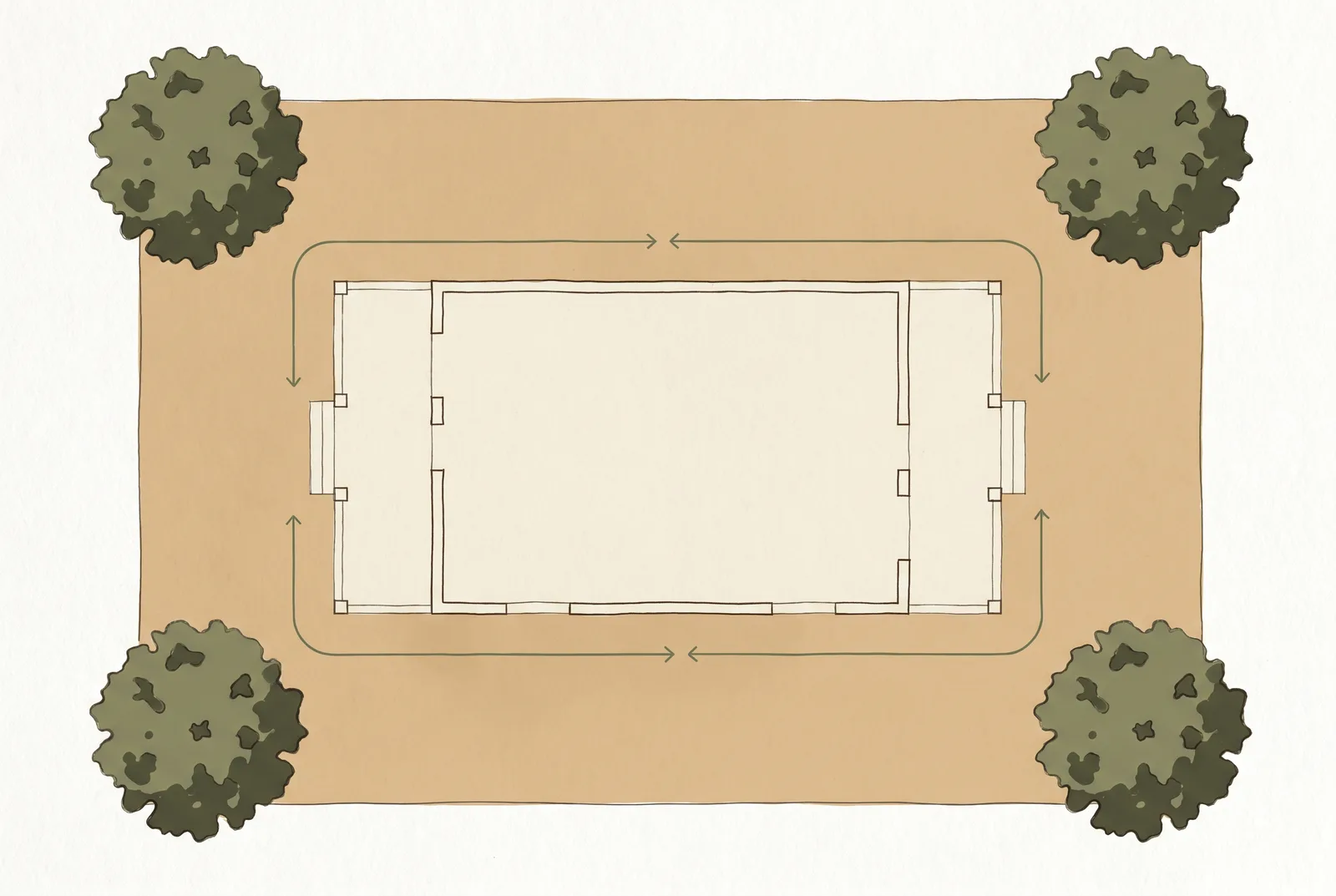
Run the line around all four sides of the house, not just the front, not just the cracked side. This is the most common and most damaging shortcut. Watering only one elevation — the front yard, or the side where you spotted a crack — keeps that soil moist while the rest dries and shrinks, manufacturing exactly the side-to-side moisture difference that drives differential movement. A south- or west-facing wall that bakes in afternoon sun dries far faster than a shaded north side, so if anything those hot elevations need the line more, not less. Uniformity is the entire goal: one continuous loop, consistent setback, every side getting the same water.
The Seasonal Schedule
Texas clay needs different things in July than in January. The table below is the working schedule, synthesized from AgriLife-aligned and Texas industry guidance. Read the minute and frequency figures as rules of thumb — a sensible default you adjust using the screwdriver test in the next section, not a prescription. The constant across every season is the goal: soil that's evenly damp, never powdery and never soggy.
| Season / condition | Frequency | Duration and timing | Notes |
|---|---|---|---|
| Summer / drought | 3–5 days per week (daily in severe drought) | ~15–30 min per cycle; early morning (4–6 a.m.) or evening to cut evaporation | The high-stakes season. Goal: damp, not muddy. Increase only if the soil tests dry. |
| Spring | ~2–4 times per week, adjusted to rainfall | ~20 min per cycle | Skip 2–3 days after any rain of ≥0.5 in. Watch for new cracks as the soil warms. |
| Fall | 2–3 times per week, tapering | ~20 min per cycle | Maintain moisture as temperatures drop; don't let the soil dry out heading into winter. |
| Winter | Only during extended dry spells | Short cycles midday | Soils still desiccate in a dry winter. Drain and disconnect hoses before any freeze. |
| After heavy rain | Pause | — | Resume when the soil surface starts to dry. Don't water on top of saturated ground. |
A few notes that don't fit in a table. Early-morning watering (that 4–6 a.m. window) beats midday because far less water evaporates before it soaks in, and beats late evening slightly because the soil surface dries through the day rather than staying wet overnight. The "pause after rain" line is not optional — running the schedule on top of a half-inch of rain is one of the fastest ways into the overwatering trap below. And winter is the season homeowners most often get wrong in both directions: they either stop entirely and let a dry, windy January desiccate the clay, or they keep watering and risk a frozen, burst hose. The fix for both is to watch the soil, drain the hoses before freezes, and water only when an extended dry spell actually calls for it.
How to Check Soil Moisture (the Screwdriver Test)
The schedule gets you in the right ballpark; the soil tells you the truth. The universal field test costs nothing and takes ten seconds.
The screwdriver test. Push a long screwdriver — or a soil probe — into the soil near the slab, aiming for about six inches deep. AgriLife's guidance frames adequate moisture as being able to easily push a screwdriver six inches into the ground. Then read what comes back:
- Goes in easily, comes out lightly damp → moisture is good. Hold the schedule.
- Hard to push, comes out dry or powdery → the soil is too dry. Water more — more often, or a longer cycle.
- Goes in easily but comes out caked in mud → the soil is too wet. Water less, or pause.
Do this weekly through the summer and after any change in weather. It is the feedback loop that turns the rule-of-thumb schedule into a system tuned to your soil, your sun exposure, and your trees.
The visual no-gap test. There's an even simpler check, straight from the AgriLife Dallas handout: look at the joint between the soil and the foundation. If there's no gap — the soil meets the slab — moisture is adequate. A visible gap opening up between the soil and the foundation means the clay has shrunk away and it's time to water. A gap that appears after a hot, dry week is your early warning to act before the next rain rushes into that shrunken soil and heaves it.
The Overwatering Trap
Here is the part the "just water your foundation" advice skips: too much water is as damaging as too little. Overwatering swells the perimeter clay and drives heave — frequently showing up as edge lift, where the perimeter of the slab rises above the interior. It's the mirror image of drought settlement, and just as destructive, because it's still uneven movement. You haven't stabilized the soil; you've moved it in the other direction.
Two habits cause almost all of it. The first is chasing a crack — noticing a crack on one side of the house and soaking that side, which both overwaters and breaks the whole-perimeter rule, often worsening the very movement you spotted. The second is watering by the clock instead of the soil — leaving a soaker hose running for hours, or running the full summer schedule through a wet spell. The discipline that prevents both is a single phrase: damp, not muddy. The benchmark is moisture content, not minutes. If the screwdriver test comes back muddy, you're past the target; if a gap has closed and the soil meets the slab, you're done. And when it rains, pause — resume only when the surface begins to dry. Steady and even beats heavy and occasional, on every elevation, in every season.
Drought Restrictions
It feels counterintuitive to water during a drought when the city is restricting sprinklers — but that's exactly when your foundation needs it most, and the rules usually allow it. Foundation watering by drip, soaker hose, or hand-watering is typically permitted even under municipal drought restrictions that ban or limit lawn sprinklers, because slow, targeted, low-volume watering is treated differently from broadcast irrigation. The common catch is timing: foundation watering is often allowed only at night during higher drought stages.
In the San Antonio area, landscape irrigation is governed by drought stages set through the San Antonio Water System (SAWS), and the allowed days, hours, and methods tighten as the stage escalates. Slow soaker-hose or drip foundation watering is generally treated more permissively than sprinkler use — but the specifics change with the drought stage and differ from one utility to the next. So the rule is simple: verify your local rules before you set the timer, and check again when the drought stage changes. Don't let a misread restriction talk you out of the one thing protecting your slab through the dry months.
What It Costs
This is where foundation watering wins decisively. A complete DIY soaker system is genuinely cheap:
| Component | Typical cost | Notes |
|---|---|---|
| Soaker hose | ~$15–$40 per 50 ft | One continuous run per spigot; cap each near 50 ft for even pressure. |
| Drip-line system (optional upgrade) | ~$100–$300+ in materials | More even and adjustable than soaker hose on a larger or irregular perimeter. |
| Battery hose timer | ~$10–$60 | The highest-value part of the system — automates the consistency the clay needs. |
| Long screwdriver / soil probe | ~$5–$15 | For the weekly moisture test. Most homeowners already own one. |
All in, a complete DIY foundation soaker system generally runs under $150 — and most of that is reusable for years. Set against the alternative, the math isn't close. Moderate foundation repair in Texas commonly runs in the low thousands, and a multi-pier or whole-house leveling job runs $15,000 to $30,000 or more, with an independent engineer's elevation survey alone costing $500 to $1,500 before any repair. For the price of a single pier, a homeowner can fund years of watering, gutters, and grading — measures that, applied consistently, sharply reduce the odds of ever needing the multi-pier job. Watering is one lever; it works best alongside its prevention siblings, drainage and grading (the IRC calls for the ground to fall at least 6 inches within the first 10 feet from the house) and root barriers near large trees. For the full repair-cost picture this prevention is buying you out of, see our prevention overview.
FAQ Note
The FAQ below answers what San Antonio homeowners ask most about foundation watering — whether it really works, how close the soaker hose should sit, how often and how long to water in summer, whether you can overwater, why you water the whole perimeter rather than the cracked side, how drought restrictions apply, what to do when the soil has pulled away, whether you need a timer, and what watering can and can't fix. For the trigger this schedule is built to blunt, see drought and moisture change; for the soil science beneath it, see expansive clay soil; and if you already see movement, start with the signs of a sinking foundation.
Get Matched With a Vetted San Antonio Foundation Specialist
If you're watering to protect a foundation you're worried about — or you've started to see cracks open despite a good watering routine — the right next step is a measurement, not a sales call. We'll match you with a vetted San Antonio specialist and point you to an independent engineer who can confirm whether the moisture swings have actually moved your house and, if so, how deep the fix needs to reach. The match is free, the quote is no-obligation, and we don't take a fee from you. We screen for sealed-engineer diagnosis, target depths set below the active zone, and a documented moisture-management plan alongside any structural work — because on Texas clay, stabilizing the moisture is half the repair, and the cheapest half by far.
Frequently asked questions
9 questionsDoes watering my foundation really work?
How close should the soaker hose be to the foundation?
How often and how long should I water in summer?
Can I overwater my foundation?
Should I water the whole house or just the cracked side?
Can I water my foundation during drought restrictions?
What if the soil has already pulled away from the slab?
Do I need a timer for foundation watering?
Will watering fix cracks I already have?
Related guides
- Prevention/foundation-repair/prevention
- Drought And Moisture/foundation-repair/causes/drought-and-moisture
- Expansive Clay Soil/foundation-repair/causes/expansive-clay-soil
- Drainage/foundation-repair/prevention/drainage
- Root Barriers/foundation-repair/prevention/root-barriers
- Sinking Foundation/foundation-repair/signs/sinking-foundation
- Engineer Report/foundation-repair/diagnosis/engineer-report
Sources
- [1]ASCE Texas Section — Guidelines for the Evaluation and Repair of Residential Foundations, v3 (2022)
- [2]International Residential Code 2024 §R401.3 — Surface drainage (grade to fall ≥6 in within first 10 ft)
- [3]Texas A&M AgriLife Extension — Publication B-5002, Maintenance of Existing Foundations on Expansive Clay Soils (Corley, Marsh, Quiring)
- [4]Texas A&M AgriLife Extension (Dallas) — Protecting Foundations Under Dry Conditions (soaker-hose placement 8–18 in)
- [5]Foundation Performance Association — homeowner moisture-maintenance guidance ("uniformity is the key")